Friday, April 25, 2008

Transforming learning in the Gulf

I've had a pretty eventful week - starting with a 2-day visit of Dr. Susan Komives. Susan joined us as our first Qatar Foundation Education Division Visiting Scholar. She set a very high standard for any to follow but the good thing was that she created an appetite in us all that will encourage everyone to participate in future similar events. We kept her very busy with a keynote, workshops, consultations, and guiding us in a retreat. Susan brought so much value to our community through her command of everything from the "Learning Reconsidered" model to leadership issues to her new role as President-elect of the Council for the Advancement of Standards. We're conducting an evaluation which will tell us how successful we were in helping everyone at Education City understand that student affairs work has a body of research and theory and that we can enhance our impact with students by joining together across academic and student affairs units.

It is obvious that Education City has a great deal to offer. Our facilities, the staff of Qatar Foundation and the Education City branches, bright and highly motivated students, and resources to help us do our work. We also benefit from not being inhibited by lots of history and routine. We have the opportunity to create rich learning for students by doing what makes sense, rather than being confined by old models. The only problem is that it's hard to build a team from a collection of people who are so diverse in education and life experiences. The diversity is clearly a strength but it does not make the process easier; in fact, it makes it harder.

The importance of creating shared understanding and language cannot be underestimated. We're in a stage where we are building meaning through every phrase we utter. I'm sure that much of my regular communication sounds like jargon to some. To me, it's just the way I think. However, I know that many words that I use do not carry the same depth of meaning that I intend. We're trying to create shared language that will eventually become the short-hand communication that will more quickly and fully inform each other.

Monday, April 07, 2008

Measuring life's experience

I've been involved in hosting my family in Qatar, returning for the ACPA Convention in Atlanta, and then visiting back in Oxford over the last couple of weeks. It was very fun but I had a lot facing me as I tried to return to a little more routine. I have now realized that my return included slipping into a rather frantic routine that denied the deep joy of the experiences I had - and then I remembered the following quote that I heard while at the ACPA convention:

"Life is measured not by the number of breaths we take but by the times our breath is taken away."

When things get a bit overwhelming, how true a statement. As I reflect on the opportunity to introduce the rest of my family to my new life in the Gulf, it brings such joy to my heart. We had some pretty incredible times together as we toured both in Doha and then in Muscat, Oman. Both of these cities are modern and comfortable cities but they do have elements that remind us that we are in a different area of the world. The first pictures here are of us as we took an afternoon/evening cruise on a Dowh (ancient pearling boat used in this area of the world). The skyline of Doha is behind us in the family picture and one of the other Dowhs passing by us has a closer shot of the skyline of West Bay of Doha.


The second set of pictures are of the Great Mosque in Muscat and of the Corniche in the older area of the coast, a short way from the Mosque. We were not able to go into the Mosque because we arrived too late in the day but the exterior was no less spectacular and was well worth seeing.


The Coniche at dusk reveals the bustling charm of what has been a prosperous sea-side community for years. All the way back to the shipping days of the "Silk Road," and later during the Portuguese occupation of this port, Oman has been a crossroads of the Arabian Gulf and a gateway between Europe and the far east. It is truly a beautiful area of the world and the people are as engaging and friendly as one could hope.

Once our touring was over, I returned with Diane, Devin, and Steve to the U.S.A. (hard to leave Darbi behind as she was undergoing shoulder surgery) to go to Atlanta for the ACPA Convention. I saw many colleagues and friends who I hadn't seen for a while and I told the story of moving to Qatar more times than I can count. It seemed that every one of them was a new revelation as I found a different way to express my delight with the experiences I'm having. Once ACPA concluded, I returned to Ohio for a few days before returning to begin the catch-up process.

All of this is to say that I've been on a whirlwind but one that has reminded me how deeply blessed I am. There are so many things about my health, the fulfillment of my career, and the closeness of my family that bring gasps of joy. Occasionally I get so wrapped up that I forget; it's in those moments when I have to remind myself to take a minute to reflect. When I have those little momentary gasps of realization, I am reminded that I've been drawn into something that is so very powerful. Powerful in potential, powerful in the challenge of my work, and powerful in relationships I have.

It is times like this that life's experiences truly are not measured by the number of breaths I take but the number of times my breath is taken away.

Wednesday, March 12, 2008

Attitude - The story of David Fajgenbaum

I met David two summers ago at a session of the LeaderShape Institute. He was actually fairly quiet by comparison to many in the group of 60 students from throughout the U.S.A. Yet, he had a quiet strength and humility that was a magnet for other participants. We knew he was special but now it has become even more obvious.

David was just featured in Psychology Today as an example of the power of optimism in the face of tragedy. When his mother was diagnosed with cancer as he was going off to college at Georgetown, David did what he could as his mother slipped away but in addition, he created AMF to help other students cope with the grief of losing a loved one.

The Psychology Today article supports what I've always believed - that optimism is a choice that is cultivated rather than a personality characteristic (pessimists would call it a personality disorder). With David as an example, instead of suffering the loss of his mother, he chose to take steps to create a better future. His action focused on creating an organization that would support young people who had lost their mothers or fathers or other loved ones - the kind of organization that was not available to help him cope with his grief. Another part of learning to be optimistic is journaling about the good things that have happened in your life - the research indicates that identifying just three a day will help. And ultimately, optimism is looking at your present circumstance and visualizing the world you want and acting on it.

The post that preceded this one was about Randy Pausch and now I'm blogging about David. What's the point - optimism in the face of challenge and tragedy? Yes, in fact it is. How we are impacted by life's experience is completely up to us. We can bemoan that life isn't fair and we didn't have our chance or that someone else snatched our opportunity away. Or, we can accept the gift of opportunity that is right beneath our noses. Passivity is most often accompanied by its companion, hopelessness. On the other hand, if we are optimistic, there are always opportunities to chart our own life course and to influence that of others. Optimism then becomes an interesting antidote for passivity. Choosing passivity and resignation are comfortable because they allow us to abdicate responsibility for our own beliefs and action. Randy and David have, in their individual striving, provided an alternative. Which will we choose?

Monday, March 10, 2008

Last Lecture - Randy Pausch

A professor from Carnegie Mellon University in Pittsburgh, Randy Pausch, is dying of pancreatic cancer. Instead of shriveling up in the face of death, he has become stronger and is touching the lives of college students and others with his message. Oprah Winfrey recently invited him to share a ten minute segment of his "Last Lecture" with her national audience. It's a moving tribute to Randy and to the power of family, hope, possibility, and gratitude. You know that these are recurrent themes for me - sometimes they are so dominant that colleagues have labeled me as naive. If that's what it is, I'll take it anyday over the cynicism that dominates some people's lives.

Wednesday, February 27, 2008

"Presence" in the Global Classroom

I had the opportunity to be part of launching the Georgetown University School of Foreign Service Global Classroom this evening. It was utterly amazing and the picture to the right only gives you a faint impression of the real "presence" you feel when sitting in this classroom. As you can see, classmates are pictured life-size in screens directly in front and curving around you. Thus, you get the feeling that you're simply sitting across a conference table from people who in today's case were 8,000 miles away - in Washington, D.C.

The interaction was so real that it was hard to believe that the other people on the screen were not actually with us. Today's interaction was just a demonstration but classes are already underway between Qatar and D.C. with students in discussion groups and project teams literally around the world. The thing that is so helpful is that communications research indicates that about 2/3 of our communication is what we "read" in non-verbals. Thus, when we're communicating by phone or in small images, we're missing a significant portion of the communication. Having life-size, high definition images adds significantly to the reality, the presence, and the effectiveness of our communication.

What's next - digital images that can walk around the room interacting with one another? Maybe...

Wednesday, February 20, 2008

Upgrading Authoritarianism

I've been thinking a lot lately about how to move from the dependency and passivity that monarchy fosters versus a world in which citizens take greater responsibility for themselves and for the quality of the communities where they live. It's interesting because living in the Arabian Gulf brings this question into sharper focus - an area where colonial rule or monarchy have been the way of life for many years. However, any citizen of the U.S.A. has to recognize that there is a considerable dependence on authoritarianism of a different type - the authoritarianism of dogmatic rule by politicians who presume to know what's good for "the people" when, in reality, much of their energy is focused on privileging the constituents who pay for their campaigns or who have the resources to engage in paid lobbying efforts. So, the question of authoritarianism isn't exclusive to monarchies.

Having attended the recent Brookings Institute meeting in Doha and having met a lot of very interesting people, I have pondered how to move from the passive, dependent state to a more robust and vital way of living. Whether we call that democracy or some other form of governance, I don't know. (Unfortunately, democracy has a pretty bad name these days as a result of the many blatant examples of undemocratic transformation we've witnessed.) That's why the Brookings Institute paper, Upgrading Authoritarianism, intrigues me.

I continue to work on what defines shared and mutually beneficial governance for a long time. I worked with the Kettering Foundation on "deliberative democracy." I've worked on empowerment strategies through inclusive leadership development. I've looked at community as the cohesive core of what draws people together in support of each other. I've toyed with rituals and traditions that shape connections in community. All of these have related purposes - forging shared responsibility for our destiny in communities. What are your thoughts? Do any of these help or is there something else that will help us become the kind of communities that draw the best from us all?

Saturday, February 16, 2008

U.S.-Islamic World Forum

I had the extraordinary opportunity to attend the opening session of the Brookings Institute U.S.-Islamic World Forum tonight in Doha. I continue to be astounding by being here and how so many fortuitous things happen to place me in the path of interesting people who are doing such incredible things around the world. I was contacted by a Georgetown University (D.C.) professor and former U.S.A. Ambassador to the Netherlands, to talk about how the Brookings Institute might partner with Qatar Foundation to support one of the "U.S.-Islamic World Forum" programs - the Arts and Culture Leaders initiative. I offered to meet Cynthia before the conference began and this unfolded into an evening at the conference, including the opportunity to hear His Excellency Hamid Karzai, President of the Islamic Republic of Afghanistan, Madeleine Albright, former Secretary of State of the U.S.A., and others discuss "The Opportunities and Challenges Ahead in the U.S.-Muslim World Relationship."

The atmosphere of the opening session was upbeat but it very clearly and honestly explored the incredibly bad position the U.S.A. is in with its Arab relationships. All the speakers noted that 9-11-01 and politicians and media portrayal since that time has driven a deep wedge between the relationships the U.S.A. previously had. Albright's analysis of what it will take to rebuild included five key points that she proposed as top priorities for the new President of the U.S.A.:
1. Figuring out how to deal with terrorists without creating more in the process.
2. Curbing the proliferation of nuclear weapons in the Gulf and elsewhere.
3. Restoring the good name of democracy after a period when it has been so abused and maligned.
4. Learning to deal with both the up and downsides of globalization.
5. Finding ways to effectively address environmental degradation.

She went on to say that it is a mistake to divide the Arab world into simplistic, either/or dichotomies and that it is crucial that Americans cease to see Islam as the enemy. In order to do this, America needs to listen more and lecture less, something on which we've been very short over the last several years. Her final comment was reciting three core messages of faith:
1. Blessed are the peacemakers (from the New Testament of the Bible)
2. Swords shall be beaten into plowshares (from the Old Testament of the Bible/Torah)
3. Enter in peace, one and all (Quran)
These are simple and direct statement that identify the essential core of Judaism, Christianity and Islam. Passionate moderates who believe these principles will be those who will save our globe from slipping further into a camp mentality that undermines our ability to learn from each other.

The U.S.A. has some formidable challenges ahead but new leadership is on the horizon. Choosing wisely for both domestic and foreign affairs reasons will make all the difference to what kind of world our youth and children will inherit. Note to self - what am I doing to listen more deeply and to help my fellow U.S.A. citizens understand that U.S.-Islamic affairs are not as hopeless as one might think?

Saturday, February 09, 2008

Fostering entrepreneurship and social change

One of the keys to greater prosperity around the world is fostering entrepreneurship that also brings about positive social change. A recent article in the NY Times provided a couple of examples about how this is happening. One example is a woman in Jordan who has made teaching about entrepreneurship her priority. The Injaz organization she created in 1999 now touches 100,000 students a year and helps them learn how to set up their own businesses.

This kind of initiative proves that making money can have a conscience and can create benefits beyond just the person who creates the business. Indeed, these organizations can create prosperity and can become so compelling to their creators that boundaries and conflicts might just possibly melt away as old conflicts cease to be relevant in the face of improved life conditions for all.

Friday, February 08, 2008

Spiritual vitality

I've been thinking of a post on spiritual journey for a couple of weeks now but I didn't know how to approach it. This being the day of worship in Islamic countries, those of us of other faiths worship on Friday as well. My ritual is becoming that Thursday nights I go for a long walk and listen to Dr. Craig Barnes' sermons from Shadyside Presbyterian Church on my ipod while I'm walking, then on Friday morning I get up, have breakfast at my place with Darbi, and then off to the Grace Fellowship. By Friday noon, we've observed Sabbath and are off to the rest of the weekend activities - this is a routine that I'm still working to embrace since the pattern is so different than the pattern of the rest of my life.

The question of pattern in this is key. I regret to say that during the last two years I was in the U.S.A., Diane and I did not attend church. When I was in Luxembourg in the fall of 2005, I became increasingly disenfranchised from the routine of worship in Oxford. While there are many good people who I'm sure find spiritual fulfillment in ways that became mundane for me, I just couldn't deal with it anymore and we simply didn't know where to turn for a more vital and engaged spiritual community. Then, the surprise of my life - I moved to Qatar.

Soon after arriving, Darbi and I joined together to attend the Grace Fellowship, a meeting that is not called church because the idea of Christian "church" is not accepted here yet. The group meets in a modest ville on the outskirts of Doha. At first the spiritual community felt strange - a bit evangelical and more contemporary than the worship of Shadyside, which I love. However, over the weeks, and with the coming of a 4-month visiting pastor, the service has become vital and important in my life. Part of it is the fact that we're worshiping in a place that at least to this point has not grown to accept multiple spiritual perspectives; this causes us to have an almost 1st-century feel of being Christians in a hostile place (although, truly, there is no threat here!). Another part is that the visiting minister is really very gifted in providing thought-provoking messages. Another is the contemporary music, which most attendees know well and sing with great conviction. Lastly, this worship works because it is genuine and it embraces so many people - like the church that Christ said we should be.

Every Friday, visitors are asked to introduce themselves. They are always from all over the world so that has become a familiar part of getting acquainted. This morning's visitors were from the U.S.A., Canada, South Africa, Germany, and Kenya (there will likely more but this is all I caught). The Kenyan visitor was the father of a new-born who, when unrest broke out in Nairobi, fled the country with his wife to Doha so that she could have the baby in a more secure setting. Umh... sound familiar? How ironic! The fact is the members and visitors come from everywhere around the globe and they worship in deep and sincere ways that have brought my faith journey back to a place that is extremely fulfilling.

Who would have thought - that I'd come 8,000 miles to find a faith community that believes deeply in the message of Christianity. Some are probably very evangelical and single-minded. Others are probably like me - embracing Christianity but believing that a merciful and loving God has to embrace the paths of Muslims, Hindus, Jews, and many others. Even though my own faith is firm and getting stronger, I know that I have no right to judge the adequacy of others' faith. As Craig Barnes' November 25, 2007, sermon (available at Shadyside) proposed, our responsibility is to work on our own faith and the rest of humanity will take care of themselves.

I've heard people say before that they felt the spirit of faith more strongly away from North America. I never really bought that - until now. Oh, that the routine of "church" in the comfortable spaces of America could become vital and growing communities where people take their faith, and the call to respond to the message of genuine love of others, seriously again.

Wednesday, February 06, 2008

Engaging with the community

Last night I had the opportunity for my first "gala" event in Qatar. It was a fund-raising banquet to raise money for young people with disabilities of various sorts. The organization putting on the dinner was RasGas, one of the several major multi-national organizations that process and/or ship natual gas. There were about 300 people at the dinner and they raised over 300,000 QR to support programs for these kids.

The atmosphere was decidely western, although Americans were not the dominant group. There were more Brits, Scotts, and Aussies than anything else. Most of the evening was centered on the golf tournament that will be staged over the weekend and the biggest "ticket" item was auctioning various golf teams who would play with one another in the coming days. The entire concept was foreign to me, but enjoyable nevertheless.

The thing that stood out as a departure from stereotype is that children with disabilities were the focus. Middle Eastern countries are typically seen as not paying the same attention to disabilities as western countries. However, this example demonstrated the same openness and the desire to help that we might expect. It was a great evening and fun for me to see - I only wish I had my favorite date (Diane) with me because she would have blown away all the others in the room. I did try to dress up as best I could (picture to side). This picture is in my ville staircase with my new piano in the background. I've begun to play again, although my schedule has kept me so busy that I've not played as much as I would like. It's great to be able to build a lifestyle that includes social and artistic opportunities again. What's interesting is that, when you work abroad, you have to rebuild all these dimensions into your life - social, recreational, artistic, spiritual, sports, and the list goes on.

Colleagues

One of the great joys of my new work setting is getting acquainted with colleagues and establishing new relationships. I had heard a great deal about my supervisor, Dr. Abdulla bin Ali Al-Thani, before I arrived. I had heard much about his role in getting Education City started. I had also heard much about his sensibility in working with students and colleagues. I've had many opportunities to have these perspectives confirmed but one was at the Photo-Shoot that I referenced in my lasts post. This picture shows Dr. Abdulla on the stage in front of young people from 5 to 25, interacting comfortably and helping them pass the time it took to prepare for the picture.

I was amazed by Dr. Abdulla's comfort with all these students. It was like all were friends and acquaintances - a true gathering of colleagues. This has continued to be a theme in the interactions I've had with others - the importance of relationships. And, it's one of the things that westerners have trouble understanding most. My western colleagues will frequently use persuasive or political power strategies, sometimes winning their point. However, particularly in this cultural setting, the political strategies do not win points in long-term relationships. I'm not sure the degree to which this is different in Arab culture versus the U.S.A. but I believe it at least has some additional weight. In the U.S.A., those who choose coercive and manipulative strategies have consequences - usually fear, intimidation, and distance. In the Gulf, these may also result but I wonder if those who choose these strategies retain their credibility and positions in the same that westerners do. I actually don't know and that will be part of my ongoing learning here.

I've struggled with power issues throughout my career because generally I feel that power and politics breaks down the authenticity of relationships. I think it does but I also know that politics is a natural part of organizations in which we work. It's unavoidable and accepting it for what it is and dealing with it is critical. I don't have to engage in the politics but it's at least important to recognize the dynamic and adjust my strategy accordingly.

Tuesday, January 29, 2008

QF Family Photo

Much of the buzz in our office over the last week has been about the annual Qatar Foundation "Photo-Shoot." This is an event that records the legacy of Qatar Foundation's growth and impact by photographing a significant number of Qatar Academy, Qatar Leadership Academy, and Education City students. This picture is my amateur shot of preparations for the official photograph. Around 1,500 students were assembled at the Ceremonial Court this morning at 7 a.m. to have their picture taken.


It's always hard to get students up early so there was a reward - a buffet of delectable treats.I continue to be amazed that every event at Education City includes hospitality like I've never seen before. It's just the way we do things and there are no corners to cut - it's just not acceptable.

The feeling today was like a family photo, including Her Highness in the middle of the picture. And afterward, she circulated around with students posing for candid shots with the hundreds of students who sought to have their pictures taken with her. There was great affection and appreciation in the eyes of the many young people benefiting from the broad work of Qatar Foundation. This is a legacy that will rank right up there with the creation of the great library in Alexandria and Thomas Jefferson's advocacy for the creation of the University of Virginia. I dare say Education City will go down in history as one of the great, break-through experiments of the last couple of centuries and it is well worth watching.

Wednesday, January 23, 2008

Doha Debates - Critical reflection in the Gulf

I attended my first "Doha Debates" tonight. Wow! Was it ever fascinating. The "Doha Debates" have been sponsored by the Qatar Foundation since 2005 and they are broadcast worldwide via BBCWorld. The viewership is 300 million people in more than 200 countries and what an exciting initiative to provide a voice of critical reflection in the Arabian Gulf.

Tonight's debate was particularly controversial. The resolution was "This House believes Arab Governments couldn't care less about Darfur." To even pose the question in such a way was a significant risk for the program but it was highly effective in stimulating debate among the panelists and in spurring those of us in attendance to ask questions. If you can get to a TV that carries BBCWorld, you really should watch it. The 23 January debate will be on BBC this weekend both Saturday and Sunday; it depends on your local programming when it might be available.

The debate was conducted in very traditional form and stimulated lots of controversy. Ultimately, the resolution passed, meaning that 80% of those in attendance believed that Arab countries are doing little to stem the bloodshed in Darfur. Statements were made about monetary contributions but ultimately the views of listeners turned when the issue of personal responsibility and care arose. Some expressed that they believed that Arab countries stand by as a result of tacit agreements to stay out of each others' business. Whether or not this is a reflection of reality or the perception of the people is unclear. The point is that the people believe that Arab governments should do more.

There was a moment in the debate when the conversation shifted to the role of the U.S.A. An unfortunate and very debilitating result of the Iraq War is that foreign policy in the U.S.A. is presumed by some to be driven by self-interest of those who seek control, or at least significant influence, in countries that have oil. Sudan is such a place and at one point several statements were made about the role the U.S.A. has played in perpetuating the conflict in Darfur. Again, whether foreign policy is really driven by the motivation to control oil reserves matters little - it is the perception that counts.

I deeply appreciate the opportunity to debate such topics right in the middle of the Arab world. Indeed, it is a proud moment when people find and express their voices freely. This expression will no doubt have an impact on governments and leadership and perhaps, just perhaps, there will be future action to deal with the disaster of Darfur.

If you're interested, don't miss the BBC broadcast and then start watching for the next "Doha Debates."

Monday, January 14, 2008

Keep 'em comin' - largest convention center in the Middle East to open in Doha

I went to a presentation today describing the new Convention Center that is under construction as part of the Education City complex. It was pretty amazing, as all things here seem to be. This Convention Center will be the largest in the Middle East and the hope is that it will attract small to moderately large conventions. The design reflects the sidra tree which is a desert shrub that served as shelter for Bedoins from the burning sun. The sidra shelters the conversation between friends and colleagues as they interact in an otherwise severe climate.

The Convention Center is on a perpendicular axis with the academic buildings of Education City and sets up a spectacular vista across the oasis from the Ceremonial Court to the Convention Center and then the business and research center. All of this places the practice of business, science, and medicine in direct interaction with the academic experiences of students. When I think about the design that is coming to fruition, I have trouble imagining the kind of creativity that could dream such grand ideas. It is simply too good to be true. We talk theoretically about praxis in education departments but Qatar Foundation is including it in their architectural and landscape design!

Thursday, January 10, 2008

Qatar LeaderShape '08

How do I describe the feeling one gets from being with students as they discover their passions and purposes in life? What is it like to know that they have immense potential, not only because of their talent but because of who they are and where they live? These are rhetorical questions but also questions of adequacy... Any description of my experience sharing the lead role for Qatar LeaderShape over the last week will certainly be inadequate but I'll try to provide a glimpse.

For a starter, Qatar LeaderShape was in a bit (what an understatement) of a different location than any I've experienced in the last 12 years of serving LeaderShape. This picture was taken on our next-to-last day while having poolside ice cream in celebration of one of our participant's birthdays. We overlooked a bay area in Al Khour, a beech resort north of Doha. Interestingly enough, the beech would have been a huge distraction for many Institutes but not for these students. They enjoyed it but didn't let it come in the way of their learning.

Qatar LeaderShape evolved from a cautious group of 58 students representing all our branches and representing untold national origins and cultures to a close-knit, caring, and appreciative community. The curriculum of LeaderShape, while needing cultural modification in a number of places, served very well as the platform. Students discovered themselves, explored what they cared about, learned to work across all types of differences, developed plans for how they can make a difference, and struggled with difficult questions of integrity. By definition, these students will provide leadership for the Arabian Gulf and beyond and they will do it more capably because they have experienced, and will hopefully remember, the lessons they learned.

There were so many high points that I cannot do justice to the experience. A young woman who stood alone when the question of academic integrity emerged - and by doing so, she drew everyone in the room to a new place in their own values. A young man who struggled with the balance between making money for a business that he anticipates serving - and then learned that there is something called social entrepreneurship that can make a difference in the lives of those who have few resources while still being profitable. A bright pre-med student who learned the importance of relationships and of working together to enhance the learning of all rather than toiling in isolation. A student born in California of Chinese parents who then moved to Saudi Arabia for his entire youth - struggling with where he can find a home and discovering that the journey of finding one's culture is not his alone. These are but a few of the profound encounters of the week.

The bottom line is reflected in a a metaphor I used in my closing comments - that of the pearl. Oysters are disturbed when grains of sand slip into their shells. Working at the grain, they create the pearl of great beauty and value. Qatar LeaderShape has disturbed the privilege of these incredible students, allowing them to make a difference in their world that they likely never anticipated. If their response is any indication (picture below), a new current of change is beginning that will be unstoppable.

Thursday, January 03, 2008

'07 Holiday and back to Qatar

I've been back in the U.S.A. for the last two weeks, enjoying a wonderful holiday with my family. The entire two weeks was dedicated to the five of us (wife, two daughters, son-in-law, and Gram) doting on each other. I actually can't remember a holiday when we've dedicated so much time to each other. In retrospect, the fact that Darbi and I are in Qatar probably pushes the issue and reinforces the importance of family during the holidays.

We did many fun things, including lots of shopping and gift giving, cultural experiences (Phantom of the Opera in Chicago - picture below left), and meals either in or out that were to die for. In fact, the impact on how my clothes now fit is a perfect measure of how "to die for" all the food really was. It was a wonderful time together that made the departure for Qatar on the 2nd strangely more difficult than the last. It was renewing our commitments to each other that made it more difficult to part again. We have all committed to this venture so there is no hesitation or misgiving about it. However, that does not make being apart any easier.

Darbi and my reason for being in Qatar makes all the difference. I was seated on the plane tonight by a man who works for GE and is working on a powerplant outside Doha. I'm not exactly sure what was going on in his life but his attitude about flying to Qatar was far less than ideal. He's only here for two months, yet he complained about the challenges he has faced in his work and about his separation from family. I didn't really talk with him that much because his attitude was so wrong from my perspective. I simply can't understand taking an assignment in a place where you can't see that your time and effort count for something. People like this guy should leave immediately and shouldn't even make motions toward contributing through their work. This guy has no idea why he was placed in Qatar and the lack of knowing undermines his ability to deal with the inconvenience, separation, and challenge of an ex-pat work assignment.

I return to Qatar saddened by not being with my family yet I know that we've all taken the challenge of this in our lives. We have all sacrificed, perhaps Diane, Devin, and Steve have sacrificed the most by staying in the U.S.A. Because we know that there is work worth doing and that Darbi and I have a chance to make a real contribution in the Arabian Gulf, we are able to hang on. This is what strong family and strong friends are all about - supporting each other when things take us down unexpected paths. And, rejoicing in the time that we have together.

Those who read this blog know how difficult life's choices can be. We have a New Year upon us and we are challenged to use our time in ways that contribute to the betterment of the world and those individuals around us for whom we care. The distance my be close or far. In our case, the great distance will strengthen us as family and colleagues because we know that the inconvenience of distance has purpose. And, if the last 24-hours has been any indication, it really is true that love spans amazing distances and transcends time.

Monday, December 17, 2007

World-class residence halls come to Education City

Throughout my blog posts I comment about unfolding developments at Qatar Foundation and Education City. One of the things that excites me is the development of new residence halls. Our Campus and Residence Life staff have been working with arthitects to design new residence halls that will serve our purposes in the coming year. We are about to go into the ground for halls that will be available sometime in 2009. And, they are not just any residence halls. They are the world's first Platinum level LEED-certified residences. What this means is that they will have the least impact on the natural environment and they include all the measures to make them environmentally sustainable.

A press release just came out that tells the story.

This project makes a statement that learning is everywhere, in and out of class, and it even exists in the way we live. In this case, students will live in a setting where everyday they will be reminded that they can choose to live in ways that sustains our world. This is a very exciting project!

Sunday, December 16, 2007

Abu Dhabi and back to Doha

The story is told of Abu Dhabi that the Emir once was riding through the desert when he asked the car to stop. He looked across the barren desert and asked one of his aides to begin planting trees and shrubs in the area. A year later he passed by the same area and found nothing had happened. He got out of the car and dug into the ground to plant a tree on the site he had noted the year before. From that grew a commitment to build an oasis out of this desert island and now what you see is this.

Abu Dhabi was absolutely beautiful. It is a much more manageable city than Dubai and the plantings have taken hold so much that you hardly know you're in the desert. When I flew out the day after the recruitment events, it was amazing to rise above the trees and realize that much of what I thought was wide-spread vegetation was just boundaries around highways and prominent buildings.

The trip to Dubai and Abu Dhabi was a combination of high school visits, informational receptions, and visiting with education ministry staff. The visit to the UAE education ministry in Abu Dhabi revealed some very interesting issues. A group of students came from the UAE to Education City last year. They were generally unsuccessful and the ministry was concerned about it. We talked about the need to clarify expectations for students who would come to Qatar to study, making a particular point that they had to be well prepared, or at minimum, committed to working hard to catch up. Some of my colleagues have told me that the ministry is more interested in Education City lowering its standards than UAE students increasing their effort and performance. These are dynamics that I will be exploring in the coming months.

I was greeted on my return to Doha by Darbi. We had a good Friday morning, including making breakfast at my place and then going to church. The rest of the day we spent on errands and shopping. I wanted to bring some pictures back of Doha so took a bunch of the area around the Coniche. This pictureis looking from the south side of the Coniche across to West Bay, with the old pearling boats anchored in front. The contrast of the old and new are part of Doha's charm - a contrast to much of the UAE where this kind of history and culture has been lost

This next picture is of the Museum of Islamic Art, set to open in March of 2008. This is another difference between Doha and the other Gulf cities. Doha is investing in educational and cultural buildings and institutions rather than solely business enterprise.In fact, you might have seen the news last week about the gathering of Arab scientists in Doha. The Emir invited over 100 renowned Arab scientists to return to discuss how the Arabian Peninsula could rediscover its roots as a leading intellectual and scientific center. The result of the conference is that three institutes will be established that will support these scientists and their work. Another investment in the future of Qatar...

Today is my last day of work before the holiday break. I return to the U.S.A. on Wednesday and can't wait to see my family. It should be an unbelievable reunion! I'll leave my ville in the sunset (pictured below) as I make my way west.

Tuesday, December 11, 2007

Doha - a little more and Dubai - a little less Arab

I've continued to wonder what's more or less culturally Arabic in the Gulf region. For instance, last weekend, I took our new Northwestern University branch partners out to dinner in the renovated old Souq in Doha. We went to a modernized but culturally reminiscent rooftop restaurant overlooking the streets of the Souq to the right. It was wonderful walking through the streets in the warm evening, viewing various vendors who had products either like or from the old days of the Souq - spices, teas/coffees, dates, rugs, carved wood icons, and any others. We left the evening refreshed by something old, yet renewed for us to enjoy.

By contrast, I'm in Dubai on a student recruitment trip this week. We've been visiting schools who might logically have students interested in Education City. The city of Dubai (pictured to left through the playground of one of the schools) resembles little, if anything, of its heritage. Oh, to be sure, many Arab business men still wear thobes but, for the most part, the feeling of the hotel I'm in and the neighborhoods I've seen are like any European or North American city - only newer and a bit more luxurious.

The tale of these two cities leads me to wonder what it takes for a city to be prosperous and progressive, yet not lose itself. What are the things worth keeping and what things need serious change? It's a question I'm still sorting out as I see more of this region. Come back in a few days for pictures of Abu Dhabi - that's the next stop.

Monday, December 03, 2007

A little bit of the U.S.A. (and the rest of the world)

Today marks my fourth week in Qatar - a moment of passage for sure. I still find my location here to be a bit surreal. Sometimes I've very aware I'm away from the U.S.A. and other times it seems like life as usual. Last weekend was a combination of comfort experiences and others that reflected the new world in which I live.

On Friday night, a new colleague (Kevin) invited me to a random party. He said that the person hosting it was pretty interesting and that I just had to prepare myself for it. First, before the party, we went to a great Indian restaurant where a full scale meal totaled to 50QR (about $13 USD) with Dave, Karen, Curt, and Belle (all working colleagues). The party was a hoot. The hostess, Tammy, greeted us at the gates to her ville and immediately grabbed my arm, ripping me away from the security of my new colleagues. She introduced me to a tall, young guy from Australia. We engaged in conversation for probably 10-15 minutes and then suddenly Tammy appeared again, "OK, it's time to go," she said. She grabbed me by the arm and took me off to meet my next pairing - this time a Brit woman in her 30s who teaches at Qatar Academy and knew Darbi from playing rugby. This succession of disrupted conversations and starting new ones occurred no less than 10-12 times during the evening, each time with Tammy grabbing my arm and informing all that it was time to move on. I can honestly say that I've never had the opportunity to network so quickly and it was quite fun. People from all around the world were at the party but it was in a very natural environment that felt much like a backyard in the U.S.A., except that it was almost December and it was warm and comfortable outside. The process of "OK, it's time to go" seemed at first intrusive but it connected everyone in a very helpful way - a technique I'll have to try someday if I have the guts.

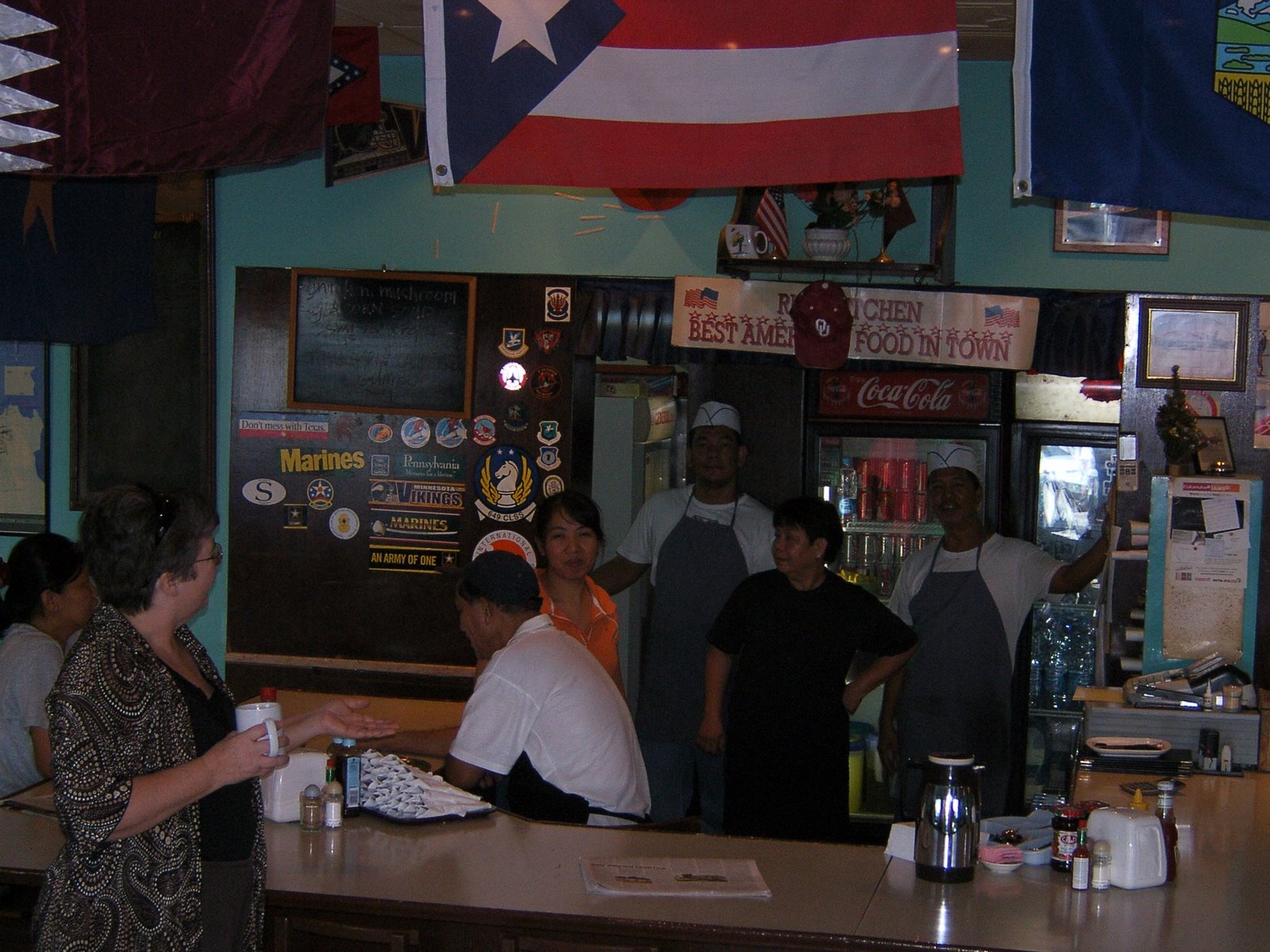
The next "little bit of the U.S.A. is pictured to the right. This is an inside picture of Rik's where I had breakfast with some other colleagues early Saturday morning. Rik's is the ex-pat gathering place in Doha. Upon entry, patrons immediately notice the flags of Texas, Kansas, and many other U.S.A. states. There are American film posters all over the place and the menu is distinctly American - and greasy and bad for you. But, oh, it tasted so good. We sat around drinking coffee and reflecting on the experience of Qatar and on the shopping trip we were about to launch - looking for Persian rugs to warm up my ville. Oh, and BTW, Rik's is owned and fully staffed by a family from the Phillipines.

All in all, it was a great weekend that reminded me of home but then jogged me to understand that I'm not really home. Maybe that's evidence that a "global citizen" perspective is beginning to settle in. Perhaps home will never quite be the same again, but in other ways, it's just exactly as it always has been, only bigger...

Sunday, November 25, 2007

Ex-pat Thanksgiving

Thanksgiving has special meaning when you're an ex-pat in one of the countries around the world where this holiday is not celebrated. The only way I know Thanksgiving is through family, food, the Macy's Parade, and collapse. Thanksgiving in Qatar went on for three days and included no less than four invitations to join other ex-pat groups for meals. It was very gratifying to be invited out so many times but I only succumbed to two offers. We all made our own renditions of sweet patatoes, salads, gravies, and more that we cherish from home.

Besides sharing Thanksgiving celebrations this last weekend, I ventured into the desert for a safari. It was very cool. Much of the safari was simply riding around in a comfortable SUV viewing the landscape (picture below and right). However, on several occassions we stopped to really absorb the setting. The last stop we made, the one where we saw this particularly photogenic camel (picture below), the sun was setting in the west while the full moon was rising in the east.
Even though there were about fifty people joining in this experience, there was a deep sense of solitude and connection in what I thought would be a pretty desolate place. It was desolate but it was this apparent void that made room for reflection, connection, and beauty. Arab lands are not filled with the lush colors of more vegetated places but they have a beauty of their own.

Ex-pat Thanksgiving - having a place to call home to which I know I can return and having a new place where being ex-pats is celebrated, even while we work to build another country.

Monday, November 19, 2007

Prospects and progress in the Arabian Gulf

My continuing ninety degree learning curve results in my stumbling into amazing things on a daily basis. One question that I've continued to field from my colleagues when they want to know more about Qatar is related to women and their opportunities. Her Highness Sheikha Mozah is a very strong woman who provides a role model for women in the Gulf and elsewhere. Her remarks from May 2007 made it clear where women's rights stand in relation to human rights. She advocated choices that balance commitments to cultural and spiritual traditions. Her actions speak even more loudly than her words when opportunities are made available for Arab women in Qatar through advancing education and creating opportunities to lead cultural and business organizations.

Beyond opportunities for women, there continue to be some questions about opportunities for various cultural and national groups. The mix of nationalities here is truly and utterly amazing. I so enjoy going places and hearing so many different languages and seeing so many different styles of dress. One of the things challenging Dubai (down the Gulf in the UAE) is the perception that they have exploited different immigrant groups in the working class, particularly in the construction and hospitality industries. I've not sorted out how I see this but I do pay attention to my surroundings. Last week I went for the blood test and tomorrow I go for my eye test for immigration approval. These experiences have exposed me to all sorts of people who are coming to Qatar. The good thing is that Qatar grants working visas to those who are sponsored by a specific organization or entity. While the presence of immigrants helping build this country may be questioned, at least there are processes in place to validate their presence - not something that is available in all developing or developed countries. Those contributing to the building and development boom are people seeking to better their own lives by serving the country of Qatar. While it may raise questions of purpose, many find a place that offers greater opportunity than they would have had in their home country - not so different from the burgeoning frontier days of the U.S.A. Sometimes it feels a little like that in Qatar.

Investing wisely

I had the phenomenal opportunity to work with a group of 17 second-year MBA students from Stanford University yesterday. They were in the Arabian Gulf region on an "Energy Trek," looking at what high-resource countries are doing to invest in their people. I was so excited to share with them the work of Qatar Foundation. From Education City to Reach Out to Asia, to $100,000,000 for Katrina relief, to forming a Qatar National Symphony, and many other things, it is almost overwhelming. The 17 students represented 12 different countries and none had ever heard of or witnessed anything like the Qatar Foundation.

So, the interesting question that floats in my head is "investing wisely" and for what purpose? Obviously, the Stanford students were inquiring whether or not Qatar and other Gulf countries are investing money in ways that will benefit large numbers of citizens and will create a positive future for this region. I hope that some of them read this blog post and join in the conversation by offering their perspective. I know my opinion and I don't hold back from offering it.

However, I left this group after three hours of very interesting conversation by encouraging them to invest in another way - investing themselves. This was a diverse, talented, and engaging group. They can make a real difference in the world but only if they decide on issues that matter and issues that reflect a wise investment on their part. Indeed, they have too much talent to waste an ounce of it or a minute of their time with frivolity. They have numerous opportunities to deepen their awareness of the world, one of which is the Global Management Immersion Experience (GMIX); we may seek to become a GMIX sponsor which would allow Qatar Foundation to have a Stanford intern for project-based work.

The importance of investing wisely came to me in another way today. I received messages from TJ and Anne about one of our dear Miami friends, Joe. Joe has struggled for the last couple of years with cancer and he lost the battle this weekend at around age 22. Joe was an amazing individual, full of wit, wisdom, and will. He was in remission when I saw him last. He was joking and carrying on as if there was nothing threatening his life. In his short years on earth, he invested wisely of his talent and his love of others. There are those who will read this post and know exactly what I mean.

Invest wisely - our talent is too great and our time to short...

Saturday, November 17, 2007

Doha before and after

You've seen some pretty incredible pictures in the previous posts. Well, you have to see some comparison pictures to understand what's really happened. The phenomenon of Doha is less that 30 years old. I don't know the exact date of the picture below but it shows Doha probably in the 1970s when the first of the great hotels that are now here was built. You can see in the picture the construction of the Sheraton. A road leads from nowhere to what was the beginning of the Renaissance of Qatar.

The next picture is looking from the Al Sharq hotel across the water to West Bay which is where you can see the Sheraton which is now dwarfed by the emerging skyline (It's the short white building a little right of the center of the picture).

The comparison of these two pictures only begins to demonstrate what a dramatically different place Doha has become in approximately 30 short years. There are lots of issues to work on and lots of challenges ahead but this is one of the most vibrant places in the world and it's important for citizens around the world to know about it. We're talking about what you see above being but a few miles south of Kuwait and Iraq and west across the Arabian Gulf from Iran. The Gulf region is typically portrayed as a dangerous and untrustworthy place. My emerging and deep concern is that western journalists and citizens must begin to understand that they simply don't know what's happening in this area of the world. I'll try to do my part so stay tuned!

No sooner did I get started...

The amazing thing about the time I've spent at Qatar Foundation is that there are so many things that have lined up so well. I had a day of other meetings and work after the Faculty and Student Services team retreat and then went immediately into the Qatar Symposium. The Symposium was sponsored by Carnegie Mellon University - Qatar. The main brain-trust behind the Symposium is Gloria, a wonderful and fun new colleague. The date of the Symposium was determined before I even knew I was coming here but it was uncanny how this event provided the opportunity to establish relationships and get a read on what's going on so quickly.

The Symposium site was a very cool new hotel in Doha - Al Sharq (picture to right and below). It has an Arab village feel with wonderful small villes, meeting rooms, and fountains and pools everywhere. I have to pinch myself when I'm in these kinds of places - not exactly like Oxford.

The Symposium started with a keynote from my superior and led into a reception where all the participants mixed and mingled. The next morning I was given the opportunity to kick off the day with a keynote about the purpose of the Qatar Foundation and the potential we have as colleagues of Education City. I always try to center myself so that I'm speaking from my heart but this particular morning was unbelievable. I felt so present and so focused that it was almost overwhelming. It was also as easy a speech as I've ever given. The primary reason - I believe so deeply in what we're doing.

The response to my keynote, the others who followed, and the general discussion over the course of the day was amazing. By the end of our time together, the branch and center representatives who were there were all ready to work hard to enhance our mutual work. There was a sense of the deep and critical importance of our work and everyone jumped in to say how they wanted to contribute. It was a very exciting day.

My challenges are now two: 1) keep the momentum going by pulling people together to refine the ideas we generated, and 2) maintain a focus on adaptive and facilitative leadership that keeps everyone at the table. In the particular case of Doha, Qatar Foundation, and Education City, things are so overwhelming that people just want someone to take care of it - fix it. The only problem - there isn't an easy fix and it takes all of us contributing everything we have in order to get the job done. Under these circumstances, it would be easy to get sucked into providing heroic and inappropriate leadership just because people want solutions so badly. The good thing is that everyone wants to do the work and we will. I've never seen this kind of commitment anywhere in my life experience - awe inspiring to say the least.

Getting started in planning

I haven't had much of a chance to blog for the last week. Honestly, I've been working from 6:30 a.m. to 10 p.m. pretty much every day. The work has been exhilirating and the pace exhausting but I've loved every minute of it. The remarkable thing is that my move here was so fast and the work cranked up almost immediately. I created some of that through advanced planning but it has been stunning how quickly things came up.

On the first day of my first full week with QF, we had a staff retreat (picture of our retreat site to the right - Diplomatic Club of Doha) for the Faculty and Student Services team.
Four young professionals took on the responsibility of organizing and preparing for the retreat. They did a terrific job of focusing on getting us more deeply acquainted (we had never retreated before) and looking at the opportunities and challenges of our work. We had a team challenge facilitator from the Reach Out to Asia staff which is another Qatar Foundation program. He was probably the best facilitator I've ever experienced. I'm totally psyched because he will probably be the lead team challenge facilitator for LeaderShape Qatar in January 2008.

The new Faculty and Student Services team is pictured to the left. We're only seventeen strong now but we're adding staff every day. We can hardly add people fast enough, especially when most of our hires involve immigration approval. As you can see, the staff team is very diverse which lends a natural and wonderful flavor to our work.

Wednesday, November 07, 2007

Continuing to adjust and opportunities it brings

I finished Day #2 and I'm off for Day #3 of Education City today (Thursday), which is the last day of this week. On Day #2 I had the chance to participate in the signing ceremony to bring Northwestern University to Qatar in Fall of '08. The people involved from Northwestern are great, especially the person who will be responsible for coordinating the student affairs work within the branch. She was very eager to collaborate with the QF staff and was eager to get started, and, she's a friend of a colleague I've known for a long time who works with her.

I continue to adjust but I struggled a bit with sleep in my first days. The first two nights, I awoke at 4 a.m. tossing and turning and unable to return to sleep. I was so tired last night that I crashed and stayed asleep until 5:30 a.m. - hoorah! The sleep deprevation was an irritation during the first days and it made me more tired than I'd like to be. However, I found a bit of thankfulness even in lost sleep. Lost sleep represents a disruption, although small, of my regular lifestyle. I started thinking during Day #2 about my transitions in life and what they each brought me.

As I think about it, I've had three major transition points in my life where I was substantially alone - the first was moving to Maryland immediately after graduate school. The second was Luxembourg in the fall of 2005. The third is Qatar. Obviously, each of these presented major challenges for me in adjustment. However, they also opened up pretty amazing things for my future. So, I plan to get my head around welcoming the change rather than freaking out - or at least I'll try.

Learning to embrace the change is a fascinating issue and came to a positive turn the morning if Day #2 at 4 a.m. I awoke, tossed and turned, heard morning prayers broadcast on loud speakers at 4:30 a.m. (actually, a very awe-inspiring sound), and then got up. I ate breakfast, listened to my ipod, and then finished reading Jaworski's "Synchronicity." The end of the book is astounding and brought me to tears as I was sitting in my upstairs gallery. I'll spare you some of the details but Joe Jaworski's life experience has many parallels to mine - a bit strange how much! Leon Jaworski (yes, the Watergate prosecutor) was Joe's Dad and before Watergate days prosecuted Nazi war criminals after WWII. The prosecution of Nazi atrocities deeply wounded Leon and he wrote a book dedicated to his son that revealed his commitment to "transform institutions as well as the individual human heart to ensure that this kind of pain doesn't continue to occur in the world again and again." The story closes with a beautiful poem that follows:
"Tell me the weight of a snowflake," a coal-mouse asked a wild dove.
"Nothing more than nothing," was the answer.
"In that case, I must tell you a marvelous story," the coal-mouse said.
"I sat on the branch of a fir, close to its trunk, when it began to snow -- not heavily, not a raging blizzrd -- no, just like in a dream, without a wound and without any violence. Since I did not have anything better to do, I counted the snowflake settling on the twigs and needles of my branch. Their number was exactly 3,741,952. When the 3,741,953rd dropped onto the branch, nothing more than nothing, as you say -- the branch broke off."
Having said that, the coal-mouse flew away.
The dove, since Noah's time an authority on the matter, thought about the story for awhile, and finally said to herself, "Perhaps there is only one person's voice lacking for peace to come to the world.


The point is that we never know whose life we are touching and it might be that one last person's voice that will turn the tide to peace. It may seem outrageously grandiose to say that I'm contributing in this way but I have to live as if this is what I'm doing. I'm an incurable romantic and I have to see my work as transformative and I think the people of Qatar can transform the world if we can learn to respect each other and work together.

Tuesday, November 06, 2007

1st day in Qatar

I made it through my first day at Education City. My day began at 4 a.m. when I couldn't sleep any longer due to jet lag and excitement. I got up, listened to music, surveyed my new surroundings, went for a walk, cleaned up, and waited for a ride to work; I don't have a car yet because all my immigration documents have to clear first and my appointment to do that is tomorrow (Wednesday). I took some pictures of my ville and will post these later. It really is a nice place, although I will need to do some personalizing of the space.

The big surprise was that 1/2 hour after getting to the office, I was informed that I needed to go to the Foundation Headquarters building to meet with the Executive Committee of the Board. Dr. Abulla Al-Thani, to whom I report, was reporting on the reorganization of his area and he wanted me to attend to meet the Board. This was my first opportunity to see the Board, and especially the Board chair, Her Highness Sheikha Mozah. The Board was very interested in the work of the Faculty and Student Services area, especially issues of student housing and building a campus culture that is attractive to students and deepens their learning. It is very clear that there is deep understanding about the need to establish a collegiate experience for Education City students.

After my day was concluded at the office, I went over to the LAS building which is where Carnegie Mellon and Georgetown now make their homes. The building was full of activity with the Georgetown students attending a lecture of an Islamic studies expert and the Carnegie students watch "An Inconvenient Truth." It is very evident that students are interested in being involved, in exploring contemporary issues, and in deepening their learning.

The combination of the vision of Her Highness and the responsiveness of Education City students bodes well for the work ahead. It's a matter of getting the work done, the buildings up, and working jointly with the branch campuses to design initiatives that fit for their students. Sounds easy but there's a lot of work to do.

I'm tired tonight and will likely go for a walk, eat, and then let my body collapse. Once I get back in the groove with the timezone, I'll have more opportunity to think. In the meantime, I just need to pace myself, keep up my exercise, and enjoy the music on my ipod.

Sunday, November 04, 2007

Last minute thought and off to Qatar

I'm in a rush this morning trying to prepare to board my flight to Qatar this afternoon. I'll be in Doha at 7 p.m. Monday night and at my new desk on Tuesday morning, ready for a new venture that will shape my life and career in ways that I never expected. Being in a rush, I'll post a couple of thoughts and then may return to them; I think it's important to reflect at least for a moment before I depart the U.S.A.

First of all, I am so thankful for the many Miami friends who have helped me so much in my transition. The last three months have flown by but things have fallen together rather nicely. Thanks to all my colleagues who are stepping up as I depart and thank you to students for always being willing to engage your learning and leadership to the fullest.

I am also thankful for the inspiration of colleagues throughout the U.S.A. and now beyond. I returned from the International Leadership Association conference in Vancouver on Saturday after having talked with colleagues like Susan Komives, Ron Heifetz, Sharon Daloz Parks, and many others. It was overwhelming to feel the good will and the affirmation for my new work in Qatar. I wouldn't have a prayer of doing what I need to do without great colleagues distributed around the world. And the friends of friends thing is unbelievable - there are so many connections I've already made in Qatar and the Arabian Gulf as a result of referrals.

As I think of what is ahead, I think of the importance of investing all of myself in every way possible. A colleague at Miami, Michael Kumler, works in cultivation and fund-raising for the Student Affairs division at Miami. He talks about investing time, talent, and treasure in things that make a difference. Different ones of us have more or less of time, talent, or treasure but the point is that we give as much of each as we can. This is a lesson that I've begun to explicitly incorporate into the way I work and engage with others. I think I've done this implicitly but knowing of the idea in more concrete ways draws more attention to it. Because of my career choice, I've had more time and talent to invest. I've realized that one of the things that gratifies me most and has the greatest impact is investing time and attention in developing others' talent. And a realization of this is that I love investing in others because I recognize the unrealized gifts that so many have. When I engage, I know that I'm working with students and colleagues who are likely to have greater gifts and more potential than I do. This makes my investment particularly critical because there is so much need to be addressed in our world. I have been blessed to have many in whom the investment of attention has paid off in such amazing ways. I know this will be the case in Qatar and I appreciate having had the experiences at Miami that have helped me sharpen my commitment to talent development.

For anyone who reads my blog, you're probably one of those who I perceive to have great gifts and potential, if not realized at this point, it is unfolding. I thank you for engaging with me and taking yourself seriously enough to know how important your contributions are to the world around you.

Friday, October 19, 2007

Higher education for a global 21st century

One of the things that I attempted through writing Deeper Learning in Leadership was to propose models of learning and leadership that would be relevant in the global environment of the 21st century. My experience prior to, and as I was writing, was exclusively U.S.A.-based and European. As I've become more aware of the Arabian Gulf region and the incredible things happening there, I've tried to figure out what's the same or different about higher education in these three geographic areas.

As my previous posts have noted, a lot is in the news regarding the emergence of higher education in the UAE, Saudi Arabia, and Qatar. However, this coverage is about the focus of these three independent, and in some ways competing countries. Interestingly enough, the three are adopting and adapting primarily U.S.A. models. But, is there a real understanding of both the strengths and shortcomings of higher education in the U.S.A.? Recent critiques of American higher education such as Derek Bok's Our Underachieving Colleges and the PBS documentary Declining by Degrees paint a pretty dire picture. At the same time these critiques are underway, new models are emerging that propose how to enhance learning both before and during the collegiate years.

One of the more interesting descriptions of how higher education can be enhanced came out of a study group convened by the American Association of Colleges & Universities. The College Learning for the New Global Century report critiques American higher education and proposes the importance of liberal education and integrative learning. The committee, which incidentally included Derek Bok, George Kuh, Ron Crutcher and others, combines ideas of globalism, experiential learning, integration of in and out of class learning, and the importance of creativity and the arts into a fascinating challenge for the future.

In addition to this U.S.A.-based perspective, Europe is also fashioning a global perspective to assure that their future is secure. The Lisbon Declaration of the European University Association defines a cooperative effort throughout Europe that will foster innovation, sustainability, and workforce preparation.

The question then becomes, with the Arabian Gulf investing proportionally more than either the U.S.A. or Europe into higher learning, and importing the best of both of these sources of "Western-style" learning, what is actually being imported and does it function in ways that truly enhance learning and build the capacity of the citizens of the U.S.A., Europe, and the Gulf? We live in interesting times where higher education appears to be at least one of the keys to a prosperous future. However, as new perspectives are proposed and resources pour into higher education, how do we figure out which models have the greatest promise? I proposed some ideas in Deeper Learning in Leadership but there need to be more. And, as leaders in higher education, we need to give our full and best conceptual energy to the challenge ahead. Will pushing the boundaries of global 21st century higher education be pushed independently and competitively or will they be pushed collaboratively and with global improvement the goal?

Tuesday, October 16, 2007

Legacy - granted or sought?


As I've read about (and have begun to observe) the explosion of development and education in the Arabian Gulf, I've begun to think of the question of legacy. While the improvement of educational and other opportunity for citizens of the UAE ("60 Minutes" covered Dubai on October 14,2007), Saudi Arabia (September 14, 2007, Chronicle of Higher Education), and Qatar are certainly good in and of themselves, all three of these countries are portrayed as developing a "legacy" for their people when the 21st century economy shifts from black gold (oil and natural gas) to other industries. So the question becomes, in what ways will this period establish a legacy and who determines it? Is the phenomenon of establishing a legacy granted or can it be sought?

Webster's Collegiate (1993; yes, I know using a dictionary is way old) defines legacy as "a gift by will" or "something transmitted by or received from an ancestor." This definition at least implies that one cannot seek to establish a legacy - it is granted by will to us or is received as a gift from an ancestor. Clearly, what leaders are attempting to do in the Arabian Gulf is to establish opportunities that will benefit the current and future generations of residents in the region. However, the degree to which the opportunities are eventually defined as a legacy depends on how it serves others. My own way of thinking of this is that we cannot seek to establish a legacy in, or through, our own lives; we are only granted a legacy through our service and as a result of our work and vision coming to fruition in ways that transcend us.

The reason this is important related to leadership is that it is fairly obvious that there are those who attempt to establish their own legacies through their acts of leadership. When we see this, how real or how transformative is the work? The work may have an impact but legacy is only granted when these acts transform and when they allow others to contribute as well. In many ways, it is only natural that we might all seek to be remembered for something we've done, something we've contributed to make the world better. My suspicion is that for those who seek the legacy, the moments of recognition are fleeting and hollow. The reward in this case is sought and most of the observers know what motivated the originator - self-aggrandizement. On the other hand, those who do not seek the recognition usually enjoy a longer and deeper appreciation for their work. Those who seek remain empty while those who simply serve are often recognized for their selfless contribution by the generations to follow.

Legacy - granted or sought? is a tough question. It requires self-examination that may not be all that comfortable. By examining, perhaps we can be freed when we let go of the desire to be recognized. The recognition comes of its own accord and lasts for many, many years and, if we are lucky, even generations. The Arabian Gulf is full of potential legacy and it will be fascinating to see how the broader globe embraces this amazing time in its history. In our own personal journeys, what potential legacies are either being granted or sought in this very moment?

Friday, October 12, 2007

Troubled and Thankful - in the same place?

I love being challenged to look more critically at my own experience and views. While I profess and embrace this a good portion of the time, I sometimes face challenges that I didn't expect and that I subliminally dismiss. That's been happening to me quite a bit this last week. I have found myself floating into a critical place that sees the problems but does not recognize my own opportunity to control my reaction to it - thus the title of this post "Troubled and Thankful - in the same place?"

As I prepare to leave Miami and to join the Qatar Foundation, I've noticed things in my current experience that have irritated or troubled me. It's not important to go into the details but let's just say that it has been primarily about the variety of responses I've had to leaving Miami and the new opportunities ahead in Qatar. Some colleagues and friends share the excitement I have and others are reserved, skeptical, or worse. Mind you, my emotional intelligence filters are probably set on "hyper-sensitive" right now so I recognize that my reactions have to be carefully examined. I have been aware of the need to monitor my own perceptions and to double-check them at every turn. Monitoring my reactions allows me to sort between what is about them versus what is about me. So, as an example, when someone reacts to my move by telling me about a visit they made to Qatar when in fact they actually visited Dubai (and this has happened a troubling number of times), and when their reaction dismisses the vision and purpose of Education City, I have to sort out what about the reaction is them or me. Further, if my conclusion is that at least a good portion of the reaction is about them, what will I do? Is there an opportunity to inform or to educate? Are there assumptions that will prohibit authentic discovery and exploration of our mutual questions?

If you've taken the "Darbi's Experiences Abroad" link, you know that my daughter has begun a process of more consistently finding and expressing thanks. This is based on a pretty cool area of research on thankfulness and how it impacts our lives. What I've realized from her posts and from this article is that looking for insights stimulated by thankfulness, we can actually turn many a troubling moment into an opportunity to know ourselves and to become more fully authentic in our interactions with others. As a very simple and pretty revealing example, I've reacted negatively on a couple of occasions when topics of interest to me and have been part of my work at Miami are carrying on without me. I was prepared to know that these conversations would take place after I was gone but not right under my nose - now! This kind of thing could have eaten at my soul until I began to understand the opportunities in thankfulness. It's actually very easy to do and it creates an alternative reality that is so powerful. When the conversations go on without me, that means that things I've valued actually mean something to others. It also means that capacity has emerged that will keep topics of deep interest to me alive. And, it also allows me the incredible luxury to spend this moment blogging about my reactions and it also affords the opportunity to think forward to the next step in my life in Qatar.

Woe! All of a sudden, a troubling feeling is replaced with thankfulness. The greater bonus is that the thankfulness opens yet unexplored opportunities to do things that really matter! What a lesson, stimulated by a little reflection and tempered with thankfulness.

Tuesday, October 02, 2007

U.S.A. and Qatar = Partners or Threats

Some very interesting things have been in the news lately about the Arabian Gulf region. Focus has been primarily on Dubai and Qatar for their entrepreneurial spirit and expansive growth. The Financial Times carried one article a couple of weeks ago and CNBC carried an interview with Qatar's First Deputy Prime Minister just today (October 2, 2007).

Browse these media commentaries and then think critically about the messages we are receiving. Are we encouraged to see the U.S.A. and countries like Qatar as partners or are we encouraged to see the growing and developing countries of the Arabian Gulf and East as threats to security in the U.S.A.? Specifically, the CNBC interview raises the specter of Qatar and other emerging Arabian Gulf countries buying out the west. Yet, the Deputy Prime Minister of Qatar raises the question of why the U.S.A. military forces can place their Arabian Gulf headquarters on Qatari soil while at the same time economists express concern that the U.S.A. doesn't know who it can trust when it comes to foreign investments in U.S.A. and European markets. So, which way is it? Some of these stories make it seem as if worldwide investing is suspect or threatening when, in fact, the U.S.A. has been doing the same thing for almost a century. The tables have turned and some other countries now own a piece of us (U.S.A.). Yes, it takes us potentially out of control of our own destiny. Yes, it means that others may prosper as much as we have in the U.S.A. But what's to fear if the U.S.A. has the capacity for innovation and competition that it says it has?

I don't mean for this post to be overly derogatory about U.S.A. media and interests. What I hope it does is to encourage us to consider the motivations of our commentators and public figures. I dare say that this is but one small example of the growing globalization that has now taken the planet. We are part of it and we need to figure out how to engage with other equal partners as we shape a future that can benefit greater numbers of citizens throughout the world.