Last Friday, June 22, 2007, I was invited to do a workshop for a group of volunteer advisors for Gamma Phi Beta national sorority. A friend from LeaderShape, Kris, was kind enough to invite me to participate. The topic was understanding and working with Millennial-era students. When I started preparation for the workshop, I had a rough time. It was difficult because I view these sweeping generational stereotypes as many times very marginalizing and unfair. In my own thinking, I see some of the trends that are associated with Millennials but much of my own contact and experience contradicts it. I also struggled in preparation because generational understanding isn't an area in which I would generally claim much expertise.
That said, this workshop with the Gamma Phis was one of the most fun I've had in a long time. The group was about 100 women from throughout the U.S.A. Their responsiveness was simply unbelievable - hence the label of this post. As I came to know this group better, it became very clear that they knew each other well, had a great deal of fun, and were bonded in common purpose. Yet, they embraced me so easily and made the task of facilitating almost effortless. From the moment I stepped to the microphone until my closing comments 2 hours later, they were with me. I don't think I've ever been able to engage a group for that long and it had nothing to do with me. It was all about their enthusiasm for each other and their commitment to their task - working with, serving, and drawing forth the best from collegiate women today. Not only were they impressive in their relationships and purposes, the Gamma Phis demonstrated that groups that are tightly bonded can also be very welcoming to others who are outside their number - a lesson that many bonded organizations might want to cultivate.
I started my work with this group by saying that I was not an expert in Millennials but that I assumed they were. Then we went on to brainstorm ideas they had about Millennials, to which I compared some of the current research. We also went on to the "so what" question of how to respond in ways that demonstrate empathy for Millennials' characteristics, questions and concerns. The conversation eventually moved to my passion - leadership. I explored with them whether or not Gamma Phi Beta, or any other sorority for that matter, is really taking young women's leadership learning seriously. The response was a pretty resounding, "No." For whatever reason, there just hasn't been the focus in sorority circles on ideas about contemporary leadership and what these organizations can do to distinguish themselves as places that really foster 21st century leadership. The "Conviction in Action" definition I advocate seemed to ring true for many of the women with whom I talked over lunch. It really is about helping young people find something they care about and then providing the opportunity, development, and coaching/mentoring to call forth their own leadership potential.
I got a very positive feeling that Gamma Phi Beta may really try to tackle the leadership question within sororities. My observation and challenge is not a criticism, it is a call to work that desperately needs to be done. Collegiate women's leadership is a vast resource that could be addressed if sororities would make it a priority - a very interesting prospect...
Saturday, June 23, 2007

Tuesday, May 29, 2007
Welcome the wind

I attended Pentecost services at Shadyside Presbyterian Church this last Sunday, 5-27-07. We were in Pittsburgh visiting Darbi and attended services hoping to hear Dr. Craig Barnes who we always enjoy. He never disappoints...
Pentecost is part of the Christian liturgical year. Depending on the denomination, it may not receive that much attention. I've grown more fascinated with the idea of Pentecost through the years because it presents an image that draws diverse voices together in search of spiritual meaning. As the Bible indicates (Acts 2:2), "And suddenly from heaven there came a sound like the rush of a violent wind..." Dr. Barnes described several Biblical examples of rushing and violent winds - the wind over the water that stirred the act of creation, the wind that parted the sea in order for the Israelites to pass into safety from Egypt, the wind that tore the Temple assunder after Jesus' crucifixion. In these cases, and in most of our human experiences, mighty winds are freightening but are often followed by peace and tranquility that brings new light and insight to us. This is the wind that creates, the spirit that blows into our lives most unexpectedly, and the turmoil that opens new opportunity.
The idea of the potential for Pentecost is noted in many spiritual traditions. In these various traditions, we are almost always promised that the struggle of life will bring a new, fresh, and more adequate tomorrow. Although it is hard to believe that these moments are for our own and others' good, the rushing wind, the disorienting trauma, the startling realization bring insights and opportunities we never imagined possible.
Pentecost literally is the celebration of fifty days after Easter. Two millenia ago, these fifty days were likely a period of time that allowed the disciples of Christ to become accustomed to the fact that they had witnessed an extraordinary moment in time. Yet, in order to bear witness to their own learning and transformation, they had to learn how to engage with each other across language, culture, and experience. They had to be transformed and be willing to transform the world in which they lived.
This sermon was typical of Dr. Barnes; he always stirs deeper questions in me. The conclusion of this sermon was something like, "If you seek safety, find a tomb. If you seek to live life fully, welcome the wind." What a statement of the power of spirit in our lives and what a call to leadership. The paraphrase of leadership implications could be, "If you seek safety in life, follow others who will protect you and lull you into passivity. If you seek to live fully, welcome the wind that brings creativity to life's experiences, provides the opportunity to hear the voices of others whose language you've never understood, and draws you into sharing the complexity of leadership that draws the best from all."
Monday, May 21, 2007
Broadening the boundaries of inclusion

I just returned from my annual LeaderShape Institute at Allerton Park this last Sunday night, May 20, 2007. What an amazing week... It turned out to be a holding environment that I've seldom seen matched before. A vessel for exploration of very big and potentially life-changing questions.
Carla and I shared Lead with six terrific Cluster Facilitators (Janie, Jess, Patrick, Shailen, Susan, and Tom), and sixty-one participants from all over the country and beyond. To be honest, this was one of the more challening Institutes I've had for a while (interesting since this is the decade anniversary of the first time I led). The reason it was difficult has nothing to do with good or bad conditions, participants, or anything else. The reason was that this Institute pushed boundaries of inclusion I'd never considered before - political and regional.
I can't remember having participants from so many political and regional backgrounds. We had very conservative students coupled with very liberal. We had every corner of the country, with an especially prominent delegation of students from Ole' Miss. Ole' Miss is an institution that has long had the reputation of being a quintessential southern institution. Even though it is perceived by many to represent the status quo, it was one the first universities in the south to admit women and to integrate Black students. The students from Ole' Miss faced conservative stereotypes in the same way that students from other institutions face liberal ones. At one point in the week, I met with a delegation to explore what they were thinking and feeling only to find that they felt silenced and unable to speak honestly and openly about their beliefs. I don't know the degree to which this perception was real or perceptual; it doesn't really matter. The point is that they felt that they could not be open and this restricted their ability to participate.
The dynamics of the week were often very difficult. The beauty of it was that, despite the struggle, the participants stuck with each other, confronted one another when appropriate, and ended up affirming each other, even though it was clear that deep differences still remained. The students from other cultural backgrounds were as gracious and willing to participate as I've every seen. This openness resulted in everyone being able to take risks that otherwise would never have been possible. The supportiveness of students from multi-cultural backgrounds supported the journey of those with more traditional upbringing. The traditional students took the risk to own their own beliefs and to share them with others, allowing for exchanges that would be rare under most circumstances. With the exception of only a couple of students who simply were not ready for such a stretch, the participants fully gave of themselves to explore and discover both the difference and sameness that we share.
I learned a great deal during the week, as I always do. The most important aspect of this was to recognize that inclusion embraces very conservative political views, people who have had privileged and isolating life experiences, and participants from every possible faith tradition. I've known this at an intellectual level before but I've never really known it in my heart like I do after last week. I am so thankful to the participants who made it possible for us all to learn these amazing lessons. These lessons will transform many lives. I actually think that the unfolding experience for many of this Institute's students is only just beginning.
Saturday, May 05, 2007
The paradox of great leadership - audacity and humility
This weekend is commencement weekend for Miami University. That means that I'm offering a lot of farewells that don't feel all that great. There are some graduates from Miami (both Masters College Student Personnel and undegraduates) who I will miss dearly in the coming weeks and months. As I say farewell to some of these incredible people, my belief is that the depth of our relationship will stand the test of time and that this farewell is only temporary.

The graduates who I will most miss are those who I've come to realize reflect a profound paradox. They are at the same time full of audacity but also of humility. These two words probably don't cross your mind as dwelling comfortably in one person. However, when it comes to leadership, they fit quite nicely and, perhaps, they are necessary paradoxes that must co-exist in those who seek to transform themselves and others through leadership. Having audacity is dreaming so big that others may perceive the vision as grandiose or impractical. While there are those who will criticize people with big dreams, these visionaries are, indeed, the only ones who will help us transcend the present. They can see a different and better world and they are not bashful to proclaim it. On the flip side of the paradox is humility. Those who captivate me most are those who have big dreams but who reflect a deep humility, not fake or dismissive, that recognizes the greatness of compelling ideas. These humble individuals know that their ideas are not theirs alone, but that they are the ideas of legions of others who are afraid to claim them. It seems to me that this kind of humility sees the future while at the same time engaging others in respectful and empowering ways that brings the future into the present.
Today I postponed the journey I share with these special individuals (you know who you are) who graduated from Miami today. They have the audacity to dream and the humility to strive with others to bring about a better world. It's been a profound and wonderful time sharing this space with you and I look forward to the broader journey you now embrace...

The graduates who I will most miss are those who I've come to realize reflect a profound paradox. They are at the same time full of audacity but also of humility. These two words probably don't cross your mind as dwelling comfortably in one person. However, when it comes to leadership, they fit quite nicely and, perhaps, they are necessary paradoxes that must co-exist in those who seek to transform themselves and others through leadership. Having audacity is dreaming so big that others may perceive the vision as grandiose or impractical. While there are those who will criticize people with big dreams, these visionaries are, indeed, the only ones who will help us transcend the present. They can see a different and better world and they are not bashful to proclaim it. On the flip side of the paradox is humility. Those who captivate me most are those who have big dreams but who reflect a deep humility, not fake or dismissive, that recognizes the greatness of compelling ideas. These humble individuals know that their ideas are not theirs alone, but that they are the ideas of legions of others who are afraid to claim them. It seems to me that this kind of humility sees the future while at the same time engaging others in respectful and empowering ways that brings the future into the present.
Today I postponed the journey I share with these special individuals (you know who you are) who graduated from Miami today. They have the audacity to dream and the humility to strive with others to bring about a better world. It's been a profound and wonderful time sharing this space with you and I look forward to the broader journey you now embrace...
Monday, April 30, 2007
Deeper Learning in Leadership - coming to fruition
The time when Deeper Learning in Leadership will be published is coming ever closer. It is now posted on Amazon for pre-purchase. It's exciting beyond belief to actually have a book cover and all the contents (including Lena and Sandy Astin's foreword) back to be processed for page proofs. The next step is review of the proofs at the end of the month. The projected real publication date is late September.
I've continued to reflect on the message I sought to send with Deeper Learning in Leadership. Every once in a while, I get a chill up my spine that there will be those who will take exception with one of the primary arguments - that our institutional models may be undermining our ability to achieve the deeper leadership that our institutions, businesses, and communities need. At the same moment I hesitate, I am struck by the constant evidence that our institutions are not sending the messages and modeling the kind of leadership that our world so desperately needs.
Matching our thought and actions seems always to be one of the greatest challenges organizations face. In the particular case of leadership learning, it seems that we have no choice but to engage as deeply as we can so that our graduates are prepared for the changing, challenging, and chaotic world of the future. We need responsive, creative, and wise leadership to create a future for citizens around the globe. The stakes are high and the opportunities are great.
I've continued to reflect on the message I sought to send with Deeper Learning in Leadership. Every once in a while, I get a chill up my spine that there will be those who will take exception with one of the primary arguments - that our institutional models may be undermining our ability to achieve the deeper leadership that our institutions, businesses, and communities need. At the same moment I hesitate, I am struck by the constant evidence that our institutions are not sending the messages and modeling the kind of leadership that our world so desperately needs.
Matching our thought and actions seems always to be one of the greatest challenges organizations face. In the particular case of leadership learning, it seems that we have no choice but to engage as deeply as we can so that our graduates are prepared for the changing, challenging, and chaotic world of the future. We need responsive, creative, and wise leadership to create a future for citizens around the globe. The stakes are high and the opportunities are great.
Monday, April 09, 2007
Sacred intrusion
I'm sure it has become abundantly clear that I am attracted to succint and provocative phrases. When they fly through my consciousness, they are like stunningly beautiful birds that I try to savor. The unfortunate part is that they are frequently gone before I have the chance to lock them in my memory. My only hope is to lunge for a piece of scrap paper so that I can go back to study it later, turn it around, and explore its deeper meaning.
Such was the case again when we attended Easter Sunday services in Pittsburgh with our daughter this last weekend. The sermon was delivered by Dr. Craig Barnes and was titled "Leaving the Dead." The image was of how startling it must have been when the tomb was empty three days after Christ's crucifixion. "But,..." he said. "But,..." "But,..." Dr. Barnes noted that frequently the Bible uses "But,..." as a sacred intrusion into our conventional or previous way of seeing our world. This sacred instrusion provided the opportunity to cease seeing our lives as a horizontal succession of events, but, instead as a vertical experience of recognizing that we are not really in control of any of our experiences. This vertical experience allows us to realize that we live our lives only as a gift, informed by an unfolding awareness of who we are and shaped by the role God intends for us to play.
I know that this post is theologically based but, regardless of your religious views, it may well deserve your consideration. If you are intrigued by this snippit of an explanation, you really should check the Shadyside Presbyterian Church sermon archives for a full copy of Dr. Barnes remarks. Suffice it to say, living a life punctuated by "But,..." is a bit unsettling but as I have attempted to understand it, this punctuation may just be the kind of sacred intrusion that keeps us alive and connected to our being.
Such was the case again when we attended Easter Sunday services in Pittsburgh with our daughter this last weekend. The sermon was delivered by Dr. Craig Barnes and was titled "Leaving the Dead." The image was of how startling it must have been when the tomb was empty three days after Christ's crucifixion. "But,..." he said. "But,..." "But,..." Dr. Barnes noted that frequently the Bible uses "But,..." as a sacred intrusion into our conventional or previous way of seeing our world. This sacred instrusion provided the opportunity to cease seeing our lives as a horizontal succession of events, but, instead as a vertical experience of recognizing that we are not really in control of any of our experiences. This vertical experience allows us to realize that we live our lives only as a gift, informed by an unfolding awareness of who we are and shaped by the role God intends for us to play.
I know that this post is theologically based but, regardless of your religious views, it may well deserve your consideration. If you are intrigued by this snippit of an explanation, you really should check the Shadyside Presbyterian Church sermon archives for a full copy of Dr. Barnes remarks. Suffice it to say, living a life punctuated by "But,..." is a bit unsettling but as I have attempted to understand it, this punctuation may just be the kind of sacred intrusion that keeps us alive and connected to our being.
Friday, April 06, 2007
Ripples and networks
The ACPA/NASPA Convention in Orlando was pretty amazing - 9,500 people from throughout the U.S.A. and with significant international representation as well. The convention was a combination of keynote speakers, workshops, presentations, meetings, and lots of opportunity to meet and network with colleagues. The deepest satisfaction at this point in my life is renewing contact with valued colleagues. I started the conference with treasured doctoral colleagues from my Maryland days - Linda and Ron. Then I moved to colleagues in the Senior Scholars group of ACPA - faculty and senior administrators attempting to push the boundaries of knowledge in student learning. I checked in with younger colleagues who are either moving through doctoral study (Chad) or are moving into the formative years of their careers (Tracy). And, I spent time with more recent Miami grads such as Erin, Laura, Dave, Julie, and Matt. All of these encounters reinforced the critical importance of building and renewing relationships over time and space. When it all comes down to the core and most important things in life, it's about the ripples of our lives and the networks that sustain us.
I was particularly touched during this convention by a couple of former Miami students. These students, one in particular, approached me to remind me who she was. In a hallway on my way to another destination, she looked at me and I at her. After realizing that I visually recognized her, she started, "Do you remember who I am?" Then she said, "I'm Felicia, a former Miami student." She went on to describe her work and how much she loved student affairs. She closed by saying that she wanted me to know that, while she was an undergraduate, she was watching - watching to see who loved their work and seemed to be making a difference. It was this observation that drew her to student affairs and a very fulfilling place in life. Who would have thought that encounters of chance could shape another person's life like this.
Beyond renewing relationships, the programs were also very informative. Former Vice President Al Gore provided a live "Inconvenient Truth" lecture. Dr. Benjamin Carson spoke on aspiration, accountability to ourselves and others, and seeking to do all that we can with the opportunities that come our way. I had the chance to present on Deeper Learning in Leadership to a group of over 200. This was particularly fun because we started by generating ideas about what we've accomplished in 30 years of leadership learning and the gaps that now need to be filled. After I presented, two reactors provided comments that deepened the concepts I presented while also addressing the gaps that were identified by others. The most rewarding feedback came from those who recognized the critical importance of going deeper in our advocacy for leadership and who saw the possibility of doing this through combining presence, flow, and oscillation in putting their conviction into action.
The key is creating ripples through our many relationships, especially in those where we have no clue we are having an impact. Note to self - who is watching and modeling the actions that I assume have little impact at all?
I was particularly touched during this convention by a couple of former Miami students. These students, one in particular, approached me to remind me who she was. In a hallway on my way to another destination, she looked at me and I at her. After realizing that I visually recognized her, she started, "Do you remember who I am?" Then she said, "I'm Felicia, a former Miami student." She went on to describe her work and how much she loved student affairs. She closed by saying that she wanted me to know that, while she was an undergraduate, she was watching - watching to see who loved their work and seemed to be making a difference. It was this observation that drew her to student affairs and a very fulfilling place in life. Who would have thought that encounters of chance could shape another person's life like this.
Beyond renewing relationships, the programs were also very informative. Former Vice President Al Gore provided a live "Inconvenient Truth" lecture. Dr. Benjamin Carson spoke on aspiration, accountability to ourselves and others, and seeking to do all that we can with the opportunities that come our way. I had the chance to present on Deeper Learning in Leadership to a group of over 200. This was particularly fun because we started by generating ideas about what we've accomplished in 30 years of leadership learning and the gaps that now need to be filled. After I presented, two reactors provided comments that deepened the concepts I presented while also addressing the gaps that were identified by others. The most rewarding feedback came from those who recognized the critical importance of going deeper in our advocacy for leadership and who saw the possibility of doing this through combining presence, flow, and oscillation in putting their conviction into action.
The key is creating ripples through our many relationships, especially in those where we have no clue we are having an impact. Note to self - who is watching and modeling the actions that I assume have little impact at all?
Wednesday, March 28, 2007
Carnegie Mellon University
I visited Carnegie Mellon University this last week as a speaker in the University Lecture Series. In addition to delivering an evening lecture, I met with three different student groups, a mix of faculty and staff, and the House Fellows (full-time staff in the residence halls). Carnegie Mellon also just happens to be the institution where my youngest daughter received her bachelor's degree in 2006 and now serves as a 5th-year Scholar. Carnegie Mellon has been an incredible place for her. Therefore, it was a very special pleasure to give back a little bit by contributing to their campus conversation on leadership. Thanks to former Miami graduate student, Jon Kroll, for bringing me to Carnegie Mellon.
"My heart is in the work" is a quote used throughout Carnegie Mellon's campus. This is a quote from its founder, Andrew Carnegie. Mr. Carnegie was a poor Scottish imigrant who came to the U.S.A. as a young boy. Having experienced poverty, he was ambitious and took advantage of every opportunity to amass wealth, which he was very effective in doing. Adjusting for the value of the dollar, he is reported to be the richest man every to walk the earth. His motto was this amazing statement, "My heart is in the work." There simply couldn't be a better motto for an institution that wants to take leadership seriously. My "Deeper Leadership" proposal is based on the belief that the best of leadership begins with discovering the work worth doing, or in Andrew Carnegie's words, work in which his heart was completely invested. While not all of us will become fabulously wealthy, those of us who find and live our life's work will surely acquire riches in the fulfillment of our work. I believe that Carnegie Mellon is seriously committed to helping its students find conviction and purpose and that is why students engage deeply in their learning and it is why their students will be successful and will contribute much to the world around them.
Two of the more interesting encounters during the Carnegie Mellon visit were meetings with students from the Qatar Education City campus and with the House Fellows. There were about 8-10 Qatar students who were visiting Pittsburgh and attended a luncheon, my lecture, and then a dessert reception following the lecture. These students are wildly enthusiastic about being among the first to graduate next year from this brand new institution. And, they sensed both the opportunity and challenge of their education. They know that they will have great career opportunities and they want to represent Carnegie Mellon well as they begin to make a difference throughout the middle east. This is a powerful example of the transformative impact of higher education and it was great to see the emerging product. The other group I found very stimulating was the House Fellow group. I used Chapter 1 of Deeper Learning in Leadership with this group. Chapter 1 covers the emergence of faculty and student affairs roles in colleges and universities of the U.S.A. and then critiques how these roles and the complexity of our institutions either contribute to or distract from learning. This meeting (1.5 hours) was one of the easiest of my visit. I simply engaged them in conversation about their reactions to the chapter and I couldn't be happier about how well they seemed to take to the ideas I proposed. This is the first time I've used this chapter and I'm anxious to see how others respond as Deeper Learning in Leadership makes it into print this summer.
Next stop - Orlando. I have three presentations at ACPA this coming weekend. One is a brief presentation and colleagues' reactions to the Deeper Learning in Leadership ideas. Come back to see how it went...
"My heart is in the work" is a quote used throughout Carnegie Mellon's campus. This is a quote from its founder, Andrew Carnegie. Mr. Carnegie was a poor Scottish imigrant who came to the U.S.A. as a young boy. Having experienced poverty, he was ambitious and took advantage of every opportunity to amass wealth, which he was very effective in doing. Adjusting for the value of the dollar, he is reported to be the richest man every to walk the earth. His motto was this amazing statement, "My heart is in the work." There simply couldn't be a better motto for an institution that wants to take leadership seriously. My "Deeper Leadership" proposal is based on the belief that the best of leadership begins with discovering the work worth doing, or in Andrew Carnegie's words, work in which his heart was completely invested. While not all of us will become fabulously wealthy, those of us who find and live our life's work will surely acquire riches in the fulfillment of our work. I believe that Carnegie Mellon is seriously committed to helping its students find conviction and purpose and that is why students engage deeply in their learning and it is why their students will be successful and will contribute much to the world around them.
Two of the more interesting encounters during the Carnegie Mellon visit were meetings with students from the Qatar Education City campus and with the House Fellows. There were about 8-10 Qatar students who were visiting Pittsburgh and attended a luncheon, my lecture, and then a dessert reception following the lecture. These students are wildly enthusiastic about being among the first to graduate next year from this brand new institution. And, they sensed both the opportunity and challenge of their education. They know that they will have great career opportunities and they want to represent Carnegie Mellon well as they begin to make a difference throughout the middle east. This is a powerful example of the transformative impact of higher education and it was great to see the emerging product. The other group I found very stimulating was the House Fellow group. I used Chapter 1 of Deeper Learning in Leadership with this group. Chapter 1 covers the emergence of faculty and student affairs roles in colleges and universities of the U.S.A. and then critiques how these roles and the complexity of our institutions either contribute to or distract from learning. This meeting (1.5 hours) was one of the easiest of my visit. I simply engaged them in conversation about their reactions to the chapter and I couldn't be happier about how well they seemed to take to the ideas I proposed. This is the first time I've used this chapter and I'm anxious to see how others respond as Deeper Learning in Leadership makes it into print this summer.
Next stop - Orlando. I have three presentations at ACPA this coming weekend. One is a brief presentation and colleagues' reactions to the Deeper Learning in Leadership ideas. Come back to see how it went...
Sunday, March 18, 2007
Colgate
"Arts of Democracy and Public Achievement" is the focus of the sophomore experience at Colgate University, a campus I visited last week. I went to Colgate to hear what they were doing in leadership and residential education and to propose ideas from Deeper Learning in Leadership. As most of my trips go, I hoped to contribute but I also learned a great deal more than I ever anticipated.
I was fascinated with the way that Colgate has reconceptualized the role of student affairs staff. Adam Weinberg, the former Dean of the College, was a sociology professor who took on the role of Dean during a particularly pivotal transition time. Colgate had determined that they wanted to have a more substantial focus on residential education that could help their students learn critical lessons to engage in contemporary communities. Part of this initiative would result in Colgate buying all of the off-campus fraternity and sorority houses to make them part of the campus-wide residential education program (a bit controversial, to say the least). Adam worked with the staff to redefine their work in ways that reflected John Dewey's ideas of democratic education. As such, staff rethought and began to pursue their roles as catalysts and supporters of students' learning rather than as care-takers, programmers, and administrators. While the transition to this model is incomplete, it is obvious that students are responding well and that student affairs staff have discerned a role that makes them more central in the University learning community.
The irony of Adam's leadership in bringing about the shift toward a democratic education perspective is that he and others labeled this as an educational break-through, rather than the rediscovery of the original purposes of student personnel work. The first chapter of Deeper Learning in Leadership retraces the philosophical origins of the field and how student personnel drifted from democratic education principles to student services and then student development work. I can hardly wait until people begin to read this chapter and begin to realize the opportunity that has been missed over the last 50+ years.
While Colgate's initiative is wonderful, one tragedy of their discovery of the "Arts of Democracy and Public Achievement" is that decision makers had no clue that Dewey's views were to have been incoporated in student personnel work from the early 20th century. It's incredible that Colgate has the courage to define a new role for student affairs and that they are using this new role to forge a different kind of university - an engaged university that helps students learn how to conduct themselves in a democratic society. They have also defined a process of engaged learning that allows students, faculty, and staff to make a difference in their own community. What incredible gifts the discovery of new ways of learning have brought - too bad that the lack of clarity of student affairs work allowed these possibilities to linger undiscovered for so long.
A great person I met through last year's LeaderShape Institute brought me to Colgate - Tim Mansfield, Assistant Dean of Students. I am always amazed at how much I learn from going to other settings, attempting to help them, but all the time benefitting more myself. This example will forever by etched in my memory as I continue to work to advocate ideas from Deeper Learning in Leadership. Note to self - how many other places have similar struggles that originate from a lack of knowing? How can we become more informed so that needed changes come faster and easier?
I was fascinated with the way that Colgate has reconceptualized the role of student affairs staff. Adam Weinberg, the former Dean of the College, was a sociology professor who took on the role of Dean during a particularly pivotal transition time. Colgate had determined that they wanted to have a more substantial focus on residential education that could help their students learn critical lessons to engage in contemporary communities. Part of this initiative would result in Colgate buying all of the off-campus fraternity and sorority houses to make them part of the campus-wide residential education program (a bit controversial, to say the least). Adam worked with the staff to redefine their work in ways that reflected John Dewey's ideas of democratic education. As such, staff rethought and began to pursue their roles as catalysts and supporters of students' learning rather than as care-takers, programmers, and administrators. While the transition to this model is incomplete, it is obvious that students are responding well and that student affairs staff have discerned a role that makes them more central in the University learning community.
The irony of Adam's leadership in bringing about the shift toward a democratic education perspective is that he and others labeled this as an educational break-through, rather than the rediscovery of the original purposes of student personnel work. The first chapter of Deeper Learning in Leadership retraces the philosophical origins of the field and how student personnel drifted from democratic education principles to student services and then student development work. I can hardly wait until people begin to read this chapter and begin to realize the opportunity that has been missed over the last 50+ years.
While Colgate's initiative is wonderful, one tragedy of their discovery of the "Arts of Democracy and Public Achievement" is that decision makers had no clue that Dewey's views were to have been incoporated in student personnel work from the early 20th century. It's incredible that Colgate has the courage to define a new role for student affairs and that they are using this new role to forge a different kind of university - an engaged university that helps students learn how to conduct themselves in a democratic society. They have also defined a process of engaged learning that allows students, faculty, and staff to make a difference in their own community. What incredible gifts the discovery of new ways of learning have brought - too bad that the lack of clarity of student affairs work allowed these possibilities to linger undiscovered for so long.
A great person I met through last year's LeaderShape Institute brought me to Colgate - Tim Mansfield, Assistant Dean of Students. I am always amazed at how much I learn from going to other settings, attempting to help them, but all the time benefitting more myself. This example will forever by etched in my memory as I continue to work to advocate ideas from Deeper Learning in Leadership. Note to self - how many other places have similar struggles that originate from a lack of knowing? How can we become more informed so that needed changes come faster and easier?
Monday, February 26, 2007
Freed for...
I don't know if it's the way my mind works or if life's circumstances just swirl around me in ways that cause me to make connections. On a visit to see our youngest daughter, my wife and I had some pretty interesting experiences that relate to the Title of this post - "Freed for..." There were three experiences - one was attendance at a Carnegie Mellon Black History Month program called "Incognito," the other was viewing the film "Amazing Grace," and the third was going to church at Shadyside Presbyterian on Sunday, 2-25-07.
"Incognito" is a one-man show that relates the true story of Michael Fosberg, who when he was 30-years old, set out to find his genetic father when his mother divorced his step-father. The story was wonderfully complex but the bottom line is that Michael discovered in his search a very loving father who had waited all that time for the moment that Michael would come to find him. You see, the complexity of the story included the fact that, while Michael identified throughout his life as white, his father was African American. This autobiography revealed the surprise but the freeing of Michael's soul to be loved by a long-forgotten father.
"Amazing Grace" is a film about William Wilberforce, a British gentleman who fought Britain's role in the slave trade throughout the early nineteenth century. Wilberforce's journey was inspired by a confidant who was a monk but previously served as a slave-ship captain. The monk was the author of "Amazing Grace," a hymn he wrote in an attempt to repent for the horific abuses he perpetrated during many passages across the Atlantic. Wilberforce was haunted by the images of slaves in shackles with 50% or more dieing during the passage. This compelling image called to him to do something and eighteen years after beginning his abolitionist urgings in the British Parliament, the practice was abandoned. Wilberforce was deeply moved by his convictions. So deeply moved that he could not avoid his calling - a calling that freed him for service to his country and humanity.
Shadyside Presbyterian Church has one of the most amazing ministers I've ever heard and we go to see Dr. Craig Barnes every chance we get. This Sunday's sermon was "The Mysterious Liberator," based on Exodus 20: 1-6. The essence is that he used the story of the Hebrew people's wandering in the desert as a way to look at the things with which we struggle in life. He explained that there was actually a well-traveled and easy "highway" to the promised land that Moses could have taken. Instead, he chose the difficult path, the one that subjected the Hebrews to difficult environmental conditions, which in turn exposed their weakness in the face of adversity. The sermon is far more profound than I can portray here so I hope that you'll access it via the Shadyside web site. After this wonderful sermon, Dr. Barnes closed the service with the benediction, "Seek not only to understand what you are freed from but also what you are freed for..." This brief statement hit me like a ton of bricks and it connected the entire weekend.
Michael Fosberg - freed from his own conventional cultural beliefs but freed to educate, to enjoy life, and to be loved by his father. William Wilberforce - freed for service to his fellow citizens and to humanity. Neither of these characters had it easy. They struggled and they worked diligently to find their place in the world. However, by being willing to take the more difficult, the more challenging, and the forging path, they (and many others each and every day) are freed for...
Question to self - What am I most waiting to be freed to do?
"Incognito" is a one-man show that relates the true story of Michael Fosberg, who when he was 30-years old, set out to find his genetic father when his mother divorced his step-father. The story was wonderfully complex but the bottom line is that Michael discovered in his search a very loving father who had waited all that time for the moment that Michael would come to find him. You see, the complexity of the story included the fact that, while Michael identified throughout his life as white, his father was African American. This autobiography revealed the surprise but the freeing of Michael's soul to be loved by a long-forgotten father.
"Amazing Grace" is a film about William Wilberforce, a British gentleman who fought Britain's role in the slave trade throughout the early nineteenth century. Wilberforce's journey was inspired by a confidant who was a monk but previously served as a slave-ship captain. The monk was the author of "Amazing Grace," a hymn he wrote in an attempt to repent for the horific abuses he perpetrated during many passages across the Atlantic. Wilberforce was haunted by the images of slaves in shackles with 50% or more dieing during the passage. This compelling image called to him to do something and eighteen years after beginning his abolitionist urgings in the British Parliament, the practice was abandoned. Wilberforce was deeply moved by his convictions. So deeply moved that he could not avoid his calling - a calling that freed him for service to his country and humanity.
Shadyside Presbyterian Church has one of the most amazing ministers I've ever heard and we go to see Dr. Craig Barnes every chance we get. This Sunday's sermon was "The Mysterious Liberator," based on Exodus 20: 1-6. The essence is that he used the story of the Hebrew people's wandering in the desert as a way to look at the things with which we struggle in life. He explained that there was actually a well-traveled and easy "highway" to the promised land that Moses could have taken. Instead, he chose the difficult path, the one that subjected the Hebrews to difficult environmental conditions, which in turn exposed their weakness in the face of adversity. The sermon is far more profound than I can portray here so I hope that you'll access it via the Shadyside web site. After this wonderful sermon, Dr. Barnes closed the service with the benediction, "Seek not only to understand what you are freed from but also what you are freed for..." This brief statement hit me like a ton of bricks and it connected the entire weekend.
Michael Fosberg - freed from his own conventional cultural beliefs but freed to educate, to enjoy life, and to be loved by his father. William Wilberforce - freed for service to his fellow citizens and to humanity. Neither of these characters had it easy. They struggled and they worked diligently to find their place in the world. However, by being willing to take the more difficult, the more challenging, and the forging path, they (and many others each and every day) are freed for...
Question to self - What am I most waiting to be freed to do?
Tuesday, February 13, 2007
Open Space on the Balcony #2
We continued our Open Space on the Balcony meetings last night (2-12-07). The bad weather was onimous so we were a little late in starting and a little smaller than our last meeting. However, we proceeded to explore Heifetz' ideas and his approach to teaching adaptive leadership with our core group.
Each of us brought something to read that inspired us. We started by describing the core of each; we found an interesting symetry related to finding a pause between being and doing. There seemed to be a natural struggle for each of us in putting our worlds together in ways that allowed a time-out to explore the implications of what we are doing or seeking to achieve. This led to a very natural conclusion that for most of us, our deepest questions are adaptive concerns that have no easy answer. This is also the core of Heifetz' assertion - that the most important and profound leadership occurs on the tough questions that have no answer. When we attempt to address adaptive concerns, several perspectives can help us. As summarized in a Harvard Business Review article by Heifetz and Laurie (2001) entitled "The Work of Leadership," adaptive leadership includes 1) getting on the balcony, 2) identifying the adaptive challenge, 3) regulating distress, 4) maintaining disciplined attention, 5) giving the work back to the people, and 6) protecting voices from below. We talked about these ideas as exemplifying our intereactions in our open space meetings and we will continue to experiment with them as we delve into reading our inspirational pieces.
We didn't have a lot of time to share our pieces but Jon at least got us started. He combined two readings, one contemporary and one from a 19th century poet in Wales. Jon did a great job of taking time to center and becoming present before he began. When we talked about what was most effective in his reading, the fact that he did not rush in was one of the most important factors that helped him to be effective. In addition to thoughtful preparation, he read at a very comfortable pace, providing pauses throughout to allow us to soak in what he was reading. This was a great demonstration of important principles of leadership - not rushing in, being in the moment, and approaching the adaptive work with appropriate space and time to reflect.
We'll come back in our subsequent meetings to see how our other inspirational readings relate to adaptive leadership ideas.
Each of us brought something to read that inspired us. We started by describing the core of each; we found an interesting symetry related to finding a pause between being and doing. There seemed to be a natural struggle for each of us in putting our worlds together in ways that allowed a time-out to explore the implications of what we are doing or seeking to achieve. This led to a very natural conclusion that for most of us, our deepest questions are adaptive concerns that have no easy answer. This is also the core of Heifetz' assertion - that the most important and profound leadership occurs on the tough questions that have no answer. When we attempt to address adaptive concerns, several perspectives can help us. As summarized in a Harvard Business Review article by Heifetz and Laurie (2001) entitled "The Work of Leadership," adaptive leadership includes 1) getting on the balcony, 2) identifying the adaptive challenge, 3) regulating distress, 4) maintaining disciplined attention, 5) giving the work back to the people, and 6) protecting voices from below. We talked about these ideas as exemplifying our intereactions in our open space meetings and we will continue to experiment with them as we delve into reading our inspirational pieces.
We didn't have a lot of time to share our pieces but Jon at least got us started. He combined two readings, one contemporary and one from a 19th century poet in Wales. Jon did a great job of taking time to center and becoming present before he began. When we talked about what was most effective in his reading, the fact that he did not rush in was one of the most important factors that helped him to be effective. In addition to thoughtful preparation, he read at a very comfortable pace, providing pauses throughout to allow us to soak in what he was reading. This was a great demonstration of important principles of leadership - not rushing in, being in the moment, and approaching the adaptive work with appropriate space and time to reflect.
We'll come back in our subsequent meetings to see how our other inspirational readings relate to adaptive leadership ideas.
Friday, February 09, 2007
Open Space on the Balcony
One of the models I reference in Deeper Learning in Leadership is that of Dr. Ron Heifetz' at Harvard University. Dr. Heifetz has been very influential in the leadership studies world. His insights as an artist, M.D. with a focus on psychiatry, and an organization consultant have shed very significant light on the most important dynamics of leadership, a specific form of leadership that he calls "adaptive leadership." The latest book to be published about Dr. Heifetz' work and his teaching method, called "case-in-point" teaching, is described in Sharon Daloz Parks' Leadership Can be Taught. This book is a remarkable account of a style of teaching that takes students to a much deeper level of learning about leadership. As I launched into rereading this book a month ago, I've become captivated by his methods and I'm beginning to use them in some of my interactions and work with students.
One application on which I'm working is the "Open Space on the Balcony" non-credit seminar with students in the Scholar Leader program at Miami. This is a residentially based program of upperclass students who have a special interest in leadership, service, and creating healthy communities. The open space part of the title indicates that anyone can come, anything is fair game, and all are free to come and go at will. The balcony part of the title uses Dr. Heifetz' metaphor of "going to the balcony" from the dancefloor in order to gain perspective about the organizations of which we are part. We've only had two meetings of this group but the process promises to be extremely informative. Witness to this is a post to the Scholar Leader listserv by one of the participants, Brendan on 2-6-07:
I just wanted to take a few minutes to share with you guys some of my thoughts about the open-space discussions that we've begun to hold at 8PM in the Stoddard living room on Monday evenings (right before the community meeting). Having the discussions has become a relaxing yet reflective time of day. It is certainly a light atmosphere in that nobody is obliged to be there, can participate in the discussion at their will, and is slightly free of strict parameters. At the same time, they are incredibly serious and meaningful conversations that we have, so far focusing on three general themes: leadership, service, and purpose.
I've participated in the open space discussions very willingly so far, and feel that through engaging in them learn so much more about myself, and yet the same about everyone else. It is an excellent time for self-reflection, -discovery, and -evaluation, while it also allows you to learn so much more about the other community members. I feel that this may be one of the most powerful ways that we as community members can interact to build community and relationships amongst each other. I'm excited that by the end of this semester, I feel that I will have developed myself in many ways, as well as built personal connections with some community members that may prove to be stronger than many of the bonds that have been created with other people at Miami University.
I think that the open space discussions truly are an excellent activity that all of us in Stelliott can participate in and benefit from and I'd encourage anyone and everyone to just pop in one time and attend - you'll find that by the time 9PM rolls around and it's time to leave, you wish there was more time. Although it hurts the discussion, having a time-frame is useful for most of us who have already extremely busy schedules.
Those who are considering coming next week, Denny asked that we bring some piece of writing that we find very important and meaningful. This could be anything from poetry or prose, to song lyrics, to an essay on...anything! Just bring a writing of some sort that you have found meaningful to your life.
Thanks for reading, Stelliott,
Brendan
We will use the readings students bring to creat the "holding environment" that allows us to learn about leadership. A key factor in this is that leadership is not something we exercise or impose on others. Adaptive leadership involves all participants actively engaging with other - expressing, responding, engaging, risking - to truly encounter one anothers' ideas and greatest aspirations. As college students, these aspirations may seem tentative and small but to begin to explore them is what is important. Brendan told us at the conclusion of last week's meeting that he felt he hadn't yet discerned big and important things the he held sacred. I tried to respond compassionately by saying that to not have a deep commitment was not the problem. Instead, the problem is that so many of us are unwilling to explore the possibility of having a deep commitment. Not exploring our deeper purposes is a terrible waste of talent and possibility.
We'll see where next week's Open Space on the Balcony takes us...
One application on which I'm working is the "Open Space on the Balcony" non-credit seminar with students in the Scholar Leader program at Miami. This is a residentially based program of upperclass students who have a special interest in leadership, service, and creating healthy communities. The open space part of the title indicates that anyone can come, anything is fair game, and all are free to come and go at will. The balcony part of the title uses Dr. Heifetz' metaphor of "going to the balcony" from the dancefloor in order to gain perspective about the organizations of which we are part. We've only had two meetings of this group but the process promises to be extremely informative. Witness to this is a post to the Scholar Leader listserv by one of the participants, Brendan on 2-6-07:
I just wanted to take a few minutes to share with you guys some of my thoughts about the open-space discussions that we've begun to hold at 8PM in the Stoddard living room on Monday evenings (right before the community meeting). Having the discussions has become a relaxing yet reflective time of day. It is certainly a light atmosphere in that nobody is obliged to be there, can participate in the discussion at their will, and is slightly free of strict parameters. At the same time, they are incredibly serious and meaningful conversations that we have, so far focusing on three general themes: leadership, service, and purpose.
I've participated in the open space discussions very willingly so far, and feel that through engaging in them learn so much more about myself, and yet the same about everyone else. It is an excellent time for self-reflection, -discovery, and -evaluation, while it also allows you to learn so much more about the other community members. I feel that this may be one of the most powerful ways that we as community members can interact to build community and relationships amongst each other. I'm excited that by the end of this semester, I feel that I will have developed myself in many ways, as well as built personal connections with some community members that may prove to be stronger than many of the bonds that have been created with other people at Miami University.
I think that the open space discussions truly are an excellent activity that all of us in Stelliott can participate in and benefit from and I'd encourage anyone and everyone to just pop in one time and attend - you'll find that by the time 9PM rolls around and it's time to leave, you wish there was more time. Although it hurts the discussion, having a time-frame is useful for most of us who have already extremely busy schedules.
Those who are considering coming next week, Denny asked that we bring some piece of writing that we find very important and meaningful. This could be anything from poetry or prose, to song lyrics, to an essay on...anything! Just bring a writing of some sort that you have found meaningful to your life.
Thanks for reading, Stelliott,
Brendan
We will use the readings students bring to creat the "holding environment" that allows us to learn about leadership. A key factor in this is that leadership is not something we exercise or impose on others. Adaptive leadership involves all participants actively engaging with other - expressing, responding, engaging, risking - to truly encounter one anothers' ideas and greatest aspirations. As college students, these aspirations may seem tentative and small but to begin to explore them is what is important. Brendan told us at the conclusion of last week's meeting that he felt he hadn't yet discerned big and important things the he held sacred. I tried to respond compassionately by saying that to not have a deep commitment was not the problem. Instead, the problem is that so many of us are unwilling to explore the possibility of having a deep commitment. Not exploring our deeper purposes is a terrible waste of talent and possibility.
We'll see where next week's Open Space on the Balcony takes us...
Shifting to Deeper Learning in Leadership
I've used the Pursing Leadership by Denny blog to chart the course of my journey toward more deeply understanding leadership from just before I went to Europe in the fall of 2005. I knew I was embarking on both a physical and conceptual journey and I was not disappointed. My posts throughout 2005 and 2006 noted insights that came to me from various experiences and interactions I had throughout this period. While I was experiencing and sorting out the implications, I was working on the manuscript for Deeper Learning in Leadership, a book to come out during summer of 2007. The ideas included in this book came from 30+ years working in leadership but they were more specifically stimulated by reading, studying, and exploring new ideas that I might include in the book.
Deeper Learning in Leadership is now in the hands of the editors and designers at Jossey-Bass. I'll still have a bit of work to do as the final proofs come back. For the most part, I'm shifting my attention to how to convey the core ideas of the book in speaking opportunities and consultations that I will have in the coming months. The nature of this blog will shift to this testing and application phase. I hope previous readers will stay with me and that new readers will join as we all engage in dialogue on what deeper leadership might be. I invite you to join with me and I invite you to offer questions, refining comments, or just reflections as we journey together.
Deeper Learning in Leadership is now in the hands of the editors and designers at Jossey-Bass. I'll still have a bit of work to do as the final proofs come back. For the most part, I'm shifting my attention to how to convey the core ideas of the book in speaking opportunities and consultations that I will have in the coming months. The nature of this blog will shift to this testing and application phase. I hope previous readers will stay with me and that new readers will join as we all engage in dialogue on what deeper leadership might be. I invite you to join with me and I invite you to offer questions, refining comments, or just reflections as we journey together.
Sunday, January 21, 2007
Coastal Carolina University
I spent Wednesday/Thursday (1-24/25-07) at Coastal Carolina University introducing them to the concepts of Deeper Learning in Leadership. I had a full day of meetings on Thursday during which I met with students, faculty, and staff. Besides assisting campuses, I intend to use these trips like this to help me refine and to actually test the ideas I've proposed in Deeper Learning in Leadership.
The meetings with staff and faculty all included lively exchanges. Each new group presented new challenges and questions about how to create a campus environment that would foster leadership. The campus has primarily relied on cocurricular experiences and involvement to provide leadership opportunity. There was not much in relation to programs and specific leadership-focused events or services. However, there was broad enthusiasm for leadership which could stimulate a shared commitment among a broad number of people. There were some discussions about student affairs staff feeling that they were not respected and appreciated for what they did. This was accepted as just the way it is at most campuses. This realization is sadly true when I think of the many colleagues with whom I've talked and the campuses I've visited over the years. It is a very sad commentary about the status of student affairs in most of higher education - it is more or less assumed that student affairs staff will be treated as 2nd-class citizens in the academy.
Coastal Carolina looked as if it was a relatively diverse campus but, when I asked, I was informed that it isn't quite representative of the population statistics of the state of Carolina. Students of culture came out in large numbers and reported having great experiences at Coastal. Staff shared with me that the graduataion rate among African American students is higher than that of white students - an incredible accomplishment compared to the lack of parity in graduation rates at most colleges and universities. I asked why students of culture were more successful and the immediate response was that these students are proud to be at Coastal and seek to succeed in order to have the chance to advance in life and to make their families proud. This is contrasted with some other students who come from privileged families in the northeast corridor. Evidently, these students come to Coastal for the beach, for the abundant nightlife, shopping, golfing, and good weather. What a contrast? I don't want to make judgments but I find it very interesting that students from more modest socio-economic backgrounds succeed at higher levels than more privileged students, a factor of motivation and aspiration rather than ability. What does that mean for the future of both sets of students and many more?
I found that I had prepared too much material for the formal presentation which will require that I cut down the content in future presentations. I also began to wonder if the thrust of my presentation - helping students discover their leadership potential - might not be inverted to start with the leadership journey of staff and faculty. In some ways, how can our institutions serve students and help them develop their leadership potential to the fullest if they, themselves, have not done the work to create a good environment for all faculty and staff who work and contribute so much to these campuses? I haven't come to a conclusion that my presentations should be reoriented but some of the points I make about organizational barriers and paradigns certainly have an important place in Deeper Learning in Leadership.
One of the most moving moments during the visit to Coastal was with a large group of students in the last of my major meetings. It was a very diverse gathering. One African American first-year woman sat to the right of me. She had asked a couple of questions during the earlier part of our meeting but just as we were about to close, she asked, "What's the most important thing I can do to become a leader?" I paused a moment and then said that the most important thing was to cultivate authenticity in everything that she did. I explained a little more what I meant and I embellished authenticity with a few other attributes but she seemed very satisfied with the notion that authenticity was at the core. It was also interesting that her question stimulated an outpouring of advice from other students around the circle. And, another student assured her that she would have the experiences that she needed at Coastal to do whatever she wished to do. What a nice way to end a visit at a campus seeking to dig deeper to cultivate leadership in its students...
The meetings with staff and faculty all included lively exchanges. Each new group presented new challenges and questions about how to create a campus environment that would foster leadership. The campus has primarily relied on cocurricular experiences and involvement to provide leadership opportunity. There was not much in relation to programs and specific leadership-focused events or services. However, there was broad enthusiasm for leadership which could stimulate a shared commitment among a broad number of people. There were some discussions about student affairs staff feeling that they were not respected and appreciated for what they did. This was accepted as just the way it is at most campuses. This realization is sadly true when I think of the many colleagues with whom I've talked and the campuses I've visited over the years. It is a very sad commentary about the status of student affairs in most of higher education - it is more or less assumed that student affairs staff will be treated as 2nd-class citizens in the academy.
Coastal Carolina looked as if it was a relatively diverse campus but, when I asked, I was informed that it isn't quite representative of the population statistics of the state of Carolina. Students of culture came out in large numbers and reported having great experiences at Coastal. Staff shared with me that the graduataion rate among African American students is higher than that of white students - an incredible accomplishment compared to the lack of parity in graduation rates at most colleges and universities. I asked why students of culture were more successful and the immediate response was that these students are proud to be at Coastal and seek to succeed in order to have the chance to advance in life and to make their families proud. This is contrasted with some other students who come from privileged families in the northeast corridor. Evidently, these students come to Coastal for the beach, for the abundant nightlife, shopping, golfing, and good weather. What a contrast? I don't want to make judgments but I find it very interesting that students from more modest socio-economic backgrounds succeed at higher levels than more privileged students, a factor of motivation and aspiration rather than ability. What does that mean for the future of both sets of students and many more?
I found that I had prepared too much material for the formal presentation which will require that I cut down the content in future presentations. I also began to wonder if the thrust of my presentation - helping students discover their leadership potential - might not be inverted to start with the leadership journey of staff and faculty. In some ways, how can our institutions serve students and help them develop their leadership potential to the fullest if they, themselves, have not done the work to create a good environment for all faculty and staff who work and contribute so much to these campuses? I haven't come to a conclusion that my presentations should be reoriented but some of the points I make about organizational barriers and paradigns certainly have an important place in Deeper Learning in Leadership.
One of the most moving moments during the visit to Coastal was with a large group of students in the last of my major meetings. It was a very diverse gathering. One African American first-year woman sat to the right of me. She had asked a couple of questions during the earlier part of our meeting but just as we were about to close, she asked, "What's the most important thing I can do to become a leader?" I paused a moment and then said that the most important thing was to cultivate authenticity in everything that she did. I explained a little more what I meant and I embellished authenticity with a few other attributes but she seemed very satisfied with the notion that authenticity was at the core. It was also interesting that her question stimulated an outpouring of advice from other students around the circle. And, another student assured her that she would have the experiences that she needed at Coastal to do whatever she wished to do. What a nice way to end a visit at a campus seeking to dig deeper to cultivate leadership in its students...
Legacy
One of the things many of us hope for is to establish some type of legacy during our life's experiences. Those with humility do not set out to form a legacy but it certainly is a wonderful achievement if we are so luck to make a mark that will be remembered.
I had the opportunity to attend a memorial service for William L. "Bud" Thomas, Jr., on Wednesday, 1-17-07, at the University of Maryland. There were probably 300 people who attended from all over the U.S.A. and from every age, race, and experience. These people came together to honor Bud who served as the Vice President for Student Affairs during the years I was at Maryland. He continued to serve Maryland as Vice President for over 20 years, he taught graduate seminars, he mentored young professionals, and he helped shape the movement to establish standards of student affairs practice. He did these things while maintaining balance, energy, and perspective in all that he did. He died as the result of two back-to-back strokes that began on an evening when he had just attended a lecture by Thomas Friedman, author of The World is Flat. The wonderful part of that is that Bud enjoyed nothing more than exploring a provocative topic with colleagues and getting into a deeply analytical and engaging debate.
As I saw the many colleagues Bud nurtured over the years, I was overwhelmed by the influence of his life. He shaped generations of educators by simply paying attention to those around him and caring enough to question and challenge conventional thinking. Bud laid a lifetime of possibility in my lap when he, along with Dru Bagwell, invited me to begin the University of Maryland's leadership program in 1974. My lifetime love affair with leadership and constant striving to know what it is and how to cultivate it in others is a gift I will never forget.
Bud was a mentor to many - myself included. He did not provide the answers but sought always to pose the important questions and then never to be satisfied with the answers. Somehow, this fits with the model of a mentor that truly has a transformative impact on others. I was blessed to have the opportunity to encounter Bud and I hope a little of him remains in me today.
I had the opportunity to attend a memorial service for William L. "Bud" Thomas, Jr., on Wednesday, 1-17-07, at the University of Maryland. There were probably 300 people who attended from all over the U.S.A. and from every age, race, and experience. These people came together to honor Bud who served as the Vice President for Student Affairs during the years I was at Maryland. He continued to serve Maryland as Vice President for over 20 years, he taught graduate seminars, he mentored young professionals, and he helped shape the movement to establish standards of student affairs practice. He did these things while maintaining balance, energy, and perspective in all that he did. He died as the result of two back-to-back strokes that began on an evening when he had just attended a lecture by Thomas Friedman, author of The World is Flat. The wonderful part of that is that Bud enjoyed nothing more than exploring a provocative topic with colleagues and getting into a deeply analytical and engaging debate.
As I saw the many colleagues Bud nurtured over the years, I was overwhelmed by the influence of his life. He shaped generations of educators by simply paying attention to those around him and caring enough to question and challenge conventional thinking. Bud laid a lifetime of possibility in my lap when he, along with Dru Bagwell, invited me to begin the University of Maryland's leadership program in 1974. My lifetime love affair with leadership and constant striving to know what it is and how to cultivate it in others is a gift I will never forget.
Bud was a mentor to many - myself included. He did not provide the answers but sought always to pose the important questions and then never to be satisfied with the answers. Somehow, this fits with the model of a mentor that truly has a transformative impact on others. I was blessed to have the opportunity to encounter Bud and I hope a little of him remains in me today.
Tuesday, January 09, 2007
Campaign for Community - WHY?
I returned from the annual Scholar Leader "Plunge" late on last Saturday night. We were gone for four days - delving into the history, culture, and aspiration of Memphis, TN. It was a great trip with 24 of us participating.
One of the best parts of the "Plunge" is the fact that it is a great bonding time for the Scholar Leaders. It's odd that a group that lives together doesn't really take the time to bond on a regular basis unless they are taken away from campus and placed in an environment where they have nothing to concentrate on but each other. In additon to the bonding, we saw and experienced so many terrific things in Memphis. We met with representatives from their SmartCity initiative - an organization in Memphis and in select other cities that is focused on improving the community environment for "creatives" - young people who are educated, interesting, and bring many resources to urban communities. We visited the National Civil Rights Museum and experienced the evolution of the civil rights movement in the U.S.A. This museum culminates in a visit to the room where Martin Luther King, Jr., was assassinated in 1968. We worked with sick children at St. Jude Children's Research Hospital, visited Graceland to learn of Elvis' legacy, and we made a visit to the Rock and Soul Museum. We had a couple visits to Rhodes College, once to meet with the CODA Scholars, a group dedicated to advocating for the arts and the other visit was for a campus tour and the chance to learn about the way Rhodes connects faith journey and service.
You may have been trying to figure out how any of what you just read relates to the topic of this post - "Campaign for Community - Why?" It's because of two very powerful and connected perspectives that we encountered. Our group meal for Plunge was a visit to BB King's on Beal Street for a little BBQ. We did this with some of our Miami alum contacts before going to a live theater production of "Exonerated," a play about unjustly accused death row inmates. It wasn't the meal that was so great - it was the company - and unexpected company at that. While we were having dinner, four guys from the University of Minnesota (Brian, James, Drew, and Eric) wearing t-shirts that said "Campaign for Community" dropped by our table. I couldn't help but ask about their t-shirts... They said their t-shirts captured the essence of their 11-day trip over winter break. Their campaign involved following a path they had not planned. They were simply taking the path suggested by the people they encountered along the way. It took them to Iowa, Tennessee, Louisiana, Florida, Georgia, and Ohio. This was their way of understanding, engaging in, and building community. Having connected with us, we had the pleasure of hosting them and learning more about their terrific work when they visited Oxford last night and today.
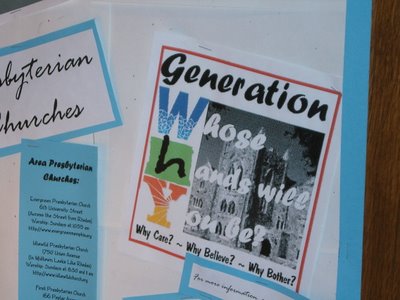
The other part of the post title is "Why?" The picture above was on one of the bulletin boards in the Faith and Service center at Rhodes College. I was so struck by the power of this poster, the others that were in the room, and the message that Rhodes sought to give about caring about community and those around us. I've sometimes heard the current generation of students referred to as the "Why?" generation. Maybe this is the reason - Whose hands will you be? Why care? Why believe? Why bother? Our friends from Minnesota were seeking the "Why?" The historic figures of Memphis were seeking the "Why?" And those of us who will ultimately make a difference in the world will unceasingly seek the "Why?" It's nice to know that we have company for the road.
One of the best parts of the "Plunge" is the fact that it is a great bonding time for the Scholar Leaders. It's odd that a group that lives together doesn't really take the time to bond on a regular basis unless they are taken away from campus and placed in an environment where they have nothing to concentrate on but each other. In additon to the bonding, we saw and experienced so many terrific things in Memphis. We met with representatives from their SmartCity initiative - an organization in Memphis and in select other cities that is focused on improving the community environment for "creatives" - young people who are educated, interesting, and bring many resources to urban communities. We visited the National Civil Rights Museum and experienced the evolution of the civil rights movement in the U.S.A. This museum culminates in a visit to the room where Martin Luther King, Jr., was assassinated in 1968. We worked with sick children at St. Jude Children's Research Hospital, visited Graceland to learn of Elvis' legacy, and we made a visit to the Rock and Soul Museum. We had a couple visits to Rhodes College, once to meet with the CODA Scholars, a group dedicated to advocating for the arts and the other visit was for a campus tour and the chance to learn about the way Rhodes connects faith journey and service.
You may have been trying to figure out how any of what you just read relates to the topic of this post - "Campaign for Community - Why?" It's because of two very powerful and connected perspectives that we encountered. Our group meal for Plunge was a visit to BB King's on Beal Street for a little BBQ. We did this with some of our Miami alum contacts before going to a live theater production of "Exonerated," a play about unjustly accused death row inmates. It wasn't the meal that was so great - it was the company - and unexpected company at that. While we were having dinner, four guys from the University of Minnesota (Brian, James, Drew, and Eric) wearing t-shirts that said "Campaign for Community" dropped by our table. I couldn't help but ask about their t-shirts... They said their t-shirts captured the essence of their 11-day trip over winter break. Their campaign involved following a path they had not planned. They were simply taking the path suggested by the people they encountered along the way. It took them to Iowa, Tennessee, Louisiana, Florida, Georgia, and Ohio. This was their way of understanding, engaging in, and building community. Having connected with us, we had the pleasure of hosting them and learning more about their terrific work when they visited Oxford last night and today.
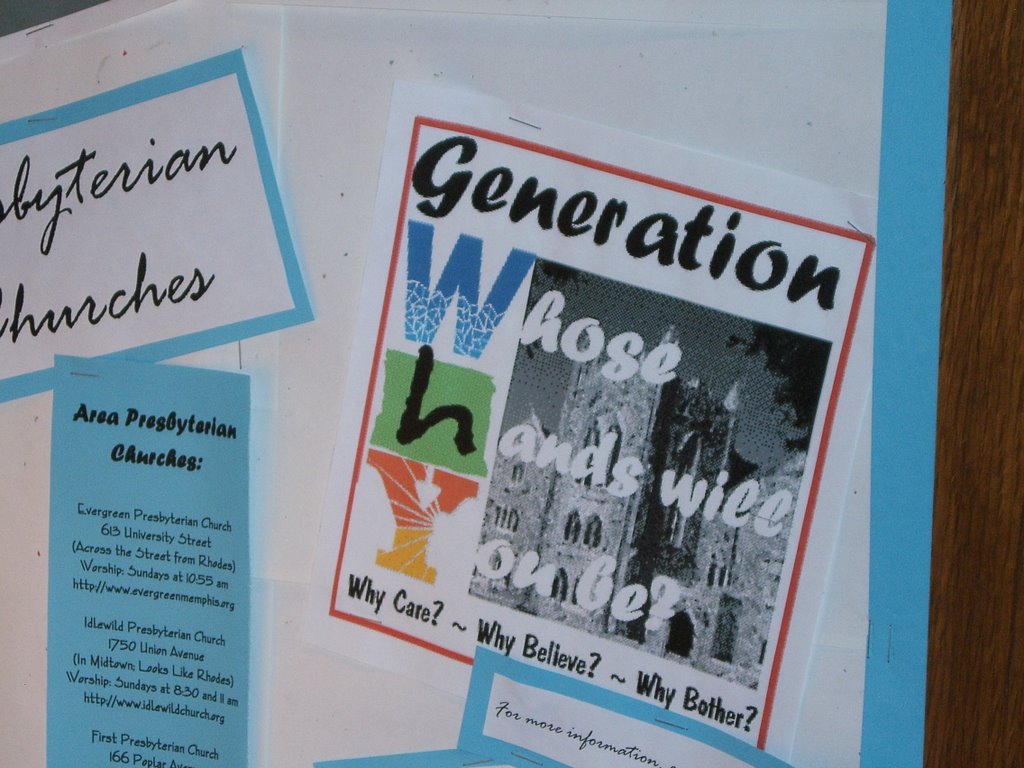
The other part of the post title is "Why?" The picture above was on one of the bulletin boards in the Faith and Service center at Rhodes College. I was so struck by the power of this poster, the others that were in the room, and the message that Rhodes sought to give about caring about community and those around us. I've sometimes heard the current generation of students referred to as the "Why?" generation. Maybe this is the reason - Whose hands will you be? Why care? Why believe? Why bother? Our friends from Minnesota were seeking the "Why?" The historic figures of Memphis were seeking the "Why?" And those of us who will ultimately make a difference in the world will unceasingly seek the "Why?" It's nice to know that we have company for the road.
Tuesday, January 02, 2007
Inconvenient truth

I'm back at work for the new year and getting ready to go on a learning and service trip with the Miami Scholar Leaders tomorrow. We are going to Memphis to do a variety of things including service at St. Jude Children's Hospital, visiting the National Civil Rights Museum, dropping by Graceland, and meeting with participants in the SmartCity movement that is underway. I'll post on the trip later but I had to offer a post on a film I saw during the holiday break - "Inconvenient Truth."
"Inconvenient Truth" is a documentary of Al Gore's lecture about global warming. It is an extremely sobering and jolting analysis of indicators that the Earth is in a very dangerous downward spiral of environmental conditions. The evidence Gore provides is difficult to dispute, even though some will interpret the film as politically motivated. I bought a copy of the film because I hope to encourage everyone I encounter to view it. We owe it to ourselves to become informed, affirm or dispute the evidence, and then take action. If the film is correct, the advance of global warming is faster than scientists expected and, while many of us thought the effects would not be seen until later generations, there is some evidence that global conditions are already showing the signs.
For more information, go to Inconvenient Truth for specifics, reviews, etc. There are lots of reasons why the U.S.A. doesn't want to recognize the possibility that Al Gore is correct. The U.S.A. and Australia are the only two developed countries who have been unwilling to adopt the Kyoto Accord, an initiative that would require more stringent greenhouse gas emissions controls. The oil producers and auto industry in the U.S.A. would be effected if the U.S.A. signed on to Kyoto. Signing would require them to begin exploring alternative fuels and it would require probably more fuel efficient and smaller autos and trucks. Requiring our U.S.A. manufacturers to face the reality that our industrial ignorance and arrogance only achieve short-sighted economic gain while selling future generations down the drain is one possibility. What other views about emissions control and global warming are available to us?
I would love to hear others' thoughts about "Inconvenient Truth" and the questions it raises. I do not claim expertise in this area but the film certainly got my attention.
Thursday, December 21, 2006
Preparing for Christmas back home
With last year having been such an adventure, it has been a little difficult getting in the spirit of Christmas. A year ago tonight we were in Florence and would be on our way to Rome and then to Venice for Christmas eve. It's a little hard to beat the glamour of that kind of Christmas. On the other hand, we really missed not seeing Devin, Steve, and Gram at Christmas and this year we'll all be together for a full week. Darbi is already here, Devin and Steve come tomorrow, and then we'll all go shopping and playing together on Saturday. We very much look forward to a wonderful celebration together.
I also have something to celebrate today that will make the holidays even more fun. The editor for Deeper Learning in Leadership made some recommendations for changes in November and I promised to turn them around with a new draft ready by January 15, 2007. To my utter shock, I finished the revisions today - almost a month ahead of time. I probably won't turn it in until January but it feels so great being able to look forward to time with the family with nothing hanging over my head. I also intend to return to practicing piano during the holiday and I can hardly wait. Darib has been taking piano lessons at Carnegie Mellon and I need to brush up so I can stay ahead of her.
I feel a deep sense of satisfaction tonight. I'm home, with loved-ones, preparing my mind and heart for the coming of Christmas - an absolutely wonderful time of year. I pray for the happiness and peace of all our family and friends. We have many treasures to be thankful for!
I also have something to celebrate today that will make the holidays even more fun. The editor for Deeper Learning in Leadership made some recommendations for changes in November and I promised to turn them around with a new draft ready by January 15, 2007. To my utter shock, I finished the revisions today - almost a month ahead of time. I probably won't turn it in until January but it feels so great being able to look forward to time with the family with nothing hanging over my head. I also intend to return to practicing piano during the holiday and I can hardly wait. Darib has been taking piano lessons at Carnegie Mellon and I need to brush up so I can stay ahead of her.
I feel a deep sense of satisfaction tonight. I'm home, with loved-ones, preparing my mind and heart for the coming of Christmas - an absolutely wonderful time of year. I pray for the happiness and peace of all our family and friends. We have many treasures to be thankful for!
Wednesday, December 13, 2006
December 13 - one year later
A year ago I was finalizing grades for my MUDEC class, doing laundry, packing, and temporarily closing down my blog. Tomorrow, December 14, Diane and Darbi would start their trek to Frankfurt, and December 15, we reunited and began our European extravaganza. It hardly seems possible!
So much has happened over the last year that has cemented my MUDEC and European experience in my memory. First of all, I'm so pleased that I started this "Pursuing Leadership" blog so that I could get back to all the ideas I've had and so that I could chart the journey of my discovery of Europe and leadership.
This experience brought to fruition a decade-long dream just last week. I keynoted the Leadership Educators' Institute in Arizona with the title of my remarks being Deeper Learning in Leadership. It was an incredible honor and opportunity to roll out the core ideas that will eventually be in print with the book. The participants' responses were very good and the ideas seemed to stimulate considerable dialogue through the rest of the conference. Preparation for the conference also helped me refine how some ideas were presented, which will help in completing the final revisions of the text by January 15, 2007.
I'm finishing up grading for the semester and then will dig into writing. I also hope to kick back a bit for the holidays. Last year was so incredible that only the deep warmth of being with my family could even begin to compare!
So much has happened over the last year that has cemented my MUDEC and European experience in my memory. First of all, I'm so pleased that I started this "Pursuing Leadership" blog so that I could get back to all the ideas I've had and so that I could chart the journey of my discovery of Europe and leadership.
This experience brought to fruition a decade-long dream just last week. I keynoted the Leadership Educators' Institute in Arizona with the title of my remarks being Deeper Learning in Leadership. It was an incredible honor and opportunity to roll out the core ideas that will eventually be in print with the book. The participants' responses were very good and the ideas seemed to stimulate considerable dialogue through the rest of the conference. Preparation for the conference also helped me refine how some ideas were presented, which will help in completing the final revisions of the text by January 15, 2007.
I'm finishing up grading for the semester and then will dig into writing. I also hope to kick back a bit for the holidays. Last year was so incredible that only the deep warmth of being with my family could even begin to compare!
Sunday, December 03, 2006
Vienna - one year later
I've been reliving my weekend in Vienna throughout the current weekend. Clearly, Vienna was one of my favorite European cities and it's hard to forget what an amazing visit I had. With adjustments for time zones, by now I was back in Differdange, moving into the final days of teaching, writing, and solitude.
Vienna was amazing because of the overwhelming history that took place there and the art which stands as a testament to Vienna's importance throughout Europe for 700 years - up to the dawn of the 21st century. I keep thinking back about when Diane and I can return. I loved Vienna in the winter, with its very short days, snow floating through the air, streets filled with fur-clad shoppers, and musicians in concerts halls and the streets. I want to go back in the summer as well to see its lush gardens, the Danube, and the outdoor environs made for all to enjoy.
Shifting to another of my favorite cities, I noticed a piece in the paper this morning about JFK's 1963 visit to Berlin. The piece informed of the opening of a new exhibit just at the threshold of the Brandenburg gates that is dedicated to JFK's visit. His visit was intended as a statement of support to Berlin after the USSR erected the Berlin Wall in 1961. Free Germans were fearful of being overtaken by Soviet power but JFK had the courage to go there and to proclaim, "Ich ben eine Berliner." His statement reflected that free citizens everywhere are connected to each other. This event still ranks as the top historical event of the past one hundred years for most Germans.
JFK and RFK's times were different - the cold war, civil rights, economic disparity... Or were they? Having seen "Bobby" this last week with my first-year leadership seminar students, I was deeply reminded of the turmoil of the 1960s. My belief is that we have reached another pinnacle time of turmoil in human history. The cold war, where outright military confrontation was avoided but unknown enemies lurked behind every headline, is strangely reminiscent of the war on terrorism. Gains acheived in the Civil Rights Act of 1954 are being challenged in a Supreme Court case moving to the national center stage tomorrow, 12-4-06. Economic disparity is at an all-time high in the U.S.A. Corporate CEO conpensation has risen at outrageous rates while downsizing requires layoffs and flat compensation for the working class.
There is a strange symetry among the random thoughts in this post this morning. The dynasty of the Habsburg family in Austria, the legacy of the Kennedy family as advocates for change while they occupied places of privilege, and the present struggle before us in finding politicians who are capable of the leadership we need to advance the human condition. These times may stir fear in our souls but they also enliven the quest for more adequate and, indeed, effective ways of understanding leadership. What kind of "leadership" do we need to engage citiznes in the complex negotiations of the modern day?
Vienna was amazing because of the overwhelming history that took place there and the art which stands as a testament to Vienna's importance throughout Europe for 700 years - up to the dawn of the 21st century. I keep thinking back about when Diane and I can return. I loved Vienna in the winter, with its very short days, snow floating through the air, streets filled with fur-clad shoppers, and musicians in concerts halls and the streets. I want to go back in the summer as well to see its lush gardens, the Danube, and the outdoor environs made for all to enjoy.
Shifting to another of my favorite cities, I noticed a piece in the paper this morning about JFK's 1963 visit to Berlin. The piece informed of the opening of a new exhibit just at the threshold of the Brandenburg gates that is dedicated to JFK's visit. His visit was intended as a statement of support to Berlin after the USSR erected the Berlin Wall in 1961. Free Germans were fearful of being overtaken by Soviet power but JFK had the courage to go there and to proclaim, "Ich ben eine Berliner." His statement reflected that free citizens everywhere are connected to each other. This event still ranks as the top historical event of the past one hundred years for most Germans.
JFK and RFK's times were different - the cold war, civil rights, economic disparity... Or were they? Having seen "Bobby" this last week with my first-year leadership seminar students, I was deeply reminded of the turmoil of the 1960s. My belief is that we have reached another pinnacle time of turmoil in human history. The cold war, where outright military confrontation was avoided but unknown enemies lurked behind every headline, is strangely reminiscent of the war on terrorism. Gains acheived in the Civil Rights Act of 1954 are being challenged in a Supreme Court case moving to the national center stage tomorrow, 12-4-06. Economic disparity is at an all-time high in the U.S.A. Corporate CEO conpensation has risen at outrageous rates while downsizing requires layoffs and flat compensation for the working class.
There is a strange symetry among the random thoughts in this post this morning. The dynasty of the Habsburg family in Austria, the legacy of the Kennedy family as advocates for change while they occupied places of privilege, and the present struggle before us in finding politicians who are capable of the leadership we need to advance the human condition. These times may stir fear in our souls but they also enliven the quest for more adequate and, indeed, effective ways of understanding leadership. What kind of "leadership" do we need to engage citiznes in the complex negotiations of the modern day?
Subscribe to:
Posts (Atom)