Monday, August 07, 2023

The Singing Revolution

I've posted previously about the many benefits of music training and listening. For the Love of Music (Mauceri, 2019) and Experimentalism and Empiricism are examples. Neither of these posts specifically call out music as a revolutionary act although both of them imply the potential.

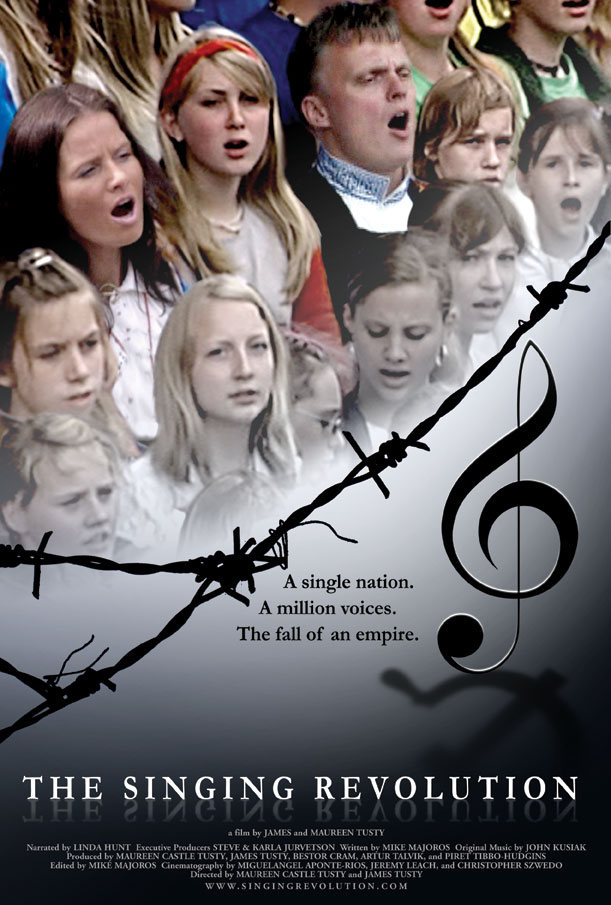
A good friend, Kathy Beardsley, offered a wonderful travel post from Bob and her exploration of Estonia this last summer in which she referenced "The Singing Revolution." Kathy's dedication to learning from travel and sharing with others is a wonderful example of Traveling with a Critical Perspective, a view I've grown to embrace. The Singing Revolution is a documentary about the role of music as Estonia cast off the USSR's military and attempted cultural control of the Estonian people. This documentary has so many lessons to inform both individual and group leadership. The first lesson is that natural characteristics of groups are often times the most effective in mobilizing shared purpose. In the case of Estonia, singing in groups had long been something that drew them together. The second lesson is that music can symbolize, and often gives voice to, shared yearning that otherwise would remain invisible. An annual gathering of singers while Estonia was still controlled by the USSR turned into a spontaneous realization of the loss of freedom when a single individual road past the assembly flying the outlawed Estonian flag. The third lesson is that joining together in common cause is unstoppable. Once the singing revolution gained momentum, the crowds swelled to as many as 300,000 singers in one event. Although the USSR saw the threat and considered military action, they knew the number of peacefully protesting singers was too great a force.

Coincidentally to Kathy's post about the Singing Revolution, we attended a concert at Chicago's Ravinia Festival that was curated by Marin Alsop. The "Breaking Barriers" concert series at Ravinia featured young female composers with the crowd warmly applauding the new, fresh, and innovative artistry of both composers and performing artists. As a follow-up to the concert, the local FM station WFMT interviewed Alsop and her friend and colleague Jude Kelly on "Leadership and Purpose." During the interview, Alsop commented "courage is important in leadership, but accountability is, too." Her belief is that conducting requires a balance for who she's leading, holding them accountable for doing their best, while providing room for all artists to be themselves. Kelly also commented on a British architect she admired who advocated "Always build toward the light" - in other words, always travel towards something that has got hope inside.

The Singing Revolution, Breaking Barriers, and joining together in the exploration of our humanity through music are powerful forces and perhaps unstoppable in many other places than just Estonia.

Saturday, July 22, 2023

Chiaroscuro of Leadership

One of the things I've grown to understand over decades of studying leadership is that recognizing the chiaroscuro of leadership is essential. It may seem odd to use the term chiaroscuro but it captures the problem beautifully. Chiaroscuro involves highlighting contrasts of light and dark, a technique used by artists such as Leonardo da Vinci and Caravaggio. At an earlier point in studying leadership, I was inclined to see only positive engagement (bringing light) as leadership and attributed examples of negative engagement (bringing darkness) to the destructive imposition of authority and power. Years later I came to accept both the dark and light of leadership and the necessity to accept that both exist and that some acts of leadership can actually involve both. Further, the reality of our world is that the darkness of humanity frequently is what calls forth light-giving leadership.

Six quotes that might be useful in exploring the importance of chiaroscuro in leadership:
  • "Our community will work toward change that will result in this tragedy being a 'distant and unimaginable past'" - Boulder, Colorado, mayor's statement after mass murder, March 23, 2021.
  • "We will lead not by the example of power but by the power of our examples" - Joseph R. Biden Presidential Inaugural Address, January 20, 2021.
  • "Muddied water left to stand becomes clear" - non attributable.
  • "May your heart be pure and your will firm" - Jamil Karam, Eid greeting, 2021.
  • "Hallelujah, anyhow" - Van Jones, Juneteenth coverage, 2023.
  • "Faith is not bound by what I don't know but what I do know" - Van Jones' guest during Juneteenth coverage, 2023.
How do these fit together to inform our understanding of both negative and positive in leadership? In the first example from the Boulder mass murder at a grocery store, the mayor proclaimed to the community that they had been challenged, and must respond to, the heinous act by working together to address all sources of potential violence - creating a distant and unimaginable past. In the second example, following the incredible January 6 attack on the Capital of the United States and all is institutions and safeguards, President Biden declared that wielding power remedies little but that acting in faithful and concerted unity can restore when all else seems to have collapsed. The unattributable quote reflects that easily discernible solutions to complex problems are elusive (muddied waters) but that left to settle, pathways toward resolution can emerge. The fourth quote was offered as an Eid greeting by a former Qatar colleague and admonishes that we can make a difference when our hearts (e.g. motivation, intent, purpose) are examined and clarified, which then allows for the will to remain resolute. During discussion on air covering the 2023 Juneteenth celebrations around the U.S., Van Jones characterized the day as confirming a common African American belief - "Hallelujah, whatever!" The meaning here was that, although the journey of African Americans across generations of enslavement to Jim Crow to the present has been extraordinarily difficult, celebration of the journey and progress that has been made is essential. And, finally, an artist Van Jones was interviewing described his ambivalence regarding faith over his lifetime by saying that "Faith is not bound by what I don't know but what I do know." This last quotation guides me to confirm the faith I have, letting go of doubts that will surely persist throughout life, as well as leaning into what we know about light-giving leadership instead of being confounded by what we don't know.

Purposeful and courageous response to trauma, perseverance in the face of significant problems, examination of one's own purposes, celebrating all gains as they are achieved, and relying on what we know rather than what we question - these seem to cover some essential elements in the chiaroscuro of leadership.

Monday, July 17, 2023

Komives & Owen - A Research Agenda for Leadership Learning

Staying on top of trends and innovations in leadership research can be challenging. The recently released A Research Agenda for Leadership Learning & Development through Higher Education (Komives & Owen (Eds.), 2023) was conceived to help leadership educators and scholars stay up with current and emerging research ideas.


As a contributing co-author with Aoi Yamanaka for the chapter on "International perspectives in leadership learning," I highly recommend the book for several reasons. The first reason is that Komives and Owen are extraordinary in the breadth of their contacts and awareness in leadership research and have used their deep knowledge to inform the entire project. The second reason is the insight gained from the writing process; Komives & Own enlisted all contributing authors in the review and critique of each others' drafts which led to improving the sharpness, integration, and substance of the broader collection of chapters. The third reason is that our chapter (Roberts & Yamanaka) was revelatory in the exploration of truly internationally-informed leadership research and was a cross-cultural and cross-generational project of its own. I deeply enjoyed writing the chapter and hope that readers will embrace our assertion of the importance of "international context" and that it leads to fundamental changes in the way that researchers approach their work.

Traveling with a "critical perspective"

I'm a student affairs "lifer" and can't let go of the calling I accepted to pursue a student affairs in higher education career in 1973 (50+ years ago!). That calling was to contribute to the learning and development of students and colleague faculty and staff and it was a commitment to a critical perspective that involved doing research, applying practice to theory and back to practice, and being reflective in everything I did by writing, presenting, or engaging with others.

My fifty-year career took me to several higher education settings in different states and concluded with work abroad, first in a visiting faculty role in Luxembourg, and second in Qatar where working for Qatar Foundation opened an entirely different world to me. The cumulative impact of career and life experiences calls me to stay current in philosophical and theoretical orientation, regardless of whether or not I'm full-time employed. One of the theoretical lenses I've grown to appreciate and has garnered considerable attention in contemporary writing is John Dugan's "critical perspective."

At this point in my life everything is fused so maybe that is why applying a critical perspective to not only work-related but also life-informing experiences has become paramount. What does that mean for travel? It means that I feel a responsibility to reflect on, and show appreciation for, the places I've been and continue to explore. This commitment has become more urgent for me recently as I view the travels that many are taking around the world. In very interesting ways, "The Case Against Travel" in the New Yorker raises questions similar to my own. Fortunately, Rick Steves offers an alternative in his reflections on life, travel, and cancer. He calls for transformational or pilgrim travel that approaches being in another place or culture as an opportunity to engage with reality rather than escapism.

As I've observed the rush to travel after the pandemic, fueled by improving financial means of privileged Americans, I decided to respond to those who post about or share their travel experiences only when they demonstrate a commitment to appreciative and critical learning. This is challenging and has required constant monitoring of what motivates my decisions. I am sure I've missed travelers who are committed to inquiry and understanding and I'm sorry for having missed them. Three wonderful examples of critical perspectives in travel are Kathy Beardsley, Keith Edwards, and Patrick Love. In these examples, documentation and posts about travel are like a public journal, including reflection and appreciation for the places visited, taking the posts beyond "been there, done that" to what people and places reflect about history, art and architecture, and the broader view of human striving.

Particularly in the age of social media, and specifically during a time when Facebook has been abandoned by youth and adopted by "boomers" and older Millennials, I've grown very cautious about what I say or post, knowing that negative emotional consequences may be an unintended outcome for some of those who hear or view my updates. The negative impact of being left out or marginalized in youth has been documented but not much is being said about the impact for mid-life and older adults. Every celebration of travel, places I've been or things I've done, has increasingly included consideration for who has the passport, time, resources, and physical ability to engage in international travel. The spirit of why I share, and the inclusive intent of my sharing, has become central in my considerations.

What kinds of travel can be not only enjoyable but have the broader outcome of connecting across culture, understanding history, and examining my own privilege as a white, heterosexual, mainly fully abled, male American? To check my own authenticity, I looked back over my blog of the last eighteen years to see if my view of travel has changed and what types of experiences had the most profound impact. To be sure, a few of my blogposts have been just "been there, done that" but most have included a lot of reflection and appreciation for what I observed. What's interesting about the reflections that began in 2005, accelerated in 2007, and continue to the present is that they started not as tourism but as intentional learning. And the most powerful learning in travel was almost always the result of encounters with cultural informants in settings that were very different from my own life experiences. Realizing this has caused me to perceive a possible answer to a question that Aoi Yamanaka and I recently raised in a chapter on international context in leadership research. We asked what experiences can be most useful in stimulating deeper learning about international leadership? As I reviewed my blogposts, my travel started with seeking to learn and that has shaped all my subsequent experiences, which gradually included increasingly distant and diverse cultures. Perhaps this is an insight about how international travel might be introduced to anyone - before even receiving a passport, how important is it for there to be intentional consideration of "why am I doing this and what do I anticipate being the outcome for myself, my learning, and the way I live in the world?

Some examples of reflection and appreciation in travel using the elements of Dugan's critical perspective taking include: compositional diversity (Who's traveling and who is encountered in travel?); historical legacy of inclusion and exclusion (Whose stories are honored and whose are silenced?); organizational/structural aspects (What do the palatial residences of monarchs and edifices of religious institutions tell us about equity?); behavioral climate (Who is welcomed and given attention?); and, psychological climate (Whose identity and being is celebrated and what does it mean for travelers today?). If these were used in preparing for travel and as a framework for reflecting on what we encounter in travel, I suspect that outcomes of travel might be immeasurably enhanced.

Wednesday, July 12, 2023

Hawken - Drawdown

Drawdown: The Most Comprehensive Plan Ever Proposed to Reverse Global Warming (Hawken, 2017) is a well-documented encyclopedia of scientific ideas rather than a story to be read. It is a compilation of various authors' insights on alternatives to fossil fuel use, including various other natural resource reductions, and how each can plausibly lead us out of the current threatening environmental tailspin.

The solutions that are included could all result in "regenerative economic outcomes that create security, produce jobs, improve health, save money, facilitate mobility, eliminate hunger, prevent pollution, restore soil, clean rivers, and more" (p. x). The premise of the entire
book is that atmospheric transformation that is descending upon us requires reimagining almost everything we do. But reimagining is not some far-fetched impossible scenario - it is doable and as citizens of the Earth we have a responsibility to act.

An important principle of the combination of solutions is that each is still emerging, which will result in some strategies being immediately viable while others will improve in potential over time. The book is too extensive to list all the possibilities but options that are included and analyzed are wind turbines, microgrids, geothermal, solar farms, rooftop solar, wave & tidal, biomass, and nuclear. And these solutions can be used in concert by using one source when another is less or not available, providing the opportunity to consistently maintain the necessary levels of power.

Two of the current challenges that require attention are storage and distribution of power. Strategies to store power for when power cannot be generated, such as solar power at night, are essential and will require cooperation across the globe. In order to do this, grid adaptability and storage during peak production must be solved.

As a future treasured resource, which will surely be revised over time, Hawken's book concludes with a summary of the net costs and savings of each of the environmental solutions covered in the book. The bottom line of examining the costs is that repair is less costly than where we are presently headed in coping with environmental degradation and the resulting shortages, disasters, and irrevocable consequences we face. And the concluding sentence - "What it takes to reverse global warming is one person after another remembering who we truly are" (p. 217).

Thursday, June 01, 2023

Hamid - The Problem of Democracy

The problem of dealing with unsavory characters is a challenge across a variety of situations. Think of dealing with a "pesky" neighbor, the business that failed to repair your car or a public official whose views are repugnant. In international diplomacy, dictators and despots perpetrate abuse of their citizens. In each of these examples, are there ways to maintain relationships that over the longer haul can result in positive change?

Shadi Hamid's The Problem of Democracy: America, the Middle East, and the Rise and Fall of an Idea (2022) explores the difficult issue of the contamination of democracy promotion versus the values of the liberal, Western, world. Hamid's view is that American politicians have fused the two by advancing a particular type of democracy, one that embraces among other things gender inclusion, equal rights, and free market economic principles. The result of the U.S.A. fusing democracy promotion with liberal ideology is hypocrisy in action and ineffective diplomacy that results in the world not trusting America's expression and advocacy for either. America has regularly aided unsavory governments and their leaders in order to achieve advances in liberalism or beneficial business and commodity bargains. On the flip side, America has abandoned grass roots democratic movements when it was not prepared to deal with the disruption and chaos that is a natural by-product of governmental transition.

Hamid's focus is primarily the Middle East (African countries in the north that border the Mediterranean, to the Saudi peninsula, and across to Iran). What these countries have in common is the influence of Islam. The bottom line is that American politicians are profoundly skeptical of Islam due to the perception that it is fundamentally anti-democratic. However, the precepts of Islam advocate fairness, equality, education, and advancement through diligent work. To be sure, Islamists come in many different guises, sometimes contradicting the values for which they presumably stand. But could this not be said about democracies around the world, including the U.S.A.?

The problem of democracy promotion then requires, quoting Roger Scruton's essay, "Limits of Democracy," the "ability or willingness to be unhappy but still obliging when one's adversary wins an election." Hamid's conclusion after reviewing presumed democracy promotion efforts in the Middle East is that liberalism must be separated by observing democratic minimalism "with its emphasis on the preferences of majorities or pluralities through regular elections and the rotation of power, over liberalism, which prioritizes individual freedoms, personal autonomy, and social progressivism" (locator 170 in Kindle). Democratic minimalism involves placing the foundations of legitimate government at the center of American foreign policy rather than any other liberalizing outcomes. The approach would require abandoning the advocacy of individual freedoms in favor of the collective obligations of free expression and participation in electing one's government.

The disruption that results in formerly undemocratic cultures from expressions of dissent is often avoided at all costs when the American government is involved. This has been part of America's Middle East foreign policy for generations and is largely the result of its protection of Israel. Pushing Arab regimes, many partially or entirely Islamic, to make peace with Israel significantly undermines the prospect of democracy because embracing Israel is only possible when an autocrat imposes it against the will of its citizens. American's commitment to security over democratization was graphically demonstrated during the "Arab Spring" of 2011-13 when Egypt erupted in mass demonstrations and protests. A more contemporary Middle East example is the fact that at the same time "Saudi Arabia and the UAE were becoming more repressive at home and promoting regression abroad, they were attracting more, rather than less, American support" (locator 752).

The bottom line of democratic advocacy in the Middle East is that it presently, and likely forever, will require the acceptance of Islam as central to its people and governments. As Hamid indicates, "one can think that Islamists are bad and still prioritize their participation in the democratic process" (locator 2871). The discomfort with Islamists must be countered in these circumstances with a fuller and more persistent commitment to democratic minimalism that welcomes participation by the Muslim Brotherhood, which has been vilified over the years. With the Muslim Brotherhood's founding partially a reaction to Israel's occupation of the holy land, America's unqualified advocacy for Israel is a potential, but not necessarily a determinant, obstacle. The Botherhood's adoption in 2004 of its "Reform initiative" as a commitment to a constitutional and democratic system within a framework of Islamic principles is a building block on which U.S. foreign policy could be centered.

If the U.S.A. were to commit to true democratization in the Middle East, it first must accept uncertainty and secondly commit to a reasoned response to actions that could possibly threaten U.S. security and economic interests. Uncertainty related to Israel would be one of the greatest challenges for American diplomats and politicians, including the potential for the regional order and architecture being fundamentally changed. However, Hamid asserted that prioritizing Arab democracy could be actualized by publicly guaranteeing Israel defense protection if attacked while shifting to a Middle Eastern policy  of placing democracy as the first and foremost priority, abandoning the folly of the "stability first" policy it presently imposes through a hypocritical mix of liberal ideology coupled with democracy promotion.

Saturday, February 18, 2023

Genius and Leadership - Mahler, Bernstein, and Tar

Look up "genius" online or, as I first did this morning, in our 1937 Webster's New English dictionary. The online Webster's includes a range of uses for the word including the benign examples of "strong leaning or inclination," a "strongly marked capacity," or "a person endowed with extraordinary mental superiority." The 1937 Webster's starts with reference to persons who have some aspect of deity. I've only personally known two certified geniuses in my lifetime, although I suspect there have been many more. I know that I do not qualify and that I've been intimidated by "genius" in some examples and empowered in others. The fact of it is, genius can count as a result of the privilege we grant those who have it, how it can inspire great things, or how it can destroy relationships, institutions, and governments (remember the declaration of "stable genius?").

Genius is certified in terms of intellectual capability in the IQ test but, based on the definitions available to us, goes far beyond that to the realms of science, business, philosophy, the arts and more.  The ability to influence through exceptional insight or creativity and the genius associated with mobilizing people and ideas are beautifully reflected in music. The 2023 Academy award nominations of the movie Tar stimulated me to look more deeply into genius and the musicians who have demonstrated it. I was not a fan of Tar and was relieved when it received no Oscars. Why? I believe it portrays genius and its resulting power in a very bad light, let alone the near slanderous parallels between the movie's main character and Marin Alsop, a noted female conductor who sponsors female musicians and happens to be married to a woman with whom she has children. Lydia Tar's malign grooming and power-wielding mirror what men do in various sectors every day and, other than novelty and a not-so-sensational revelation that sexism and exploitation come in many guises, what motivated the creation of her fictional character? Finally, regardless of the accolades for Cate Blanchett's acting, the scenes where she conducts are abysmal at best. The director should have known how bad Blanchett was and should have done something about it.


Nevertheless, Tar stimulated reflection for me into the references in the script to Alsop, Bernstein, and Mahler. The lineage here is fascinating and it is direct. Mahler was a conducting sensation in the late 19th and early 20th century who garnered rave reviews from the moment he directed Beethoven's 9th by memory in his debut in Vienna. His flamboyance (genius) as a conductor was controversial enough, and rising anti-Semitism incendiary enough, for Mahler to leave Vienna for a respite period of conducting in the U.S.A. He returned to Vienna in 1911 and died at the age of only 51. Mahler's compositions were not as popular as his conducting during his lifetime but were retained through proteges such as Bruno Walter and revived substantially by Leonard Bernstein in the 1960s.

The use of Mahler's Symphony #2 for John F. Kennedy's funeral in 1963 and Mahler's Symphony #5 Adagietto for Robert F. Kennedy's funeral in 1968, as well as the score draped across his chest at his own burial in 1990, were indicative of Bernstein's affinity to Mahler's compositions. Bernstein's use of Mahler's compositions during American tragedy have become routine to ceremonies of remembrance. Bernstein also came to great public recognition first from his conducting but then through his televised "Young People's Concerts" and popular acclaim in "West Side Story." However, Bernstein's substance as a composer has not always been recognized. Here again, a devoted protege, Marin Alsop, specializes in conducting Bernstein, seeking to renew his prominence as a composer. The fictional character, Lydia Tar, claims to also be a protege of Bernstein, placing herself as a peer to Alsop.

What is this lineage about and what does the choice of the music at the center of the film imply? The choice of Mahler's Symphony #5 and the Adagietto movement are likely indicative of the struggle between artistic death and life for Lydia Tar and perhaps even her struggle with relationships. But maybe there's more. Interpretations of the ending of Tar indicate that perhaps the puzzle image that appears repeatedly conveys that there is a puzzle that the director never intended to reveal. A protege of Leonard Bernstein, John Mauceri, author of For the Love of Music, was the music advisor for "Tar" and surely knew all of the details about Bernstein's affinity to Mahler in general and the 5th Symphony in particular. On the broader topic of music, Mauceri would likely have wanted viewers of Tar to connect with and feel the Mahler #5 and he would also have wanted each individual to discern their own interpretations of what they heard.

My study of musicologists' view of the 5th is that it was the point at which Mahler turned away from "programs" in his music to the broader philosophical questions that he pursued for the rest of his compositions. The 5th itself reflects a massive pivot from the funeral march at the beginning, to searching and yearning in the 2nd and 3rd movements, to finding and professing his love for Alma in the Adagietto, and finally to the triumph and ecstatic celebration in the final movement. The Adagietto is perplexing in itself because it includes moments of lush romanticism but also includes anguish, exaggerated by repeated appoggiaturas, perhaps a reflection of the ambivalence in the troubled relationship Gustav was to have with his malevolent muse, Alma. The anguish of the Adagietto might also be understood by considering the thematic quotations in Mahler's Ruckert Lieder, Ich bin der Welt abhanden gekommen'. This particular text and Mahler's setting of it is about the deep satisfaction found in solitude, especially of a type that births creation. Might Mahler have been declaring the need for solitude while simultaneously yearning for the connective ecstacy that love provides? 

Returning to the idea of genius, Mahler and Bernstein reflect the height of genius, if for no other reason than their prominence in public notoriety and recognition, partially recognized in their own time but more substantially after their deaths. Mahler and Bernstein struggled with demons that likely drove them to offer their creative best and they both attempted to engage with others as they did. They both had impact in their own times as they exercised artistic and human leadership. I believe that the fictional Lydia Tar, with humble background who was drawn to Bernstein's genius, sought to advance herself rather than truly to advance art and the human spirit. After all, the beginning and conclusion of the film are about Lydia's work with publishers on her autobiography, Tar on Tar. Perhaps Lydia Tar began with a commitment to her art but became captivated by her own advancement, abused power in the process, and these brought her cataclysmic downfall. For me, the Mahler #5 was symbolic of the demons with which Lydia Tar struggled and the Adagietto represented the see-saw of ecstatic love and anguish over love that could not be satiated as long as Lydia was unable to be true to herself.

True genius in leadership is about something beyond oneself and, if it is not, the dark and deep spiral of destruction that was Lydia Tar's life will be the end that one is likely to meet. This is the transcending message I take from Tar; for all the flaws in the story and the acting, this is a crucial message to take away about genius and leadership.

Monday, February 06, 2023

Jamail & Rushworth (Eds.) - We are the Middle of Forever: Indigenous Voices from Turtle Island on the Changing Earth

We can never destroy the Earth is a message that rings loud and clear in Jamail & Rushworth’s (Eds.) We are the Middle of Forever (2022). However, that’s not a good message. Instead, it is a statement of the ultimate reality of human existence on Earth – regardless if we destroy the environment and our own survivability on Earth, the Earth has and will continue to replenish itself after untold catastrophic transitions over the millennia. This collection of interviews with indigenous Natives of North America tells us that we can do something about environmental destruction but that we must enter the conversation about saving the natural environment with humility. The lesson of humility is critical across all types of leadership but it is particularly relevant in the context of the environment.

These interviews of Native persons from various tribal backgrounds and experiences include highly educated faculty and researchers, community advocates, grass-roots organizers, and more. Each interview is labeled for its focus and includes areas such as strength, sense of permanence, living from the heart, awareness, trust, kinship, and more, all of which contribute to a set of disciplines for saving Mother Earth. The interview summaries begin with a description of each individual and then proceed through the exploration of ideas that each individual views as essential to respecting nature and the Earth. To be honest, I struggled with the first chapters and felt myself frequently asking, “What’s the point?” As the book builds momentum and connections are made across chapters, the ultimate purpose and prospect of each is revealed.

“Turtle Island” is North America, the name reflecting the separation of the continent from other landmasses around the world. When invaders and settlers began coming to its shores, attacking, torturing, and killing natives into submission, grandmothers warned against complying with the invader’s human and resource views, “No, this is not the right way to relate to the Mother, and there will be consequences” (p. xi). Later in the Longest Walk of 1978, Phillip Deere reminded all of the grandmothers’ wisdom when he said, “We are going to continue to walk, and walk and walk until we find freedom for all the Native people. And I will remind you, you may not be an Indian, but you better join us. Your life is at stake. Your survival depends on this” (p. xvii).

The “sense of permanence” interview of Gregg Castro (Salinan/Ohlone) asserted that reliance on science alone reinforces a view of the superiority of humans when, in reality, all creatures have rights and have a role to play in protecting the Earth as a living, breathing, changing place. The work of dismantling human arrogance must start with fixing ourselves and reversing the relatively recent obsession of civilization with possession, the assumption of ownership, and the resulting greed it engenders. Fixing ourselves of course is dependent on awareness, which is a very strong emphasis among Native peoples. Lacking awareness results in our not seeing ourselves in the context of systems, the world, and across time. The interview of Lyla June Johnston (Navajo and Cheyenne) on trust further exposed the perversity of the colonizers who came to Turtle Island with self-perception so low that they sought to dominate the frontier through white supremacy, sometimes even misappropriating the messages of Christ and his teachings of love to justify the slaughter of innocent native men, women, and children. This slaughter occurred sometimes as extermination and in other cases took the form of children being stolen from their families and assimilated in boarding schools away from the influences of their intergenerational tribes.

The bottom line revealed by Shannon Rivers (Akimel O’otham) in “balance” was that “Mother Earth will balance herself. Whether or not we get to see that balance, and whether or not it will happen in our lifetimes, we don’t know” (p. 156). The antidote to obsessive individualism and destructive accumulation for personal gain is Indigenous values, wisdom, and sustainable ways of living (Nelson on “dispelling delusion with alchemy”).  The Anishinaabe tribal grandmothers’ seven teachings include love, bravery, respect, humility, truth, wisdom, and generosity. These seven teachings are mirrored in many Indigenous belief systems and represent a fundamental rebalancing of all living things on Turtle Island.

Melina Laboucan-Massimo (Lubicon Cree) said that “The climate crisis is the direct result of the Western capitalist industrial complex, coupled with patriarchy and all the other ‘isms’ that exist which separate humans from Mother Earth” (p. 302). Averting the crisis through Indigenous wisdom and practice would revive the sacred loop of ‘healing justice’ that opens the way to “unpack and decolonize, in trauma-informed ways” (p. 314). In straight-forward and meaningful terms, Laboucan-Massimo encourages practices of community ritual, singing and dancing and advises, “You say a morning prayer, ‘Thank you for another day of life. Thank you for keeping me pure during the night. Help me to be a good human being’” (p. 332).


Monday, November 07, 2022

Tomes - The Piano - A History of 100 Pieces

Being able to hear great music enriches everyone's life. Actually playing it takes life's pleasures to a very different level. Having started piano lessons at age 5 and continuing throughout my life has been a profound gift and reading about the 100 best pieces across 200 years of composition reinforced it. Susan Tomes captures the essence of the journey in the closing paragraphs of her final chapter of The Piano - A History of 100 pieces (2021/22):

“The concert pianist is part of an intense triangle between composer, performer, and listener. Take away the audience, however, and the pianist playing alone at home is still part of an intense conversation with the composer… Composer and pianist may never meet, or even live in the same historical era, but their hopes are invested in one another. That is a rewarding relationship which for many pianists is one of the most enduring in their lives.”


What does this have to do with leadership? Deeper leadership strives to create something of shared value and benefit and the greatest hope a leader has is that there will be some lasting impact, or legacy. Music is one of the most profound metaphors for, and examples of, deeper leadership because the listener, or indeed the musician performing, has complete choice as to whether they will engage. Only if stuck in an elevator for a few minutes listening to corporate mood music are we forced to listen. The rest of what we hear or play is choice. Thus, the composer knows that to communicate s/he must create something that is either so pleasurable that we want to hear it or a message so compelling that we can’t not hear it.


Susan Tomes’ The Piano – A History in 100 Pieces (2021/22) covers two hundred years of piano music. Readers who will most enjoy the book have played, or at least heard, a breadth of compositions across this repertoire. I was delighted that many of the pieces that I regularly play were referenced and further explained by her.


The keyboards that pre-dated the piano (piano forte) were strung and played in very different ways – plucking a string by depressing a key rather than a hammer striking a string (this is why the piano is classified as a percussion instrument). The shift to hammered piano resulted in much greater range in volume, the ability to sustain the ringing of a string, as well as more complicated compositions in general. It is for this reason that I mostly play compositions from the Classical era forward and I favor Romantic, late Romantic, and early 20th century music.


Beethoven (1770-1827) dominated both playing and composing in the early 19th century. Although of common birth he declared “’My nobility is here and here,’ striking his head and his heart” (locator 1016). This view took the status of musicians to a new level, equating it with the inherited privilege by birth granted to the titled nobility of the day. The nobility of Beethoven’s music includes simplicity as well as improvisations that border on “controlled hysteria” (locator 1091). One of his compositions, the “Moonlight Sonata” moves from a quiet, somber, and controlled movement to one of exuberance and then a last movement of frantic runs at a tempo that some might consider hysterical. Chopin (1810-1849) was a prolific composer focusing almost entirely on the piano with 200+ compositions for solo piano. These vary across pieces that can be played by a novice all the way up to some of the most challenging pieces in the piano repertoire. Some of my most pleasurable moments at the piano are with Chopin’s Nocturnes, the Fantasie-Impromptu, and the Etude in E.


Early 20th century music is really my home and is the period of music I most often play on a daily basis. Each of the following composers capture the evolution of musical ideas over time and culture. Norwegian pianist and composer Edvard Grieg (1843-1907) incorporated folk tunes into his only piano concerto, one of the most loved of the repertoire. Grieg and Jean Sibelius (1865-1957) were part of a Scandinavian movement that celebrated nature and revived mythical stories to help shape the national identities of Norway and Finland. The melodic lines in Gabriel Faure’s (1845-1924) music often incorporated mediaeval purity, inspiring his students to include graceful lines into the emerging “Impressionism” common among French composers. Claude Debussy (1862-1918) and Maurice Ravel (1875-1937) incorporated Faure’s purity of melody as they explored greater complexity, often informed by the precision of math in both melody and harmonic tone. Ravel even incorporated American jazz elements after he fell in love with the complex chords and “blue notes” prominently used by George Gershwin (1898-1937) and jazz greats such as Duke Ellington. Russian Romanticism reached its peak in Sergei Rachmaninoff’s (1873-1943) compositions, with the chromaticism that is so evident in “Impressionism” creating some of the most beautiful melodies ever written. Rachmaninoff’s permanent departure after the Russian Revolution likely increased his influence in Europe and in America where lush melodies in movie themes became the vogue of the 1930s and 40s.


Tomes laments in her concluding chapter that “Many people now get their exposure to classical music through film and television” (locator 5565) or in stadium concerts of popular performers. On the positive side she goes on to say that “piano music is in a phase of democratisation, opening itself to influences and philosophies which have particular meaning for our era” (locator 5648), a trend that proves that all music, and especially piano music, must incorporate a wide range of ideas and influences. In essence, this range reflects a collective human treasure that is constantly changing, modulating, and incorporating new cultures and ideas. Music in general, and piano repertoire in particular, personify leadership as we have now come to understand it in the 21st century – an interpersonal encounter that seeks to engage others, and through building relationships, seeks to honor various human experiences and conditions in creating a more understandable, connected and beautiful world.

Tuesday, September 06, 2022

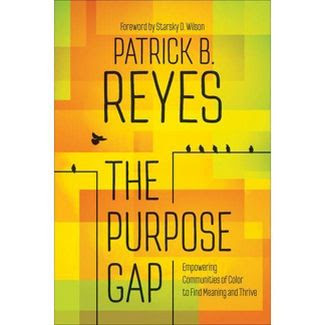
Reyes - The Purpose Gap

I felt as if I was overhearing an intimate conversation among friends and allies while reading Reyes' The Purpose Gap: Empowering Communities of Color to Find Meaning and Thrive (2021). Patrick Reyes clearly informs the reader that this book is for Black, Brown, and other minoritized individuals and groups that have not had "the resources and opportunities to fulfill their purposes in life" (Acknowledgements). As a reader who has not experienced the debilitating forces of discrimination beyond its corrosive impact on society, the book was helpful as a way to understand what needs to change and it also helped me to accept the limits that liberal advocates of inclusion should consider.


I have written about purpose and calling in life and I admit that I never realized the privilege bias in my own thinking - I wrote as if all one must do is discern purpose, continually hone it for good, develop the capacity to act on it, and stay the course. No, calling to vocation is not available to all people in the same ways and Reyes' writing helped me to understand how I missed the mark on this. The "purpose gap" is proposed as both an individual and community concern for only in a supportive community can everyone discover their potential, with "everyone" being key. Reyes is not talking about individual and exceptional stars who break the bonds of racism. His analysis is about systemic conditions that are deliberately designed to hold entire groups of people back, and these conditions will not change without dramatic transformation.

As a youth raised in a Latinx community in California, Reyes asserts "purpose is defined, stolen, or withheld before we ever enter the world" (p. 2) prohibiting youth from achieving what they were born to do. The barriers are erected by the "inheritors of wealth" who also guard the bridges to opportunity that would otherwise be available.  Reyes indicates that some of the barriers include internalized racism and imposter syndrome, but the greatest challenge is the lack of resources to pursue one's purpose. Grounded in his faith perspective, Reyes soberly recognized that we live in a society that decided who it could and would love and that "parents of color must teach our children they are loved despite a world that is not doing its best" (p. 24). Reyes goes on to say that to assume that the "American Dream" is achievable for all is nothing bot colonial piety.

The Purpose Gap admonishes those in Black and Brown communities to begin the journey by rewriting and retelling their story of purpose, drawing on the wisdom of their ancestors. He takes on Joseph Campbell's "hero's journey" by declaring it as a linear and individual story that denies the reality of minoritized communities. Instead, Reyes says, "I reserve my vocation, my life, and my purpose for my community. For my community first called me to life when the world tried to take it" (p. 46). In order to redefine the space of calling, design thinking could be used to answer four questions: What is? What if? What wows? and, What works? Design justice emerges from these questions by guaranteeing the distribution of shared benefits and burdens among various groups and peoples.

Reyes identifies community centers, libraries, parks and extended family networks as places that foster meaning and purpose for minoritized groups. Referencing the importance of faith organizations, he says that "The church not only has a call, vocation, and purpose. More importantly, it has the means and power to act on its purpose" (p. 62) and has a special responsibility in closing the purpose gap. To do this, the church must move from recognizing that stars exist to seeing that they must exist in constellations - places where the conditions for purpose and success are available to all. In these constellation places, leadership is also different. Instead of an individual act, leadership comes from tireless learners, pursuing "new angles, perspectives, viewpoints, and wisdom with excessive curiosity" (p. 109). Leadership must also foster specialists, those with wisdom and salient knowledge (e.g., intuition), and spirit workers to activate and sustain a community where constellations of stars are possible. On this final point, Reyes notes, "Closing the purpose gap is not just about changing the material world. It requires us to connect with and find healing with the spirits that guide our journey" (p. 166). In another passage he advocates hope in this work by saying, "I do want to say to this broken world, 'I see your violence, and I will raise you hope and love'" (p. 174).

In closing, Reyes offered three practices to help close the purpose gap for individuals and communities: 1) tell a new story, 2) design for purpose on our terms, and 3) know that it's about today!

Monday, September 05, 2022

Bremmer - The Power of Crisis

Ian Bremmer's latest book, The Power of Crisis: How Three Threats and Our Response will Change the World (2022), is short and very much to the point. The world community has work to do and we should do it quickly before the crises we now face get beyond our ability to address them. The hopeful part of his warning is that crisis tends to call the greatest ingenuity and most creativity from the human spirit so we can address our shared problems, but it is a matter of awareness of the risks and the will to do something about it.

Bremmer used the recent pandemic of 2020 and beyond to extract the lessons that we need to collectively learn. The three crises he says are eminent are shaking off the effects (economic, political, and social) of COVID-19, climate change, and the impact of new technologies that are changing our daily lives. The COVID-19 pandemic demonstrated graphically that we have both a civil war within the U.S.A. (polarization around science, common welfare, and politics) and the risk of a new cold war between the U.S.A. and China. In fact, COVID-19 pushed the world into a geopolitical recession where political groups withdrew from engaging with one another and across national borders. The impending crises of climate and technology will require new international systems of engagement that are designed to address today's and tomorrow's challenges.

With all that globalism promised, it has been a miserable failure. Specifically, the anticipated leveling of opportunity and economies was not only unfulfilled but wealth and resource inequality increased in the face of rising commercial exchange across borders. The wealth gaps in the U.S.A. have contributed significantly to the acrimony and divisiveness of political decision making, with those who are wealthy manipulating less-resourced groups against each other. The evidence of who controls political discourse is clearly evident in the $14 billion spent on elections for the two houses of Congress in 2020, a figure double that of 2016. One of the most inflammatory dimensions of politics in the U.S.A. is structural racism, a pervasive dynamic that many assert doesn't even exist.

Bremmer asserted that Xi Jinping, not U.S.A. Presidents and politicians, has placed U.S.A.-China relations on a more precarious path. The most frightening aspect of this is that the world has never experienced a time when its largest economy (soon to be China) was directed by an authoritarian government. The problem is that, for all the frailties of authoritarianism, it creates more cohesion and immediate functionality than messy democracy. At present, the balance of power between the U.S.A. and China is unclear, a situation in which inadvertent or purposeful conflict is much more likely to occur. Conflict could arise from governmental subsidies to businesses that lower production costs, from the theft of intellectual and innovation property, or it could arise from the growing threat China is signaling in relation to Hong Kong, and even more so in relation to Taiwan. The most likely battle between the U.S.A. and China is in relation to the future of technology - communications, machine learning, surveillance, and artificial intelligence.

The lessons that the COVID-19 pandemic taught the world include: invest in national and local readiness, share information, and share burdens and their resolution. The economic damage of the pandemic was widespread and deep, but it also sped up the transition from a 20th century to a 21st century economy. This is particularly applicable in relation to digital age companies.

For possible answers to the dysfunction of both the politics of the U.S.A. and China, Bremmer recommended looking at Europe's leadership on climate, technology, and provision of citizen safety nets. The work undertaken across European borders has been more effective than many other areas of the world, including even within the 50 Unites States. Climate and political refugees have flooded into many European countries and accommodating them has not been easy. However, by contrast to the U.S.A., political leaders recognize that refugees will create public unrest wherever they land and that constant effort to shape public perception in positive ways is essential. Climate and human migration will be challenging but Bremmer predicts that artificial intelligence is the greatest potential disrupter - "The greatest risk that AI presents is the possibility that one country will develop an insurmountable lead in its development, an achievement that would allow it monopolistic control over the world order" (p. 159).

The solution to the crises we presently face is for the U.S.A. and China to recognize that they must avoid economic and political stalemate, parking the differences that are real in order to find solutions that protect the whole of humanity. The technology challenge can be managed by creating a World Data Organization composed of European, Asian, and other allies that will by necessity bring China to the table. The resolution of our joint climate and technology challenges may emerge from a type of "Goldilocks crisis" that demonstrates the viability of multiple forms of government and focuses on practical solutions based on complex social engagement, cooperation, and coordination.

Wednesday, July 27, 2022

Herman - The Viking Heart

Partially motivated by a search to discover his own roots, Arthur Herman painstakingly documents the Viking Age to provide a more complete picture of who the Vikings were in The Viking Heart: How Scandinavians Conquered the World (2021). By going back as well as recounting the more contemporary impact of Scandinavian immigrants in America, Herman provides a much more complete characterization of a people and period of time that is often portrayed only for its brutality.

The Vikings, originally knows as Norsemen, were a people with a particular "frame of mind, a way of life, a way of doing things and making things, including making things happen in the face of the worst adversity" (Preface). Herman asserts in the book title as well as text that this particular way of being was distinctive and survives to this day, evident in a much larger portion of our collective genetic mix and human history than most people realize.

The Vikings, originally meaning "people of the Vik" or sea voyagers, traveled widely throughout Europe and into the Mediterranean, spreading ideas about astronomy, medicine, mathematics, physics, and instruments wherever they went. Coming from the current lands of Norway, Denmark, and Sweden, Vikings first sailed to England in the year 793 when they began their summer raids. Large Norse expeditions began staying over the winter in Ireland by the 840s and York became the capital of the Viking kingdom by 876. By 878 over half of England was under Viking domination, with the Orkney and Shetland Islands, Scotland and Ireland essentially being Norwegian colonies. During the period 780 to 950 Vikings from Norway and Denmark penetrated all of Europe and those from Sweden pushed as fas as the Mediterranean and the Black Sea.

The seafaring exploits of the Vikings revolutionized ship design and navigational capability, allowing them to travel faster and farther than any other sailors of the day. Mobility and pursuit of resources quickly turned from piracy and raiding to trade and settlement, resulting in Vikings establishing villages, turning to agriculture and fishing, and intermingling with Saxon tribal groups throughout England. As the number of villages increased, Vikings established "The Thing" as a political institution for landowners to address concerns that affected the entire community and elect their kings. The Althing of Iceland is derived from this self-governing entity and constitutes the oldest continuous democracy in the world.

The Vikings embraced many cultures and languages but men were privileged in all. While women were recognized as playing an important part in Viking villages, they were certainly not recognized as equals. Viking ships also supplied slaves to central Europe who were captured from Slavic tribes widely dispersed from Kiev in Ukraine to Prague in Bohemia. "The wealth and prosperity of the golden age of Islam were made possible in large part by the human labor supplied by Viking slave traders" (p. 49). The trade resulted in Vikings amassing hoards of silver, including eighty-four thousand silver coins eventually discovered in Sweden.

The concept of leadership in Viking days included the leader being one with his subordinates and loyalty terminating only at the point of death. There were no limits to the loyalty expected and given to the most revered among them. The brutality and sacrifice of the early Viking "berserkers" (from which we adopted "going berserk") would eventually merge with the spread of Christianity and by 1000 CE Vikings moved to a spiritual journey rather than a physical one. The myth of seeking a placed in Valhalla, a place where the bravest warriors go when they are killed in battle, was replaced by a Norse-informed religion that viewed the relationship between humans and gods as reciprocal. In this transactional view, "what seems to be decline and destruction is ultimately a source of renewal" (p. 112), a view adopted in Nietzsche's "myth of the eternal return." The progression of Christianity was slow and included the incorporation of previous images and borrowed traditions of paganism. Eventually, Christianity embraced compassion and moral obligation and the "Viking ideal of loyalty and service to community took on a new dimension: one of service to Christ and others as a Christian duty" (p. 122).

The Viking Heart traces the evolution of Viking character from 793 until the days of William the Conqueror (born 1027 or 1028 to September 9, 1087) when Norman's transformed the Viking "aristocracy of the brave" into the "dynastic rulers and cultural transmitters" who "laid the foundations for the unity of the medieval West" (p. 161). These foundations served the descendants of the Vikings well for almost another 1000 years.

Viking myth permeates many of today's most popular books and films - J.R.R Tolkien's Lord of the Rings, George Lucas' Star Wars, and J.K. Rowling's Harry Potter all celebrate the superheroes and fantasies of these ancient stories. The "...dazzling qualities of the Viking Heart - indomitable courage, fierce loyalty, national pride and power, plus a religious zeal and a charismatic ambition" (p. 216) are qualities that inspire many among us. The unfortunate part is that not all recognize the accompanying depth of commitment to community, equity, and helping one's neighbor that a Viking heart would embrace. Bravery, fierceness, and dominance divorced from the commitment to common welfare have inspired some of the hate and aggression that is seen among white supremacy groups today.

The Viking Heart is a long but interesting read. I have only summarized the early history portion of the book and for those who want more on how the Viking heart impacted more contemporary times, the rest of the book will be of great interest. Related to leadership, it was clear that much of the philosophy and many of the images of Vikings are celebrated in the heroic versions of leadership that popular media often portray.
Friday, July 22, 2022

Popelka - Experience, Inc.

Jill Popelka, former SAP executive and advocate for improving the experience of work, offers compelling evidence that organizations of all sorts need to change. The specific change is that they should prioritize employee experience in order to foster motivation, commitment, and innovation and all of these contribute to the bottom lines of productivity, profitability, and sustainability.


Experience, Inc. (Popelka, 2022) is relevant to all types of organizations, although the author is coming from over 25 years as a technology executive. Think schools, not-for-profits, community, churches, and for-profit businesses. None can escape the reality of 2022, a time when post-pandemic recovery is underway but with the new twist of employees being empowered to demand better compensation and working conditions. Even organizations that rely on volunteers would do well to heed Popelka’s advice; perhaps these settings require even greater focus on experience – the experience of being involved, contributing, and spending time in ways that bring meaning to one’s life.


 What do employees (e.g., workers, volunteers, contributors) want?

·      Purpose: to find meaning in their work

·      Agency: to have some say over how, when, and where they work

·      Belonging: to feel part of a community, even if they are remote, freelance, or part-time; to be part of a diverse community.

·      Recognition: to be acknowledged for their contributions, in multiple forms, on a regular basis (p. 12).

It's not about simply going through the motions of employee responsiveness. These conditions must be based on a sincere belief in people and in their desire to both advance themselves and contribute to something greater than themselves.


Agency and autonomy are core to ongoing growth and innovation and, therefore, deserve special attention. Popelka references Dr. Autumn Krauss to explain the primary challenge – “Marketing has got it all segmented down to a sample size of one… we shouldn’t be surprised that employees come to work wanting an individualized experience, specifically catered to them” (p. 54). Agency allows workers to figure out what is important to them and propose ways to achieve what they most want. Agency and autonomy require cultivation, especially among new members of any community. When you’re new, the inclination is to go along with what you believe is expected which tends to disempower. Helping newcomers identify their vision for themselves and how they will contribute may involve ambiguity that is initially challenging but it ultimately contributes to much greater involvement and satisfaction.


Leadership is obviously very important when attempting to create better workplaces or more engaging communities. And the most important responsibilities of contemporary leadership are:

·       Driving clarity of purpose

·       Creating connection

·       Requiring transparency and building trust


It’s not about charisma or power – it’s about the people and leading in ways that engage them.


Popelka’s book is easy to read, provides numerous examples, and offers “Take this with you” boxes at the end of each chapter to remind the reader of key points. Near the end of Experience, Inc. she offers the bold statement “Perhaps my single greatest motivation for writing this book is to argue that what is good for the company can never again be separated from what is good for its workers” (p. 196). Rephrase this for any organization – what is good for the collective can never again be separated from what is good for those who contribute to it. Purpose, a sense of belonging, and recognition of value naturally foster greater productivity.