Sunday, December 16, 2007

Abu Dhabi and back to Doha

The story is told of Abu Dhabi that the Emir once was riding through the desert when he asked the car to stop. He looked across the barren desert and asked one of his aides to begin planting trees and shrubs in the area. A year later he passed by the same area and found nothing had happened. He got out of the car and dug into the ground to plant a tree on the site he had noted the year before. From that grew a commitment to build an oasis out of this desert island and now what you see is this.

Abu Dhabi was absolutely beautiful. It is a much more manageable city than Dubai and the plantings have taken hold so much that you hardly know you're in the desert. When I flew out the day after the recruitment events, it was amazing to rise above the trees and realize that much of what I thought was wide-spread vegetation was just boundaries around highways and prominent buildings.

The trip to Dubai and Abu Dhabi was a combination of high school visits, informational receptions, and visiting with education ministry staff. The visit to the UAE education ministry in Abu Dhabi revealed some very interesting issues. A group of students came from the UAE to Education City last year. They were generally unsuccessful and the ministry was concerned about it. We talked about the need to clarify expectations for students who would come to Qatar to study, making a particular point that they had to be well prepared, or at minimum, committed to working hard to catch up. Some of my colleagues have told me that the ministry is more interested in Education City lowering its standards than UAE students increasing their effort and performance. These are dynamics that I will be exploring in the coming months.

I was greeted on my return to Doha by Darbi. We had a good Friday morning, including making breakfast at my place and then going to church. The rest of the day we spent on errands and shopping. I wanted to bring some pictures back of Doha so took a bunch of the area around the Coniche. This pictureis looking from the south side of the Coniche across to West Bay, with the old pearling boats anchored in front. The contrast of the old and new are part of Doha's charm - a contrast to much of the UAE where this kind of history and culture has been lost

This next picture is of the Museum of Islamic Art, set to open in March of 2008. This is another difference between Doha and the other Gulf cities. Doha is investing in educational and cultural buildings and institutions rather than solely business enterprise.In fact, you might have seen the news last week about the gathering of Arab scientists in Doha. The Emir invited over 100 renowned Arab scientists to return to discuss how the Arabian Peninsula could rediscover its roots as a leading intellectual and scientific center. The result of the conference is that three institutes will be established that will support these scientists and their work. Another investment in the future of Qatar...

Today is my last day of work before the holiday break. I return to the U.S.A. on Wednesday and can't wait to see my family. It should be an unbelievable reunion! I'll leave my ville in the sunset (pictured below) as I make my way west.

Tuesday, December 11, 2007

Doha - a little more and Dubai - a little less Arab

I've continued to wonder what's more or less culturally Arabic in the Gulf region. For instance, last weekend, I took our new Northwestern University branch partners out to dinner in the renovated old Souq in Doha. We went to a modernized but culturally reminiscent rooftop restaurant overlooking the streets of the Souq to the right. It was wonderful walking through the streets in the warm evening, viewing various vendors who had products either like or from the old days of the Souq - spices, teas/coffees, dates, rugs, carved wood icons, and any others. We left the evening refreshed by something old, yet renewed for us to enjoy.

By contrast, I'm in Dubai on a student recruitment trip this week. We've been visiting schools who might logically have students interested in Education City. The city of Dubai (pictured to left through the playground of one of the schools) resembles little, if anything, of its heritage. Oh, to be sure, many Arab business men still wear thobes but, for the most part, the feeling of the hotel I'm in and the neighborhoods I've seen are like any European or North American city - only newer and a bit more luxurious.

The tale of these two cities leads me to wonder what it takes for a city to be prosperous and progressive, yet not lose itself. What are the things worth keeping and what things need serious change? It's a question I'm still sorting out as I see more of this region. Come back in a few days for pictures of Abu Dhabi - that's the next stop.

Monday, December 03, 2007

A little bit of the U.S.A. (and the rest of the world)

Today marks my fourth week in Qatar - a moment of passage for sure. I still find my location here to be a bit surreal. Sometimes I've very aware I'm away from the U.S.A. and other times it seems like life as usual. Last weekend was a combination of comfort experiences and others that reflected the new world in which I live.

On Friday night, a new colleague (Kevin) invited me to a random party. He said that the person hosting it was pretty interesting and that I just had to prepare myself for it. First, before the party, we went to a great Indian restaurant where a full scale meal totaled to 50QR (about $13 USD) with Dave, Karen, Curt, and Belle (all working colleagues). The party was a hoot. The hostess, Tammy, greeted us at the gates to her ville and immediately grabbed my arm, ripping me away from the security of my new colleagues. She introduced me to a tall, young guy from Australia. We engaged in conversation for probably 10-15 minutes and then suddenly Tammy appeared again, "OK, it's time to go," she said. She grabbed me by the arm and took me off to meet my next pairing - this time a Brit woman in her 30s who teaches at Qatar Academy and knew Darbi from playing rugby. This succession of disrupted conversations and starting new ones occurred no less than 10-12 times during the evening, each time with Tammy grabbing my arm and informing all that it was time to move on. I can honestly say that I've never had the opportunity to network so quickly and it was quite fun. People from all around the world were at the party but it was in a very natural environment that felt much like a backyard in the U.S.A., except that it was almost December and it was warm and comfortable outside. The process of "OK, it's time to go" seemed at first intrusive but it connected everyone in a very helpful way - a technique I'll have to try someday if I have the guts.

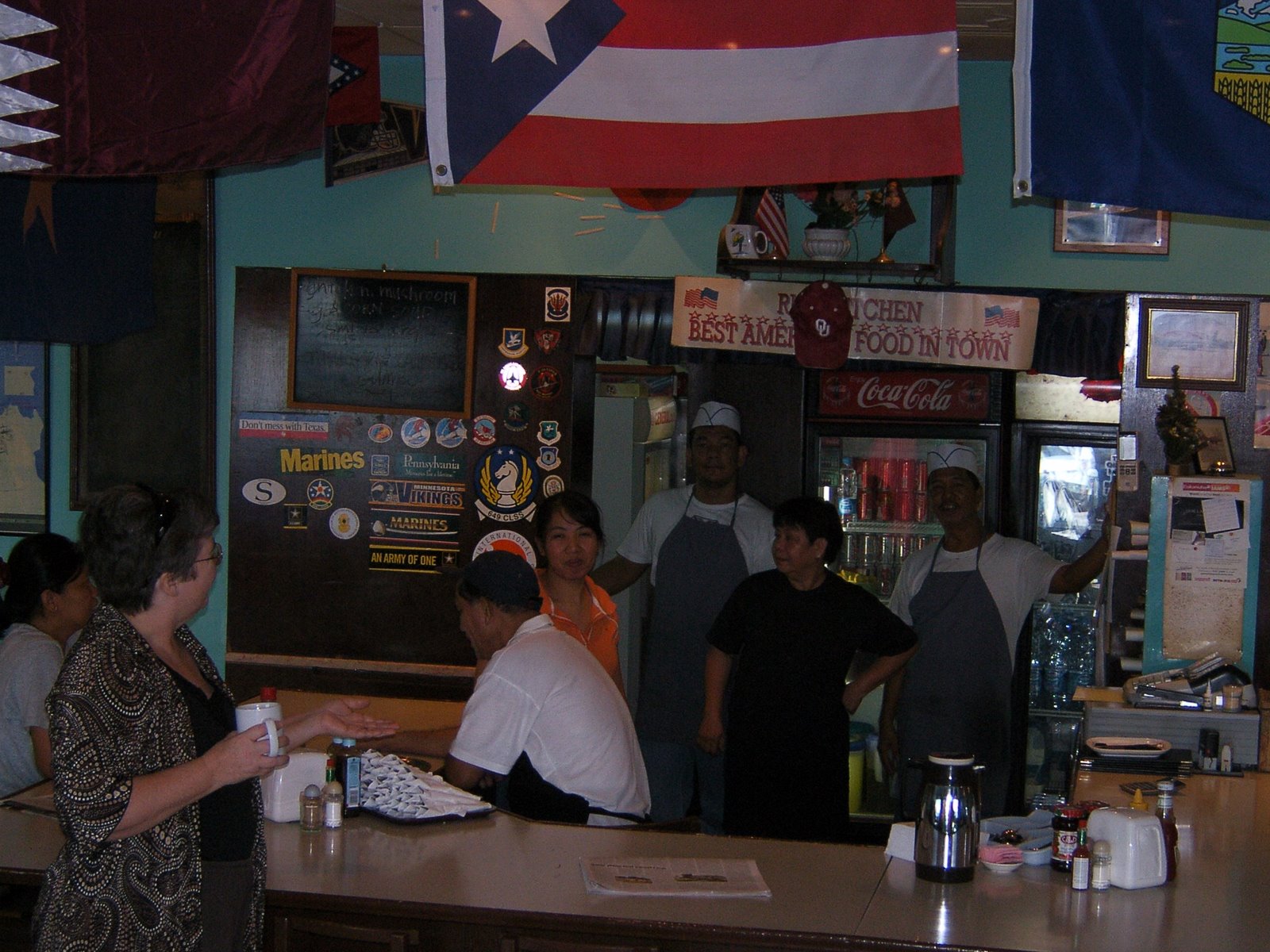
The next "little bit of the U.S.A. is pictured to the right. This is an inside picture of Rik's where I had breakfast with some other colleagues early Saturday morning. Rik's is the ex-pat gathering place in Doha. Upon entry, patrons immediately notice the flags of Texas, Kansas, and many other U.S.A. states. There are American film posters all over the place and the menu is distinctly American - and greasy and bad for you. But, oh, it tasted so good. We sat around drinking coffee and reflecting on the experience of Qatar and on the shopping trip we were about to launch - looking for Persian rugs to warm up my ville. Oh, and BTW, Rik's is owned and fully staffed by a family from the Phillipines.

All in all, it was a great weekend that reminded me of home but then jogged me to understand that I'm not really home. Maybe that's evidence that a "global citizen" perspective is beginning to settle in. Perhaps home will never quite be the same again, but in other ways, it's just exactly as it always has been, only bigger...

Sunday, November 25, 2007

Ex-pat Thanksgiving

Thanksgiving has special meaning when you're an ex-pat in one of the countries around the world where this holiday is not celebrated. The only way I know Thanksgiving is through family, food, the Macy's Parade, and collapse. Thanksgiving in Qatar went on for three days and included no less than four invitations to join other ex-pat groups for meals. It was very gratifying to be invited out so many times but I only succumbed to two offers. We all made our own renditions of sweet patatoes, salads, gravies, and more that we cherish from home.

Besides sharing Thanksgiving celebrations this last weekend, I ventured into the desert for a safari. It was very cool. Much of the safari was simply riding around in a comfortable SUV viewing the landscape (picture below and right). However, on several occassions we stopped to really absorb the setting. The last stop we made, the one where we saw this particularly photogenic camel (picture below), the sun was setting in the west while the full moon was rising in the east.
Even though there were about fifty people joining in this experience, there was a deep sense of solitude and connection in what I thought would be a pretty desolate place. It was desolate but it was this apparent void that made room for reflection, connection, and beauty. Arab lands are not filled with the lush colors of more vegetated places but they have a beauty of their own.

Ex-pat Thanksgiving - having a place to call home to which I know I can return and having a new place where being ex-pats is celebrated, even while we work to build another country.

Monday, November 19, 2007

Prospects and progress in the Arabian Gulf

My continuing ninety degree learning curve results in my stumbling into amazing things on a daily basis. One question that I've continued to field from my colleagues when they want to know more about Qatar is related to women and their opportunities. Her Highness Sheikha Mozah is a very strong woman who provides a role model for women in the Gulf and elsewhere. Her remarks from May 2007 made it clear where women's rights stand in relation to human rights. She advocated choices that balance commitments to cultural and spiritual traditions. Her actions speak even more loudly than her words when opportunities are made available for Arab women in Qatar through advancing education and creating opportunities to lead cultural and business organizations.

Beyond opportunities for women, there continue to be some questions about opportunities for various cultural and national groups. The mix of nationalities here is truly and utterly amazing. I so enjoy going places and hearing so many different languages and seeing so many different styles of dress. One of the things challenging Dubai (down the Gulf in the UAE) is the perception that they have exploited different immigrant groups in the working class, particularly in the construction and hospitality industries. I've not sorted out how I see this but I do pay attention to my surroundings. Last week I went for the blood test and tomorrow I go for my eye test for immigration approval. These experiences have exposed me to all sorts of people who are coming to Qatar. The good thing is that Qatar grants working visas to those who are sponsored by a specific organization or entity. While the presence of immigrants helping build this country may be questioned, at least there are processes in place to validate their presence - not something that is available in all developing or developed countries. Those contributing to the building and development boom are people seeking to better their own lives by serving the country of Qatar. While it may raise questions of purpose, many find a place that offers greater opportunity than they would have had in their home country - not so different from the burgeoning frontier days of the U.S.A. Sometimes it feels a little like that in Qatar.

Investing wisely

I had the phenomenal opportunity to work with a group of 17 second-year MBA students from Stanford University yesterday. They were in the Arabian Gulf region on an "Energy Trek," looking at what high-resource countries are doing to invest in their people. I was so excited to share with them the work of Qatar Foundation. From Education City to Reach Out to Asia, to $100,000,000 for Katrina relief, to forming a Qatar National Symphony, and many other things, it is almost overwhelming. The 17 students represented 12 different countries and none had ever heard of or witnessed anything like the Qatar Foundation.

So, the interesting question that floats in my head is "investing wisely" and for what purpose? Obviously, the Stanford students were inquiring whether or not Qatar and other Gulf countries are investing money in ways that will benefit large numbers of citizens and will create a positive future for this region. I hope that some of them read this blog post and join in the conversation by offering their perspective. I know my opinion and I don't hold back from offering it.

However, I left this group after three hours of very interesting conversation by encouraging them to invest in another way - investing themselves. This was a diverse, talented, and engaging group. They can make a real difference in the world but only if they decide on issues that matter and issues that reflect a wise investment on their part. Indeed, they have too much talent to waste an ounce of it or a minute of their time with frivolity. They have numerous opportunities to deepen their awareness of the world, one of which is the Global Management Immersion Experience (GMIX); we may seek to become a GMIX sponsor which would allow Qatar Foundation to have a Stanford intern for project-based work.

The importance of investing wisely came to me in another way today. I received messages from TJ and Anne about one of our dear Miami friends, Joe. Joe has struggled for the last couple of years with cancer and he lost the battle this weekend at around age 22. Joe was an amazing individual, full of wit, wisdom, and will. He was in remission when I saw him last. He was joking and carrying on as if there was nothing threatening his life. In his short years on earth, he invested wisely of his talent and his love of others. There are those who will read this post and know exactly what I mean.

Invest wisely - our talent is too great and our time to short...

Saturday, November 17, 2007

Doha before and after

You've seen some pretty incredible pictures in the previous posts. Well, you have to see some comparison pictures to understand what's really happened. The phenomenon of Doha is less that 30 years old. I don't know the exact date of the picture below but it shows Doha probably in the 1970s when the first of the great hotels that are now here was built. You can see in the picture the construction of the Sheraton. A road leads from nowhere to what was the beginning of the Renaissance of Qatar.

The next picture is looking from the Al Sharq hotel across the water to West Bay which is where you can see the Sheraton which is now dwarfed by the emerging skyline (It's the short white building a little right of the center of the picture).

The comparison of these two pictures only begins to demonstrate what a dramatically different place Doha has become in approximately 30 short years. There are lots of issues to work on and lots of challenges ahead but this is one of the most vibrant places in the world and it's important for citizens around the world to know about it. We're talking about what you see above being but a few miles south of Kuwait and Iraq and west across the Arabian Gulf from Iran. The Gulf region is typically portrayed as a dangerous and untrustworthy place. My emerging and deep concern is that western journalists and citizens must begin to understand that they simply don't know what's happening in this area of the world. I'll try to do my part so stay tuned!

No sooner did I get started...

The amazing thing about the time I've spent at Qatar Foundation is that there are so many things that have lined up so well. I had a day of other meetings and work after the Faculty and Student Services team retreat and then went immediately into the Qatar Symposium. The Symposium was sponsored by Carnegie Mellon University - Qatar. The main brain-trust behind the Symposium is Gloria, a wonderful and fun new colleague. The date of the Symposium was determined before I even knew I was coming here but it was uncanny how this event provided the opportunity to establish relationships and get a read on what's going on so quickly.

The Symposium site was a very cool new hotel in Doha - Al Sharq (picture to right and below). It has an Arab village feel with wonderful small villes, meeting rooms, and fountains and pools everywhere. I have to pinch myself when I'm in these kinds of places - not exactly like Oxford.

The Symposium started with a keynote from my superior and led into a reception where all the participants mixed and mingled. The next morning I was given the opportunity to kick off the day with a keynote about the purpose of the Qatar Foundation and the potential we have as colleagues of Education City. I always try to center myself so that I'm speaking from my heart but this particular morning was unbelievable. I felt so present and so focused that it was almost overwhelming. It was also as easy a speech as I've ever given. The primary reason - I believe so deeply in what we're doing.

The response to my keynote, the others who followed, and the general discussion over the course of the day was amazing. By the end of our time together, the branch and center representatives who were there were all ready to work hard to enhance our mutual work. There was a sense of the deep and critical importance of our work and everyone jumped in to say how they wanted to contribute. It was a very exciting day.

My challenges are now two: 1) keep the momentum going by pulling people together to refine the ideas we generated, and 2) maintain a focus on adaptive and facilitative leadership that keeps everyone at the table. In the particular case of Doha, Qatar Foundation, and Education City, things are so overwhelming that people just want someone to take care of it - fix it. The only problem - there isn't an easy fix and it takes all of us contributing everything we have in order to get the job done. Under these circumstances, it would be easy to get sucked into providing heroic and inappropriate leadership just because people want solutions so badly. The good thing is that everyone wants to do the work and we will. I've never seen this kind of commitment anywhere in my life experience - awe inspiring to say the least.

Getting started in planning

I haven't had much of a chance to blog for the last week. Honestly, I've been working from 6:30 a.m. to 10 p.m. pretty much every day. The work has been exhilirating and the pace exhausting but I've loved every minute of it. The remarkable thing is that my move here was so fast and the work cranked up almost immediately. I created some of that through advanced planning but it has been stunning how quickly things came up.

On the first day of my first full week with QF, we had a staff retreat (picture of our retreat site to the right - Diplomatic Club of Doha) for the Faculty and Student Services team.
Four young professionals took on the responsibility of organizing and preparing for the retreat. They did a terrific job of focusing on getting us more deeply acquainted (we had never retreated before) and looking at the opportunities and challenges of our work. We had a team challenge facilitator from the Reach Out to Asia staff which is another Qatar Foundation program. He was probably the best facilitator I've ever experienced. I'm totally psyched because he will probably be the lead team challenge facilitator for LeaderShape Qatar in January 2008.

The new Faculty and Student Services team is pictured to the left. We're only seventeen strong now but we're adding staff every day. We can hardly add people fast enough, especially when most of our hires involve immigration approval. As you can see, the staff team is very diverse which lends a natural and wonderful flavor to our work.

Wednesday, November 07, 2007

Continuing to adjust and opportunities it brings

I finished Day #2 and I'm off for Day #3 of Education City today (Thursday), which is the last day of this week. On Day #2 I had the chance to participate in the signing ceremony to bring Northwestern University to Qatar in Fall of '08. The people involved from Northwestern are great, especially the person who will be responsible for coordinating the student affairs work within the branch. She was very eager to collaborate with the QF staff and was eager to get started, and, she's a friend of a colleague I've known for a long time who works with her.

I continue to adjust but I struggled a bit with sleep in my first days. The first two nights, I awoke at 4 a.m. tossing and turning and unable to return to sleep. I was so tired last night that I crashed and stayed asleep until 5:30 a.m. - hoorah! The sleep deprevation was an irritation during the first days and it made me more tired than I'd like to be. However, I found a bit of thankfulness even in lost sleep. Lost sleep represents a disruption, although small, of my regular lifestyle. I started thinking during Day #2 about my transitions in life and what they each brought me.

As I think about it, I've had three major transition points in my life where I was substantially alone - the first was moving to Maryland immediately after graduate school. The second was Luxembourg in the fall of 2005. The third is Qatar. Obviously, each of these presented major challenges for me in adjustment. However, they also opened up pretty amazing things for my future. So, I plan to get my head around welcoming the change rather than freaking out - or at least I'll try.

Learning to embrace the change is a fascinating issue and came to a positive turn the morning if Day #2 at 4 a.m. I awoke, tossed and turned, heard morning prayers broadcast on loud speakers at 4:30 a.m. (actually, a very awe-inspiring sound), and then got up. I ate breakfast, listened to my ipod, and then finished reading Jaworski's "Synchronicity." The end of the book is astounding and brought me to tears as I was sitting in my upstairs gallery. I'll spare you some of the details but Joe Jaworski's life experience has many parallels to mine - a bit strange how much! Leon Jaworski (yes, the Watergate prosecutor) was Joe's Dad and before Watergate days prosecuted Nazi war criminals after WWII. The prosecution of Nazi atrocities deeply wounded Leon and he wrote a book dedicated to his son that revealed his commitment to "transform institutions as well as the individual human heart to ensure that this kind of pain doesn't continue to occur in the world again and again." The story closes with a beautiful poem that follows:
"Tell me the weight of a snowflake," a coal-mouse asked a wild dove.
"Nothing more than nothing," was the answer.
"In that case, I must tell you a marvelous story," the coal-mouse said.
"I sat on the branch of a fir, close to its trunk, when it began to snow -- not heavily, not a raging blizzrd -- no, just like in a dream, without a wound and without any violence. Since I did not have anything better to do, I counted the snowflake settling on the twigs and needles of my branch. Their number was exactly 3,741,952. When the 3,741,953rd dropped onto the branch, nothing more than nothing, as you say -- the branch broke off."
Having said that, the coal-mouse flew away.
The dove, since Noah's time an authority on the matter, thought about the story for awhile, and finally said to herself, "Perhaps there is only one person's voice lacking for peace to come to the world.


The point is that we never know whose life we are touching and it might be that one last person's voice that will turn the tide to peace. It may seem outrageously grandiose to say that I'm contributing in this way but I have to live as if this is what I'm doing. I'm an incurable romantic and I have to see my work as transformative and I think the people of Qatar can transform the world if we can learn to respect each other and work together.

Tuesday, November 06, 2007

1st day in Qatar

I made it through my first day at Education City. My day began at 4 a.m. when I couldn't sleep any longer due to jet lag and excitement. I got up, listened to music, surveyed my new surroundings, went for a walk, cleaned up, and waited for a ride to work; I don't have a car yet because all my immigration documents have to clear first and my appointment to do that is tomorrow (Wednesday). I took some pictures of my ville and will post these later. It really is a nice place, although I will need to do some personalizing of the space.

The big surprise was that 1/2 hour after getting to the office, I was informed that I needed to go to the Foundation Headquarters building to meet with the Executive Committee of the Board. Dr. Abulla Al-Thani, to whom I report, was reporting on the reorganization of his area and he wanted me to attend to meet the Board. This was my first opportunity to see the Board, and especially the Board chair, Her Highness Sheikha Mozah. The Board was very interested in the work of the Faculty and Student Services area, especially issues of student housing and building a campus culture that is attractive to students and deepens their learning. It is very clear that there is deep understanding about the need to establish a collegiate experience for Education City students.

After my day was concluded at the office, I went over to the LAS building which is where Carnegie Mellon and Georgetown now make their homes. The building was full of activity with the Georgetown students attending a lecture of an Islamic studies expert and the Carnegie students watch "An Inconvenient Truth." It is very evident that students are interested in being involved, in exploring contemporary issues, and in deepening their learning.

The combination of the vision of Her Highness and the responsiveness of Education City students bodes well for the work ahead. It's a matter of getting the work done, the buildings up, and working jointly with the branch campuses to design initiatives that fit for their students. Sounds easy but there's a lot of work to do.

I'm tired tonight and will likely go for a walk, eat, and then let my body collapse. Once I get back in the groove with the timezone, I'll have more opportunity to think. In the meantime, I just need to pace myself, keep up my exercise, and enjoy the music on my ipod.

Sunday, November 04, 2007

Last minute thought and off to Qatar

I'm in a rush this morning trying to prepare to board my flight to Qatar this afternoon. I'll be in Doha at 7 p.m. Monday night and at my new desk on Tuesday morning, ready for a new venture that will shape my life and career in ways that I never expected. Being in a rush, I'll post a couple of thoughts and then may return to them; I think it's important to reflect at least for a moment before I depart the U.S.A.

First of all, I am so thankful for the many Miami friends who have helped me so much in my transition. The last three months have flown by but things have fallen together rather nicely. Thanks to all my colleagues who are stepping up as I depart and thank you to students for always being willing to engage your learning and leadership to the fullest.

I am also thankful for the inspiration of colleagues throughout the U.S.A. and now beyond. I returned from the International Leadership Association conference in Vancouver on Saturday after having talked with colleagues like Susan Komives, Ron Heifetz, Sharon Daloz Parks, and many others. It was overwhelming to feel the good will and the affirmation for my new work in Qatar. I wouldn't have a prayer of doing what I need to do without great colleagues distributed around the world. And the friends of friends thing is unbelievable - there are so many connections I've already made in Qatar and the Arabian Gulf as a result of referrals.

As I think of what is ahead, I think of the importance of investing all of myself in every way possible. A colleague at Miami, Michael Kumler, works in cultivation and fund-raising for the Student Affairs division at Miami. He talks about investing time, talent, and treasure in things that make a difference. Different ones of us have more or less of time, talent, or treasure but the point is that we give as much of each as we can. This is a lesson that I've begun to explicitly incorporate into the way I work and engage with others. I think I've done this implicitly but knowing of the idea in more concrete ways draws more attention to it. Because of my career choice, I've had more time and talent to invest. I've realized that one of the things that gratifies me most and has the greatest impact is investing time and attention in developing others' talent. And a realization of this is that I love investing in others because I recognize the unrealized gifts that so many have. When I engage, I know that I'm working with students and colleagues who are likely to have greater gifts and more potential than I do. This makes my investment particularly critical because there is so much need to be addressed in our world. I have been blessed to have many in whom the investment of attention has paid off in such amazing ways. I know this will be the case in Qatar and I appreciate having had the experiences at Miami that have helped me sharpen my commitment to talent development.

For anyone who reads my blog, you're probably one of those who I perceive to have great gifts and potential, if not realized at this point, it is unfolding. I thank you for engaging with me and taking yourself seriously enough to know how important your contributions are to the world around you.

Friday, October 19, 2007

Higher education for a global 21st century

One of the things that I attempted through writing Deeper Learning in Leadership was to propose models of learning and leadership that would be relevant in the global environment of the 21st century. My experience prior to, and as I was writing, was exclusively U.S.A.-based and European. As I've become more aware of the Arabian Gulf region and the incredible things happening there, I've tried to figure out what's the same or different about higher education in these three geographic areas.

As my previous posts have noted, a lot is in the news regarding the emergence of higher education in the UAE, Saudi Arabia, and Qatar. However, this coverage is about the focus of these three independent, and in some ways competing countries. Interestingly enough, the three are adopting and adapting primarily U.S.A. models. But, is there a real understanding of both the strengths and shortcomings of higher education in the U.S.A.? Recent critiques of American higher education such as Derek Bok's Our Underachieving Colleges and the PBS documentary Declining by Degrees paint a pretty dire picture. At the same time these critiques are underway, new models are emerging that propose how to enhance learning both before and during the collegiate years.

One of the more interesting descriptions of how higher education can be enhanced came out of a study group convened by the American Association of Colleges & Universities. The College Learning for the New Global Century report critiques American higher education and proposes the importance of liberal education and integrative learning. The committee, which incidentally included Derek Bok, George Kuh, Ron Crutcher and others, combines ideas of globalism, experiential learning, integration of in and out of class learning, and the importance of creativity and the arts into a fascinating challenge for the future.

In addition to this U.S.A.-based perspective, Europe is also fashioning a global perspective to assure that their future is secure. The Lisbon Declaration of the European University Association defines a cooperative effort throughout Europe that will foster innovation, sustainability, and workforce preparation.

The question then becomes, with the Arabian Gulf investing proportionally more than either the U.S.A. or Europe into higher learning, and importing the best of both of these sources of "Western-style" learning, what is actually being imported and does it function in ways that truly enhance learning and build the capacity of the citizens of the U.S.A., Europe, and the Gulf? We live in interesting times where higher education appears to be at least one of the keys to a prosperous future. However, as new perspectives are proposed and resources pour into higher education, how do we figure out which models have the greatest promise? I proposed some ideas in Deeper Learning in Leadership but there need to be more. And, as leaders in higher education, we need to give our full and best conceptual energy to the challenge ahead. Will pushing the boundaries of global 21st century higher education be pushed independently and competitively or will they be pushed collaboratively and with global improvement the goal?

Tuesday, October 16, 2007

Legacy - granted or sought?


As I've read about (and have begun to observe) the explosion of development and education in the Arabian Gulf, I've begun to think of the question of legacy. While the improvement of educational and other opportunity for citizens of the UAE ("60 Minutes" covered Dubai on October 14,2007), Saudi Arabia (September 14, 2007, Chronicle of Higher Education), and Qatar are certainly good in and of themselves, all three of these countries are portrayed as developing a "legacy" for their people when the 21st century economy shifts from black gold (oil and natural gas) to other industries. So the question becomes, in what ways will this period establish a legacy and who determines it? Is the phenomenon of establishing a legacy granted or can it be sought?

Webster's Collegiate (1993; yes, I know using a dictionary is way old) defines legacy as "a gift by will" or "something transmitted by or received from an ancestor." This definition at least implies that one cannot seek to establish a legacy - it is granted by will to us or is received as a gift from an ancestor. Clearly, what leaders are attempting to do in the Arabian Gulf is to establish opportunities that will benefit the current and future generations of residents in the region. However, the degree to which the opportunities are eventually defined as a legacy depends on how it serves others. My own way of thinking of this is that we cannot seek to establish a legacy in, or through, our own lives; we are only granted a legacy through our service and as a result of our work and vision coming to fruition in ways that transcend us.

The reason this is important related to leadership is that it is fairly obvious that there are those who attempt to establish their own legacies through their acts of leadership. When we see this, how real or how transformative is the work? The work may have an impact but legacy is only granted when these acts transform and when they allow others to contribute as well. In many ways, it is only natural that we might all seek to be remembered for something we've done, something we've contributed to make the world better. My suspicion is that for those who seek the legacy, the moments of recognition are fleeting and hollow. The reward in this case is sought and most of the observers know what motivated the originator - self-aggrandizement. On the other hand, those who do not seek the recognition usually enjoy a longer and deeper appreciation for their work. Those who seek remain empty while those who simply serve are often recognized for their selfless contribution by the generations to follow.

Legacy - granted or sought? is a tough question. It requires self-examination that may not be all that comfortable. By examining, perhaps we can be freed when we let go of the desire to be recognized. The recognition comes of its own accord and lasts for many, many years and, if we are lucky, even generations. The Arabian Gulf is full of potential legacy and it will be fascinating to see how the broader globe embraces this amazing time in its history. In our own personal journeys, what potential legacies are either being granted or sought in this very moment?

Friday, October 12, 2007

Troubled and Thankful - in the same place?

I love being challenged to look more critically at my own experience and views. While I profess and embrace this a good portion of the time, I sometimes face challenges that I didn't expect and that I subliminally dismiss. That's been happening to me quite a bit this last week. I have found myself floating into a critical place that sees the problems but does not recognize my own opportunity to control my reaction to it - thus the title of this post "Troubled and Thankful - in the same place?"

As I prepare to leave Miami and to join the Qatar Foundation, I've noticed things in my current experience that have irritated or troubled me. It's not important to go into the details but let's just say that it has been primarily about the variety of responses I've had to leaving Miami and the new opportunities ahead in Qatar. Some colleagues and friends share the excitement I have and others are reserved, skeptical, or worse. Mind you, my emotional intelligence filters are probably set on "hyper-sensitive" right now so I recognize that my reactions have to be carefully examined. I have been aware of the need to monitor my own perceptions and to double-check them at every turn. Monitoring my reactions allows me to sort between what is about them versus what is about me. So, as an example, when someone reacts to my move by telling me about a visit they made to Qatar when in fact they actually visited Dubai (and this has happened a troubling number of times), and when their reaction dismisses the vision and purpose of Education City, I have to sort out what about the reaction is them or me. Further, if my conclusion is that at least a good portion of the reaction is about them, what will I do? Is there an opportunity to inform or to educate? Are there assumptions that will prohibit authentic discovery and exploration of our mutual questions?

If you've taken the "Darbi's Experiences Abroad" link, you know that my daughter has begun a process of more consistently finding and expressing thanks. This is based on a pretty cool area of research on thankfulness and how it impacts our lives. What I've realized from her posts and from this article is that looking for insights stimulated by thankfulness, we can actually turn many a troubling moment into an opportunity to know ourselves and to become more fully authentic in our interactions with others. As a very simple and pretty revealing example, I've reacted negatively on a couple of occasions when topics of interest to me and have been part of my work at Miami are carrying on without me. I was prepared to know that these conversations would take place after I was gone but not right under my nose - now! This kind of thing could have eaten at my soul until I began to understand the opportunities in thankfulness. It's actually very easy to do and it creates an alternative reality that is so powerful. When the conversations go on without me, that means that things I've valued actually mean something to others. It also means that capacity has emerged that will keep topics of deep interest to me alive. And, it also allows me the incredible luxury to spend this moment blogging about my reactions and it also affords the opportunity to think forward to the next step in my life in Qatar.

Woe! All of a sudden, a troubling feeling is replaced with thankfulness. The greater bonus is that the thankfulness opens yet unexplored opportunities to do things that really matter! What a lesson, stimulated by a little reflection and tempered with thankfulness.

Tuesday, October 02, 2007

U.S.A. and Qatar = Partners or Threats

Some very interesting things have been in the news lately about the Arabian Gulf region. Focus has been primarily on Dubai and Qatar for their entrepreneurial spirit and expansive growth. The Financial Times carried one article a couple of weeks ago and CNBC carried an interview with Qatar's First Deputy Prime Minister just today (October 2, 2007).

Browse these media commentaries and then think critically about the messages we are receiving. Are we encouraged to see the U.S.A. and countries like Qatar as partners or are we encouraged to see the growing and developing countries of the Arabian Gulf and East as threats to security in the U.S.A.? Specifically, the CNBC interview raises the specter of Qatar and other emerging Arabian Gulf countries buying out the west. Yet, the Deputy Prime Minister of Qatar raises the question of why the U.S.A. military forces can place their Arabian Gulf headquarters on Qatari soil while at the same time economists express concern that the U.S.A. doesn't know who it can trust when it comes to foreign investments in U.S.A. and European markets. So, which way is it? Some of these stories make it seem as if worldwide investing is suspect or threatening when, in fact, the U.S.A. has been doing the same thing for almost a century. The tables have turned and some other countries now own a piece of us (U.S.A.). Yes, it takes us potentially out of control of our own destiny. Yes, it means that others may prosper as much as we have in the U.S.A. But what's to fear if the U.S.A. has the capacity for innovation and competition that it says it has?

I don't mean for this post to be overly derogatory about U.S.A. media and interests. What I hope it does is to encourage us to consider the motivations of our commentators and public figures. I dare say that this is but one small example of the growing globalization that has now taken the planet. We are part of it and we need to figure out how to engage with other equal partners as we shape a future that can benefit greater numbers of citizens throughout the world.

Friday, September 28, 2007

First reaction to Deeper Learning in Leadership

I just had a particularly exhilirating moment - the first conversation with someone who's read Deeper Learning in Leadership. It was a Washington University staff member who was looking for ways to both broaden and deepen the leadership learning opportunities for Wash U. students. She contacted me last week to set up a conference call; I told her that she might want to order the book, read it, and then give me a call. Interestingly enough, Deeper Learning in Leadership had arrived earlier the same day and she was ready to start reading.

I know it may seem that I was a little self-absorbed to be so interested in someone else's reactions to what I've written but I couldn't help myself. I was extremely gratified when her two first reactions were being overwhelmed by the possibilities while being relieved by my message that all we have to do is start somewhere, don't sweat the small stuff, learn from what we do, and approach the opportunities of leadership learning as a journey in discovery.

I hope that Deeper Learning in Leadership serves as a summary and a catalyst for more substantive work. I also desperately hope that it reminds us that sometimes our organizational models don't serve us well. If we really want to reach students, we may need to look at ourselves at the same time - critically analyzing our way of approaching each other and the way we foster learning in students.

Friday, September 21, 2007

Deeper Learning in Leadership - It's out!

Deeper Learning in Leadership is finally out! I got my copy yesterday (9-20-07) which will go down in history for me as a day of relief, accomplishment, and fulfillment. It was a bit strange not knowing what to do with the knowledge that this journey was finally over. This book has been a dream for at least a decade and having it out allows me to turn my attention to other things - most importantly to my work in Qatar, an opportunity that will allow me to use the ideas I espouse in the book in practice.

I am still utterly amazed by how the upcoming opportunity in Qatar provides a potential alternative organizational model for student development work. Who would have thought that encountering Esther Lloyd-Jones in 1985, digging into her different view of student personnel work, and then writing a book to remind contemporary student affairs workers of her contribution would have led to this moment? I could not see that this 20+ year path could bring me to this point and place and I'm not sure it matters. As an example of the "conviction in action" that I advocate in Deeper Learning in Leadership, the growing and deeper understanding of our purpose in work and in life may not always be understood. However, trusting our intuition and being patient as the purpose emerges makes all the difference. I know that I have pushed at earlier points of life to do things that, in retrospect, may not have been a good fit for the grand plan of my life. The consolation is that even the detours taught me important lessons that I've ultimately incorporated into who I am. I don't always remember the lessons and I don't always actualize the things I know are right, but I'm getting closer. "Progress not perfection" is a mantra for people who struggle with various addictions in life. Maybe progress, not perfection, is a pretty good philosophy for us all and it may just capture a core truth of life's experience...

Wednesday, September 19, 2007

Museum of Islamic Art


One of the most amazing things about Qatar, and Doha specifically, is that it not only seeks to be an educational and scientific center in the Middle East, it also strives to be a cultural center. The new I.M. Pei Museum of Islamic Art (picture to left) is set to open in the near future and is reported to hold the most significant collection of Islamic art ever assembled. The Pei-designed museum reaches out into the Gulf and shimmers in the twilight of day or evening lights of the city. It is a stunning place and one that is likely to set the art world afire with reviews.

Another thing I heard, which has my juices pumping, is that Qatar is about to launch recruitment and selection for a Qatar national orchestra to have its home in Doha. Ads will run in major cities around the world inviting orchestral musicians to audition for this new, phenomenal ensemble.

Before you know it, Doha will have a world-renowned museum and who knows what will happen with the orchestra. You can count on my being there!

Tuesday, September 18, 2007

Qatar - 2nd visit


As I prepare to move to Qatar, I'm doing lots of things like filing visa papers, doing medical exams and treatments, trying to figure out what I'll take and what I'll leave behind. All of these are gradual steps on the path to my November 4 departure to the Arabian Gulf. They don't feel overwhelming yet but I know that the clock is ticking.

I was in Qatar for most of last week. I went over to get more deeply acquainted with colleagues and to get some things started in preparation for November. If I didn't have things to tie up in Ohio, I probably would have sent for my personal things and not returned. There are many things that I want to still savor but my thoughts keep drifting to the opportunities ahead. Don't get me wrong, I don't seek to walk away from anything; it's just that there is so much to look forward to discovering. Most of that discovery is in understanding new perspectives and people and in seeing ideas I've believed so deeply come to fruition. I'll share a couple of examples.

A surprise rediscovery in myself is realizing that my childhood and undergraduate focus has come back to front and center in my life - music. As I continued to get more acquainted with colleagues, particularly faculty who serve in administrative roles in the branch campuses of Education City, I have found artistic connections with literally every one of them. In some cases it has been sharing joy in a favorite composer, in other cases it has been seeing music as a pathway to learning. The Dean at Georgetown saw the arts as a gateway to understanding world politics. The Dean of VCU saw music as a stimulus to break-through creativity in design. Not only am I glad that I've maintained my musical commitments over my lifetime, I now realize that music (or any art) makes us educated, interesting, and culturally competent to converse with others. Regardless of what I studied in my advance degrees, it is my undergraduate degree in music that created more connections than anything.

Another moment of awakening occurred when I asked for names of staff who might be interested and available to work on planning a retreat for our staff. I'm used to having to work to identify a diverse group of people who reflect the breadth of cultural perspectives in an organization. At the Qatar Foundation, I simply asked for 3-4 people and received suggestions for professionals from Brazil, Qatar, Jordan, and the U.S.A. They are all of different backgrounds, perspectives, and talents and we're all right there to work with and learn from each other. The struggles we have in diversity in the U.S.A. are usually about getting people to the table; the opportunity of diversity at the Qatar Foundation will be meshing our various voices for positive change.

The last example was one that really stunned me. I was talking to a Qatari woman who wanted to work with the Faculty and Student Services area. She wanted to have the opportunity to pursue advanced graduate education and then to work for the Foundation. I started off by asking her what she had in mind. I'm convinced that she initially thought that she had to give me the answer I wanted. However, something called me to ask her what she really cared about. She immediately lit up with excitement and started talking about writing books for children that would teach them the importance of leadership, and teaching them that they are capable of leadership. Hearing her real passion allowed us to connect and to pursue something that she really could do for Qatar Foundation that would make a real difference. I can hardly wait to return to see her proposal which is likely to include working with college students who will work with youth to help them understand the importance of high quality education and the need to prepare themselves for leadership.

These examples are about what we bring to this moment (perhaps our latent talents), how we tap the potential of all those around us, and how we dig down deep to find something we really care about. Combining these three things are simple, concrete examples of the "Deeper Leadership" model I espouse in my book. Discovering leadership potential isn't magical; it's just a matter of looking within and nurturing the insights that are already in most of us. I have a feeling that my work in Qatar is going to be filled with such examples.