I'm supposed to be working on several writing tasks but I had to offer a quick post on a very interesting "ah-ha" I had this week. Darbi (daughter) attends Shadyside Presbyterian Church in Pittsburgh. This church has a phenomenal minister - Dr. Craig Barnes. Whenever we visit Darbi, we go to church to hear Dr. Barnes and this weekend we have that opportunity. When we're not in Pittsburgh, I download the sermons he posts on the Shadyside web site. The February 12, 2006, sermon was titled "Making Change." This sermon included the exploration of "transformation" in ways that I had never considered.
The text used for the sermon was Romans 12:1-2, which includes the admonition by Paul "Do not be conformed to this world but be transformed." Dr. Barnes explained that grammatically "conformed" is in the middle voice, which conveys that this is something we do to ourselves. In essence, "Don't conform yourself" means that we should not squeeze ourselves into the models that others and society have of us. In order to avoid conformity, we have to be transformed. This is where his analysis gets very interesting... Paul in this text used the word "metamorphou" which is the word from which metamorphosis is derived. Metamorphosis was used by Aristotle to describe his view of the essence of being. In other words, metamorphosis or transformation is potentially not about becoming something else or something new, it's about becoming what we really are or were meant to be.
Wow! What a realization... This interpretation might encourage us to look at transformational leadership, organizational transformation, or personal metamorphosis not as changing to something else but becoming more fully ourselves. Amorphous is not just being vague, it is something that cannot be formed. I know of few things that are truly amorphous - especially individuals or organizations. In reality, there is always something inside us or in our systems that is seeking to be realized. The truly transformational experience is to allow or encourage the process of becoming.
Your thoughts? Are you being transformed by your learning and leadership? Are the organizations you inhabit being transformed in their own image or in the image leaders presume they need to be? Hmmh?
Friday, February 17, 2006

Monday, January 30, 2006
It's the end of the world as we know it...
The new Leader to Leader magazine has an interesting summary of Peter Georgescu's new book The source of success: Five enduring principles at the heart of real leadership. Mr. Georgescu is chairman emeritus of the advertising agency, Young & Rubicam, and proposes that the standard paradigms of leadership espoused in many best sellers are becoming increasingly irrelvant. Why - because the global economy (and particularly that of the U.S.A.) is moving from one dominated by excess demand to one of excess supply. The consumer demand of the 1950s through the early 1990s fueled increasing demand that seemed unsatiable. However, in the late 1980s, price became the focus of many businesses. Georgescu now proposes that demand and price cannot be the continuing focus as products look more and more the same - commoditized. Products that consumers will buy will be unique, different, and tailored to individual interests. This movement will require different leadership and organization strategies.
The leadership Georgescu predicts will be one based on five principles. The first principle is creativity. In his words, "creative capacity and brand value are an organization's most important asset" and to maintain the creativity that establishes value, employees have to be freed to make their best contributions. The second principle is enlightened leadership, the kind that causes employees to say, "there's nowhere else I would ever want to work." When employees say this, customers will begin to say, "there's no one else I'd rather buy from." The third principle is achieving competency and excellence in execution. In such an environment, every employee relationship with a customer is an opportunity for marketing, assuring the consumer that there is full confidence and excellence in the product. The fourth principle is alignment among management, employees, financial analysts and consumers that assures that the product in question is superior in fact and perception. The final and fifth principle is that values count. Basic human values will dominate the relationships among organizations and consumers and these include honesty, integrity, and respect for yourself and others. With these core values and accountability to actualize them, there will be trust. Without them, trustful relationships cannot be established.
While this summary may appear only to be relevant to for-profit companies, my own head quickly bridged to the relationship between education and students, families, and employer consumers. Further, I began to wonder about the role of values-based leadership learning, especially leadership that fosters creativity, enlightened leadership that supports it, commitment to excellence, alignment from creation to delivery of the product, and a commitment to shared human values. Are we on the verge of the end of the world as we knew it and is there actually a better world ahead?
The leadership Georgescu predicts will be one based on five principles. The first principle is creativity. In his words, "creative capacity and brand value are an organization's most important asset" and to maintain the creativity that establishes value, employees have to be freed to make their best contributions. The second principle is enlightened leadership, the kind that causes employees to say, "there's nowhere else I would ever want to work." When employees say this, customers will begin to say, "there's no one else I'd rather buy from." The third principle is achieving competency and excellence in execution. In such an environment, every employee relationship with a customer is an opportunity for marketing, assuring the consumer that there is full confidence and excellence in the product. The fourth principle is alignment among management, employees, financial analysts and consumers that assures that the product in question is superior in fact and perception. The final and fifth principle is that values count. Basic human values will dominate the relationships among organizations and consumers and these include honesty, integrity, and respect for yourself and others. With these core values and accountability to actualize them, there will be trust. Without them, trustful relationships cannot be established.
While this summary may appear only to be relevant to for-profit companies, my own head quickly bridged to the relationship between education and students, families, and employer consumers. Further, I began to wonder about the role of values-based leadership learning, especially leadership that fosters creativity, enlightened leadership that supports it, commitment to excellence, alignment from creation to delivery of the product, and a commitment to shared human values. Are we on the verge of the end of the world as we knew it and is there actually a better world ahead?
Thursday, January 26, 2006
Language
I had a wonderful experience in Oxford's Starbucks this morning. I was standing waiting to be served behind a father and his son (probably 3-4 years old). The father was speaking German to the son but, when the barrister talked to him, he spoke in typical English. I assumed that the father was teaching his son to be bi-lingual and I asked as we were walking out. The father replied proudly that his father was German and that he wanted his son to be able to converse easily in multiple languages.
I had a couple of reactions. First, it felt so good to hear another language this morning. I got so used to hearing multiple languages all the time in Europe that living in a country with only one dominant language is now a bit stale. Second, (and I commented on this to the father) it is so important for any of us who have or can acquire multiple languages to do so. It's part of our world and something that will be the mark of a global citizen in the future. It's very easy as an English-speaker to let others accommodate me rather than my working to acquire another language.
I had a couple of reactions. First, it felt so good to hear another language this morning. I got so used to hearing multiple languages all the time in Europe that living in a country with only one dominant language is now a bit stale. Second, (and I commented on this to the father) it is so important for any of us who have or can acquire multiple languages to do so. It's part of our world and something that will be the mark of a global citizen in the future. It's very easy as an English-speaker to let others accommodate me rather than my working to acquire another language.
Wednesday, January 25, 2006
Some final pictures of Europe
I took over 1,000 pictures during the two months I was in Europe. I have two picture albums I've organized and labeled to remind me of my experiences. I'll share a few of my favorites from Diane, Darbi, and my last days of travel before we returned to the U.S.A. How these particular images remind me of important new learning is noted for each.
The first picture is of the front of the Salzburg, Austria, building that was the birthplace of Mozart. Interestingly enough, this year marks Mozart's 250th birthday. Wolfgang was the son of Leopold who realized when Wolfgang was only 6 years old that he was a musical genius. This spurred concert tours that took Wolfgang and his sister throughout Europe in a day and age when travel was not easy. Imagine a 6 year old traveling to the palaces and concert halls of Europe to perform for royalty and others. He composed his first opera at age 12 and went on to be one of the most productive composers of all time, even though he died at the age of 35. The thing that was amazing about going to Mozart's birthplace was that there was a map at the end of the historical exhibit indicating where Mozart traveled during his concert tours. To my great surprise, over the two months I was in Europe, I traveled almost all the paths Mozart traveled with the exception of Naples, Italy, and London. It gave me great satisfaction to know that I had been to most of these great European cities that welcomed Mozart.

The Salzburg, Austria, Fortress rises above the landscape on a high hill in the middle of an incredible range of mountains surrounding the city. This Fortress was never taken by hostile forces during all the European battles for land and domination until the Fortress opened its doors willingly to Napolean. I don't know the reason for not fighting Napolean unless it was an inevitable belief that Austria would lose. The Fortress is a landmark but it also represents a period of European history when all possessions had to be protected from invading forces of nobility or dictators. The EU has now bonded together to assure that these hostilities will never again plague Europe.

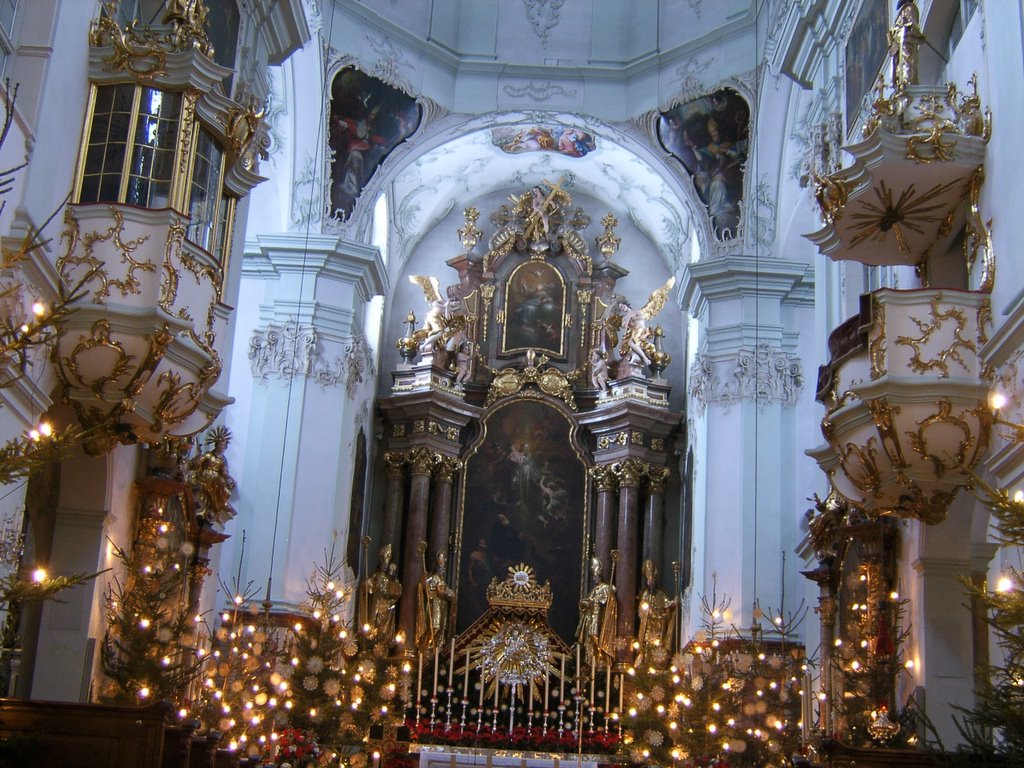
Salzburg is filled with churches, most of which were designed and decorated in high Baroque style. St. Peters' church is one of the most beautiful. This picture was taken early in the morning before many people had begun their tourism treks. It was wonderful to see it with all the Christmas lights and candles. The opulence of the place was overwhelming, as many churches/cathedrals throughout Europe are.

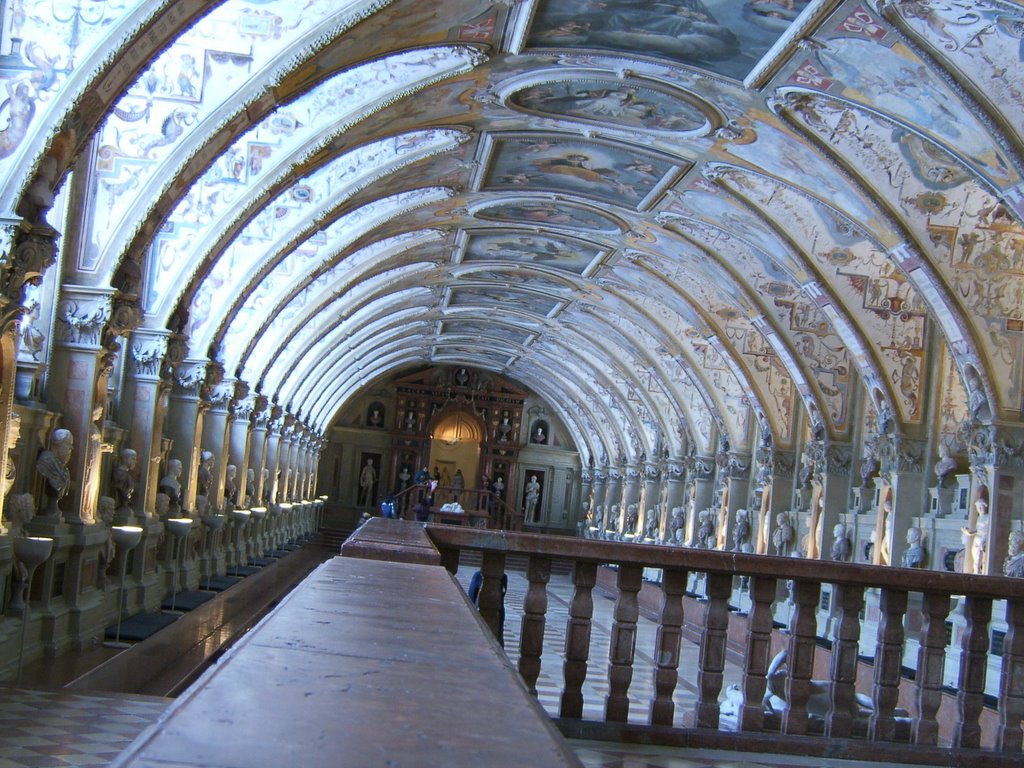
Munich, Germany, was our last stop on our way back to Frankfurt and home. Munich was a wonderful surprise. It was snowing but people were everywhere - shopping, ice skating, and enjoying the last days of the Christmas Market. Munich will be one of the cities to which I will return to learn more. It was the home of much of the Bavarian royal family and the Residenz is proof of it. The sculpture hall that is pictured first served in the early days of the Residenz as an entry hall, lined with the sculptures that had been collected by the royal family. Later, the sculpture hall was used for banquets and other events as other areas of the Residenz became more opulent.

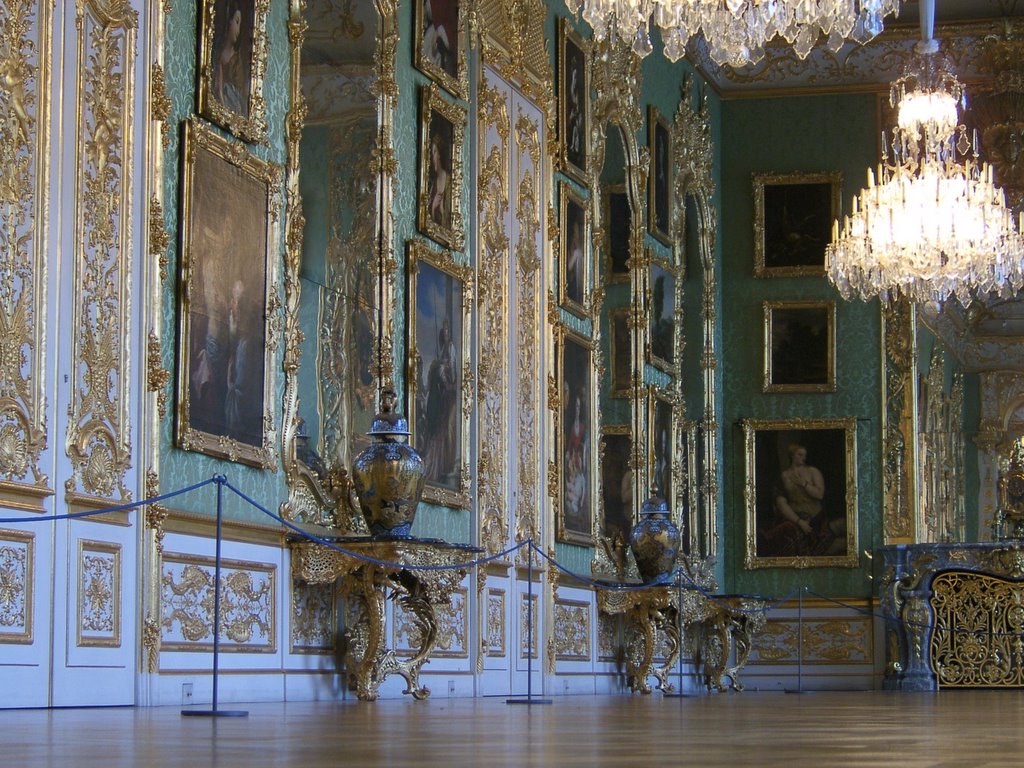
The newer part of the Residenz became even more ornate, as is evidenced by this picture of the private areas of the palace where only special guests of the royal family were entertained. Overall, the Residenz is overwhelming in size - not quite as large as the Louvre (Paris) or the Hoffburg Palace (Vienna) but nevertheless an incredible statement of wealth and privilege. Most of the Residenz was actually rebuilt after having been destroyed at the end of WWII. Many public buildings in Germany were destroyed when allied forces invaded in the later part of the war. This was partially a necessary military step to dismantle the Nazi war machine but it also symbolized the destruction of German culture which had been such a source of pride among its people for so many years.
You've probably seen and read enough about my European travels so this will be the last of the entries about this. If you want to see more, ask to see my picture album. The European discovery has transformed my thinking about the U.S.A. and about our role in the global community. Europeans are critical advocates and partners in advancing democracy worldwide and it is important that, as citizens, we do all we can to listen to them and to invite them into partnership in making our world a better place. It will happen however slowly or quickly we can bring it about.
The first picture is of the front of the Salzburg, Austria, building that was the birthplace of Mozart. Interestingly enough, this year marks Mozart's 250th birthday. Wolfgang was the son of Leopold who realized when Wolfgang was only 6 years old that he was a musical genius. This spurred concert tours that took Wolfgang and his sister throughout Europe in a day and age when travel was not easy. Imagine a 6 year old traveling to the palaces and concert halls of Europe to perform for royalty and others. He composed his first opera at age 12 and went on to be one of the most productive composers of all time, even though he died at the age of 35. The thing that was amazing about going to Mozart's birthplace was that there was a map at the end of the historical exhibit indicating where Mozart traveled during his concert tours. To my great surprise, over the two months I was in Europe, I traveled almost all the paths Mozart traveled with the exception of Naples, Italy, and London. It gave me great satisfaction to know that I had been to most of these great European cities that welcomed Mozart.

The Salzburg, Austria, Fortress rises above the landscape on a high hill in the middle of an incredible range of mountains surrounding the city. This Fortress was never taken by hostile forces during all the European battles for land and domination until the Fortress opened its doors willingly to Napolean. I don't know the reason for not fighting Napolean unless it was an inevitable belief that Austria would lose. The Fortress is a landmark but it also represents a period of European history when all possessions had to be protected from invading forces of nobility or dictators. The EU has now bonded together to assure that these hostilities will never again plague Europe.

Salzburg is filled with churches, most of which were designed and decorated in high Baroque style. St. Peters' church is one of the most beautiful. This picture was taken early in the morning before many people had begun their tourism treks. It was wonderful to see it with all the Christmas lights and candles. The opulence of the place was overwhelming, as many churches/cathedrals throughout Europe are.
Munich, Germany, was our last stop on our way back to Frankfurt and home. Munich was a wonderful surprise. It was snowing but people were everywhere - shopping, ice skating, and enjoying the last days of the Christmas Market. Munich will be one of the cities to which I will return to learn more. It was the home of much of the Bavarian royal family and the Residenz is proof of it. The sculpture hall that is pictured first served in the early days of the Residenz as an entry hall, lined with the sculptures that had been collected by the royal family. Later, the sculpture hall was used for banquets and other events as other areas of the Residenz became more opulent.
The newer part of the Residenz became even more ornate, as is evidenced by this picture of the private areas of the palace where only special guests of the royal family were entertained. Overall, the Residenz is overwhelming in size - not quite as large as the Louvre (Paris) or the Hoffburg Palace (Vienna) but nevertheless an incredible statement of wealth and privilege. Most of the Residenz was actually rebuilt after having been destroyed at the end of WWII. Many public buildings in Germany were destroyed when allied forces invaded in the later part of the war. This was partially a necessary military step to dismantle the Nazi war machine but it also symbolized the destruction of German culture which had been such a source of pride among its people for so many years.
You've probably seen and read enough about my European travels so this will be the last of the entries about this. If you want to see more, ask to see my picture album. The European discovery has transformed my thinking about the U.S.A. and about our role in the global community. Europeans are critical advocates and partners in advancing democracy worldwide and it is important that, as citizens, we do all we can to listen to them and to invite them into partnership in making our world a better place. It will happen however slowly or quickly we can bring it about.
Monday, January 16, 2006
Implications of my European work, study, and travel
I will continue to reflect on what I am learning about leadership on this blog. Understanding leadership is a life-long journey for me and I know that I'll never be able to say that I fully understand it. The following points are offered in that context.
First of all, my European journey taught me that the USA is not the center of the globe. Secondly, as the USA continues to be challenged in its role in the international community, retreating into isolation and vilification of others is destructive. The third point is related to the second - securing a positive future for the USA is dependent on fostering creativity and innovation as the world shrinks and flattens.
In relation to learning, I also now realize that true global understanding results from experiencing, rather than observing or reading. I am also reassured to know that leadership is being reconceptualized in all kinds of work and communities. I am encouraged by the fact that higher education in the USA has a strategic advantage in holism and focus, if we utilize it. And on a very practical basis, it is exciting to confirm that enhancing student learning serves as a very natural intersection in the work between faculty and student affairs staff.
First of all, my European journey taught me that the USA is not the center of the globe. Secondly, as the USA continues to be challenged in its role in the international community, retreating into isolation and vilification of others is destructive. The third point is related to the second - securing a positive future for the USA is dependent on fostering creativity and innovation as the world shrinks and flattens.
In relation to learning, I also now realize that true global understanding results from experiencing, rather than observing or reading. I am also reassured to know that leadership is being reconceptualized in all kinds of work and communities. I am encouraged by the fact that higher education in the USA has a strategic advantage in holism and focus, if we utilize it. And on a very practical basis, it is exciting to confirm that enhancing student learning serves as a very natural intersection in the work between faculty and student affairs staff.
Unique attributes of "Americans"
One of the fascinating things about Europeans is that they are very aware of what's unique about "Americans." (To some degree I would include our Canadian and Mexican North American neighbors but in other ways I would not.) They recognize what is different about us and, while not necessarily wanting to emulate us, respect and even admire us for these differences. The things that they recognize as most distinct are 1) that we are much more comfortable in taking risks and 2) that we pride ourselves in and foster self-sufficiency among our people.
As I reflect on these two qualities, I realize that they are most evident among the privileged in our country - taking risks and being self-sufficient. These are great qualities, if you have the resources to protect you when you take risks and if self-sufficiency has a golden parachute. Europeans admire the fact that US businesses develop and move products into the marketplace faster than any other country in the world. Some even express envy that much of intellectual innovation originates from US citizens. This is why many intellectuals, artists, scientists and others have immigrated to the US over the decades. By contrast to raw self-sufficiency, Europeans pride themselves in establishing a base quality of life for all citizens. This isn't perfect and there is persistent uneveness in wealth in Europe, yet, at least all citizens can avail themselves of medical help when they need it. Additionally, anyone who is seeking work has public support in acquiring living needs.
One other realization that emerged for me is that the USA tends to accentuate difference rather than embrace it. Diversity was evident everywhere I went in Europe. Not until I returned to the USA did I hear about diversity, although it was much less visible. On this important day in US history, the day that commemorates the birth of Martin Luther King, it seems as if this observation may have relevance and importance.
The last observation I would offer is that US media invades every corner of Europe, regardless of language. Storefronts carry product endorsements from Hollywood celebrities. News media almost always carry speculation or information about sports and entertainment elites. Even the unique and beautiful environment of the German and Austrian Christmas Markets is affected as the only language heard in the musical lyrics of every market from Koln to Vienna is Engligh.
Observation of these unique attributes is not scientific. They are simply accumulated from conversations and observations throughout my travels. I don't completely understand their impact if, in fact, the observations are accurate. I only know that seeking to observe has caused me to see myself and "Americans" in a differently light than before.
As I reflect on these two qualities, I realize that they are most evident among the privileged in our country - taking risks and being self-sufficient. These are great qualities, if you have the resources to protect you when you take risks and if self-sufficiency has a golden parachute. Europeans admire the fact that US businesses develop and move products into the marketplace faster than any other country in the world. Some even express envy that much of intellectual innovation originates from US citizens. This is why many intellectuals, artists, scientists and others have immigrated to the US over the decades. By contrast to raw self-sufficiency, Europeans pride themselves in establishing a base quality of life for all citizens. This isn't perfect and there is persistent uneveness in wealth in Europe, yet, at least all citizens can avail themselves of medical help when they need it. Additionally, anyone who is seeking work has public support in acquiring living needs.
One other realization that emerged for me is that the USA tends to accentuate difference rather than embrace it. Diversity was evident everywhere I went in Europe. Not until I returned to the USA did I hear about diversity, although it was much less visible. On this important day in US history, the day that commemorates the birth of Martin Luther King, it seems as if this observation may have relevance and importance.
The last observation I would offer is that US media invades every corner of Europe, regardless of language. Storefronts carry product endorsements from Hollywood celebrities. News media almost always carry speculation or information about sports and entertainment elites. Even the unique and beautiful environment of the German and Austrian Christmas Markets is affected as the only language heard in the musical lyrics of every market from Koln to Vienna is Engligh.
Observation of these unique attributes is not scientific. They are simply accumulated from conversations and observations throughout my travels. I don't completely understand their impact if, in fact, the observations are accurate. I only know that seeking to observe has caused me to see myself and "Americans" in a differently light than before.
Wednesday, January 11, 2006
Commonalities between Europe and the USA
One of the things I pondered was what is common between Europe and the USA, particularly related to our thoughts about leadership. The commonalities (and I know that these are sweeping generalizations that surely do not apply to all) that I see us sharing are that there is both curiosity and ambivalence about leadership, that there are very good, welcoming, and courageous people everywhere, and that positive change happens when leaders act on their convictions. No where were these realizations more evident than in my travels in Germany, a country mired in questions about leadership gone wrong and right. I respect the German people's courage in recognizing how wrong and horrifying Hitler really was. Hitler was a traitor to the German people and to all of humanity. He was a traitor because he sought to advance himself, no matter the cost to others. Germany learned (and is probably learning) from this experience and my hope is that all of us might learn and become more critical observers of leadership as a result.
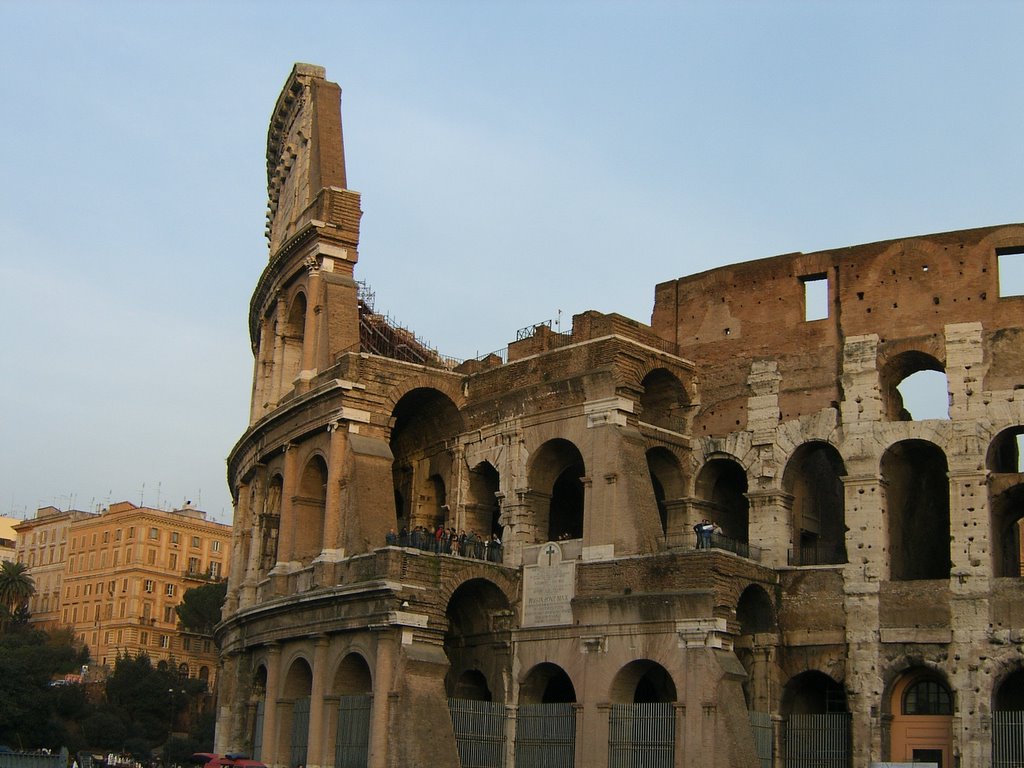
As my travels continued throughout Europe, I found other amazing examples of leadership in history. Of course, the Roman empire stands as one of the great historical attempts at democratizing our world. In many ways it worked (the Pantheon above) but in others it did not (the Coliseum below).

The Doges of Venice had three governing bodies and attempted to create governance that involved and served Venetians. Did they get it all right? No. But, the fact that they were trying as early as 5th century AD is very interesting.
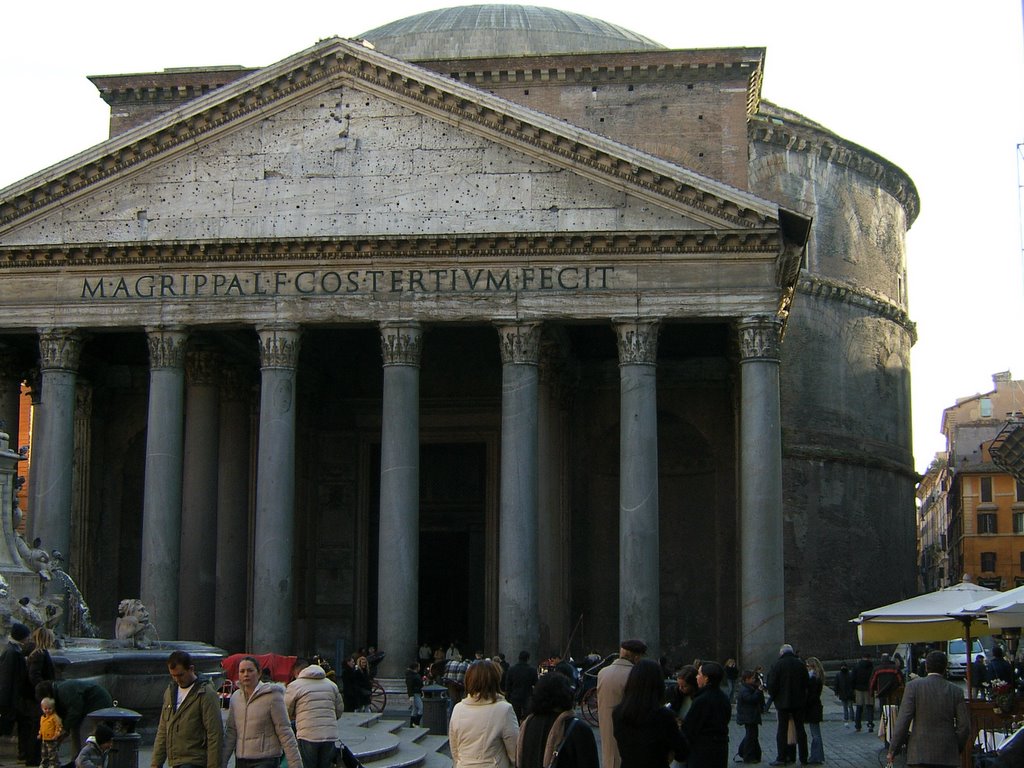
As my travels continued throughout Europe, I found other amazing examples of leadership in history. Of course, the Roman empire stands as one of the great historical attempts at democratizing our world. In many ways it worked (the Pantheon above) but in others it did not (the Coliseum below).
The Doges of Venice had three governing bodies and attempted to create governance that involved and served Venetians. Did they get it all right? No. But, the fact that they were trying as early as 5th century AD is very interesting.

Summary and realizations from Europe
I've been working over the last couple of days to summarize the implications of my teaching, research, and learning in Europe. I developed a PowerPoint that gets to the core of what this meant to me. Since blogger doesn't accommodate PowerPoint, I'll summarize the points in a couple of successive blog entries.
The first points I realized about my experience are: that I had become very accustomed to my surroundings in the USA, that I did not deal well with separation and lack of understanding in my new environment, and that the European experience had allowed me to see a fresh perspective on many things, primarily the result of becoming more acutely aware of my experiences. In my comfort as a citizen of the USA, I had been complacent and comfortable and had no particular motivation to attempt to question my beliefs and assumptions.
The next step was beginning to examine what I perceived of Europe and the USA. In analyzing this, I realized that the globe truly is shrinking and flattening (Friedman), that the EU is a very powerful emerging force in the global community (Rifkin), that EU nations share the USA’s belief in democratic ideal, and that the EU is creating a strong European bond after many centuries of conflict. The impressions related to the USA are that the role of the USA in WWII is deeply appreciated and remembered by Europeans, that the USA engages when it is in its own self-interest, and that the USA is perceived to be inconsistent in its espoused and enacted values (i.e. separation of church & state, protecting personal freedoms).
The first points I realized about my experience are: that I had become very accustomed to my surroundings in the USA, that I did not deal well with separation and lack of understanding in my new environment, and that the European experience had allowed me to see a fresh perspective on many things, primarily the result of becoming more acutely aware of my experiences. In my comfort as a citizen of the USA, I had been complacent and comfortable and had no particular motivation to attempt to question my beliefs and assumptions.
The next step was beginning to examine what I perceived of Europe and the USA. In analyzing this, I realized that the globe truly is shrinking and flattening (Friedman), that the EU is a very powerful emerging force in the global community (Rifkin), that EU nations share the USA’s belief in democratic ideal, and that the EU is creating a strong European bond after many centuries of conflict. The impressions related to the USA are that the role of the USA in WWII is deeply appreciated and remembered by Europeans, that the USA engages when it is in its own self-interest, and that the USA is perceived to be inconsistent in its espoused and enacted values (i.e. separation of church & state, protecting personal freedoms).
Sunday, January 08, 2006
Continuing the pursuit
I'm back from the holidays in Europe and a quick trip of Scholar Leaders to Toronto. I have a lot of catching up to do as the semester begins but I'm committed to maintaining my blog over the coming months. I found the experience of the European blog so helpful as a journaling strategy that I've decided I want to give it a try on a continuing basis.
Over the next week I'll post pictures and thoughts about the trip I took with Diane (wife) and Darbi (youngest daughter) after the conclusion of my teaching in Luxembourg. We had a fast and furious 15 days and covered Germany, Belgium, France, Italy, Switzerland, Austria, and back home. We were admittedly only hitting the high points but we had a wonderful time.
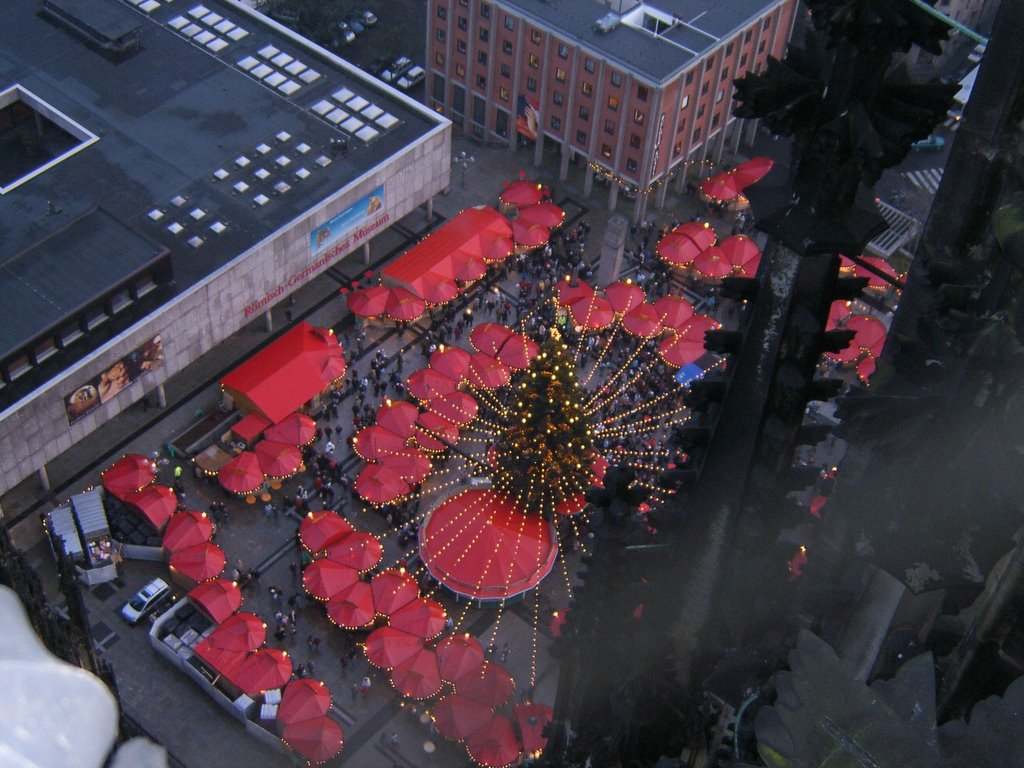
Diane and Darbi landed December 15 and we immediately jumped on a train to spend our first night in Koln, enjoying the Christmas Market that surrounded the cathedral. The picture below is taken down from one of the towers looking down on the market.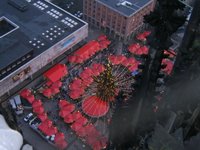
Over the next week I'll post pictures and thoughts about the trip I took with Diane (wife) and Darbi (youngest daughter) after the conclusion of my teaching in Luxembourg. We had a fast and furious 15 days and covered Germany, Belgium, France, Italy, Switzerland, Austria, and back home. We were admittedly only hitting the high points but we had a wonderful time.
Diane and Darbi landed December 15 and we immediately jumped on a train to spend our first night in Koln, enjoying the Christmas Market that surrounded the cathedral. The picture below is taken down from one of the towers looking down on the market.
Tuesday, December 13, 2005
Temporary postponement of "Pursuing Leadership"
This is my last post for a couple of weeks. I go to Frankfurt tomorrow afternoon to prepare for Diane and Darbi's arrival on the morning of December 15. The three of us then head out for a whirlwind tour of a number of European cities. Come back in January to see pictures and commentary on this part of my "Pursuing Leadership" journey.
My last day in Differdange presented three simple but very important experiences that I will remember fondly. The first was at the conclusion of my afternoon walk - something I usually do before it gets dark each day. I stopped by the Match grocery store, browsing as I've increasingly become comfortable in doing, trying to understand the labels and products. I picked out my merchandise and went to the check out. I was greeted in French and responded in French - "Bon jour." The cashier tallied my items, we exchanged cash, he thanked me and I responded, "Merci." My fantasy is that he never knew I have only the base survival vocabulary in French. This may not seem huge to you but it was a triumph to me. The second experience was at the end of my walk, returning to the Chateau. Have you seen that commercial where a spontaneous soccer game erupts in an Asian market place? Well, this wonderful kid in the school yard was kicking his soccer ball around and when I passed by, he kicked it to me. I laughed out loud and so did he. It was such a warm moment of connection and appreciation of sport and life - without one word spoken. Finally, we had an end-of-the-semester faculty chilli dinner tonight. We all gathered around the table, told stories, and celebrated a great semester. This is the way learning is supposed to be - faculty and students sharing in the common journey and enjoying every minute of it.
These thoughts may not seem that profound but one of the most profound realizations of my European pursuit of leadership is renewing a commitment to the simple things of leadership - relationships, transparency, and conviction. These really are the simple and complex things that challenge us each day. I've found a lot more than a little truth in this pursuit over the past weeks. Come back for more in January. Who know where I'll go.
My last day in Differdange presented three simple but very important experiences that I will remember fondly. The first was at the conclusion of my afternoon walk - something I usually do before it gets dark each day. I stopped by the Match grocery store, browsing as I've increasingly become comfortable in doing, trying to understand the labels and products. I picked out my merchandise and went to the check out. I was greeted in French and responded in French - "Bon jour." The cashier tallied my items, we exchanged cash, he thanked me and I responded, "Merci." My fantasy is that he never knew I have only the base survival vocabulary in French. This may not seem huge to you but it was a triumph to me. The second experience was at the end of my walk, returning to the Chateau. Have you seen that commercial where a spontaneous soccer game erupts in an Asian market place? Well, this wonderful kid in the school yard was kicking his soccer ball around and when I passed by, he kicked it to me. I laughed out loud and so did he. It was such a warm moment of connection and appreciation of sport and life - without one word spoken. Finally, we had an end-of-the-semester faculty chilli dinner tonight. We all gathered around the table, told stories, and celebrated a great semester. This is the way learning is supposed to be - faculty and students sharing in the common journey and enjoying every minute of it.
These thoughts may not seem that profound but one of the most profound realizations of my European pursuit of leadership is renewing a commitment to the simple things of leadership - relationships, transparency, and conviction. These really are the simple and complex things that challenge us each day. I've found a lot more than a little truth in this pursuit over the past weeks. Come back for more in January. Who know where I'll go.
Sunday, December 11, 2005
Saint Nicholas and Christmas in Europe

The picture to the right is the European predecessor of Santa Claus - Saint Nicholas. The tradition goes that Saint Nicholas, a Bishop, wanted to brighten the Christmas experience of children who didn't have much so collected presents that he then delivered to them during the holidays. The tradition caught on and after his death, December 6 was designated Saint Nicholas day. This is the day when many Europeans exchange presents, especially with children. In honor of Saint Nicholas' birthday, we celebrated it at the Chateau with a nice dinner and every one of us received chocolate Saint Nicholas likenesses. It was our last official gathering as the fall '05 MUDEC crew - lots of pictures and lost of ambivalent faces over what is quickly passing into only a memory.
I spent the weekend furiously writing away. Part of my commitment as a Visiting Scholar was to work on Deeper Learning in Leadership, a book under contract with Jossey-Bass. The full text has to be in their hands by May 1, 2006. To my great satisfaction, as of tomorrow I will have five of nine chapters finished with over 150 pages of text. It's amazing what you can get done when there are few night and weekend meetings and when my loved ones are 3,000 miles away. I haven't seen a movie since I left the states and I watch little TV except CNN's British coverage. All of this results in a highly productive reading, thinking, and writing environment and I've fully taken advantage of it.
I will sign off of my blog for a while after Diane and Darbi get here. I doubt that I'll have time or the desire to post pictures and commentary to the blog while we're visiting Koln, Bruges, Paris, Geneve, Florence, Rome, Venice, and Salzburg - whew! Come back for a full step by step retrospective once we get back to Oxford on December 30.
In the meantime, I wish you only the best during the holiday. I hope that you have lots of laughs and loving moments to bring you into the New Year.
Thursday, December 08, 2005
German, French and Luxembourg education
I've had the wonderful opportunity to visit four universities while in Europe - one in Trier, Germany, two in Nancy and Metz, France, and the fourth in Luxembourg City. These have stimulated profound reflection on the nature of student affairs work, how we are prepared for it, and the different organization models that can be used to advance it. In the cases of Trier and Nancy/Metz, student affairs is essentially an out-sourced service to address students' logistical needs. In the Luxembourg case, the model is still being developed.
There are very clear dividing lines between academic and non-academic affairs in all of these cases. However, there were fascinating (in my judgment) and unexamined exceptions in crossing these boundaries. Particularly in the case of Nancy, a wonderful cultural programs office is doing some of the most interesting work and I provide more detail on that below. Europeans are curious and a bit surprised that people actually study to prepare for student service/affairs roles. Those in these capacities in Europe have a variety of academic backgrounds and they report being drawn to the work as a personal commitment. They are very dedicated and interested in "serving" students and, for the most part, don't even recognize the powerful impact that they have, or could potentially have, on students' learning. As you might expect, I quoted a few research studies on the impact of out of class experience on student learning and they were curious, although not persuaded. Organizational boundaries, professional preparation, and mental models were all issues that I found inhibit the involvement of all these good people in the work that they hold so dear. These are not unusual inhibitors, even in the U.S. environments where we hope we've made some progress - or have we?
I'm providing more detail notes on the Nancy/Metz visit for those who might have interest.
The functions of student services in Nancy/Metz are application/admission services, on-campus residences for ~10% of the student population, off-campus housing referral as requested, dining, student employment coordination, cultural activities, financial aid analysis and grants, and service to international students (in the Nancy example this includes ~10% of the student population).
Some interesting policies and practices:
• On November 22, 2005, a rather historic agreement concluded that “personal development” is the primary goal of all the student service programs. This agreement was secured through conferences between administrators and the academic staff of the respective campuses.
• While the commitment to “personal development” was agreed among faculty and staff, students will be involved in the consideration of how this will be addressed.
• Technology issues are just emerging in residences. They want to convert to swipe-card access systems and they are attempting to increase the number of computer labs in residences. There is no wireless access as yet.
• Cultural activities include theater, music, dance, and literature but apparently little of the kinds of social activities characteristic of clubs/organizations on U.S. campuses. A particularly effective way to get students involved in these includes competitions for creative works; these come with monetary prizes.
o The cultural mission caused considerable resistance among faculty at first because faculty believed that they were the providers of both academic and cultural learning.
o The cultural activities in which students express the greatest interest are music of all kinds and the “Cultural Action Fund.” This fund is a source of support for students to create their own initiatives (100-1,500 Euro/project).
o Because of the reported “service” commitment and the very clear boundary between in and out of class life, there are no mechanisms to stimulate or assist students in the discovery of learning acquired from out of class experiences. (My observation is that this is happening informally due to the commitment and interest of staff.)
• There is a growing problem among French families being unwilling to assist students with the cost of a university education.
• There are no staff in the residence halls, other than to see to maintenance concerns. My observation is that this is likely the result of the organization model focused on service instead of educational purposes.
Throughout the day, I grew to have greater appreciation for the quality and depth of service being provided by the staff of Nancy/Metz. Although there were repeated statements about the service focus and the clear divisions between in and out of class life, there are very interesting educational/developmental things going on just below the surface. A couple of cultural program examples that are just below the surface and could be explored as deeper learning possibilities are:
o A program called Artem is a community development initiative in partnership with the city of Nancy. While we didn’t get into a lot of detail, this sounds like a community service or service learning initiative. The outcome of this initiative and its potential as a catalyst for learning could be fascinating.
o Because students prefer single rooms and because there appear to be benign divisions between those on campus and those who can pay for private residences off campus, it would be interesting to explore concepts of community – What is is? How it can be enhanced? These campuses seem content in students being very independent, yet, those students we met expressed a desire to connect with their peers. Is community a uniquely U.S. kind of issue or does it have relevance at Nancy/Metz and elsewhere as well?
o The cultural programs office at Nancy has a series of competitions for students in creative endeavor (film, theater, photography, literature). They are now focusing these competitions around themes (almost like Miami has our First-Year Reading focus) and the 2006 focus is “Prison.” Students are allowed to define the theme very broadly so they could address prison as incarceration or they could address prison as the mental frames which constrict our learning and development. I found this idea absolutely fascinating and wondered about its applicability to Miami in a variety of areas.
o The movement into “cultural programs” was resisted, much in the same way that faculty in the U.S. resist the notion that student affairs should have anything to do with the learning mission of the institution. The need to, and provision of services or managerial control, bring certain expectations and may place student affairs staff in boxes that are hard to escape. How can we counter the mental models and confinement of our own experiences?
o The French model is much like the growing trend on some U.S. campuses of out-sourcing. What do we need to learn from the French about the merits or difficulties of such a model? If out-sourcing becomes inevitable, how would a commitment to student development and the enhancement of learning be maintained?
There are very clear dividing lines between academic and non-academic affairs in all of these cases. However, there were fascinating (in my judgment) and unexamined exceptions in crossing these boundaries. Particularly in the case of Nancy, a wonderful cultural programs office is doing some of the most interesting work and I provide more detail on that below. Europeans are curious and a bit surprised that people actually study to prepare for student service/affairs roles. Those in these capacities in Europe have a variety of academic backgrounds and they report being drawn to the work as a personal commitment. They are very dedicated and interested in "serving" students and, for the most part, don't even recognize the powerful impact that they have, or could potentially have, on students' learning. As you might expect, I quoted a few research studies on the impact of out of class experience on student learning and they were curious, although not persuaded. Organizational boundaries, professional preparation, and mental models were all issues that I found inhibit the involvement of all these good people in the work that they hold so dear. These are not unusual inhibitors, even in the U.S. environments where we hope we've made some progress - or have we?
I'm providing more detail notes on the Nancy/Metz visit for those who might have interest.
The functions of student services in Nancy/Metz are application/admission services, on-campus residences for ~10% of the student population, off-campus housing referral as requested, dining, student employment coordination, cultural activities, financial aid analysis and grants, and service to international students (in the Nancy example this includes ~10% of the student population).
Some interesting policies and practices:
• On November 22, 2005, a rather historic agreement concluded that “personal development” is the primary goal of all the student service programs. This agreement was secured through conferences between administrators and the academic staff of the respective campuses.
• While the commitment to “personal development” was agreed among faculty and staff, students will be involved in the consideration of how this will be addressed.
• Technology issues are just emerging in residences. They want to convert to swipe-card access systems and they are attempting to increase the number of computer labs in residences. There is no wireless access as yet.
• Cultural activities include theater, music, dance, and literature but apparently little of the kinds of social activities characteristic of clubs/organizations on U.S. campuses. A particularly effective way to get students involved in these includes competitions for creative works; these come with monetary prizes.
o The cultural mission caused considerable resistance among faculty at first because faculty believed that they were the providers of both academic and cultural learning.
o The cultural activities in which students express the greatest interest are music of all kinds and the “Cultural Action Fund.” This fund is a source of support for students to create their own initiatives (100-1,500 Euro/project).
o Because of the reported “service” commitment and the very clear boundary between in and out of class life, there are no mechanisms to stimulate or assist students in the discovery of learning acquired from out of class experiences. (My observation is that this is happening informally due to the commitment and interest of staff.)
• There is a growing problem among French families being unwilling to assist students with the cost of a university education.
• There are no staff in the residence halls, other than to see to maintenance concerns. My observation is that this is likely the result of the organization model focused on service instead of educational purposes.
Throughout the day, I grew to have greater appreciation for the quality and depth of service being provided by the staff of Nancy/Metz. Although there were repeated statements about the service focus and the clear divisions between in and out of class life, there are very interesting educational/developmental things going on just below the surface. A couple of cultural program examples that are just below the surface and could be explored as deeper learning possibilities are:
o A program called Artem is a community development initiative in partnership with the city of Nancy. While we didn’t get into a lot of detail, this sounds like a community service or service learning initiative. The outcome of this initiative and its potential as a catalyst for learning could be fascinating.
o Because students prefer single rooms and because there appear to be benign divisions between those on campus and those who can pay for private residences off campus, it would be interesting to explore concepts of community – What is is? How it can be enhanced? These campuses seem content in students being very independent, yet, those students we met expressed a desire to connect with their peers. Is community a uniquely U.S. kind of issue or does it have relevance at Nancy/Metz and elsewhere as well?
o The cultural programs office at Nancy has a series of competitions for students in creative endeavor (film, theater, photography, literature). They are now focusing these competitions around themes (almost like Miami has our First-Year Reading focus) and the 2006 focus is “Prison.” Students are allowed to define the theme very broadly so they could address prison as incarceration or they could address prison as the mental frames which constrict our learning and development. I found this idea absolutely fascinating and wondered about its applicability to Miami in a variety of areas.
o The movement into “cultural programs” was resisted, much in the same way that faculty in the U.S. resist the notion that student affairs should have anything to do with the learning mission of the institution. The need to, and provision of services or managerial control, bring certain expectations and may place student affairs staff in boxes that are hard to escape. How can we counter the mental models and confinement of our own experiences?
o The French model is much like the growing trend on some U.S. campuses of out-sourcing. What do we need to learn from the French about the merits or difficulties of such a model? If out-sourcing becomes inevitable, how would a commitment to student development and the enhancement of learning be maintained?
Monday, December 05, 2005
Habsburg legacy of leadership and service
If you read the previous posts about Vienna, you know that I'm a huge fan and believe Vienna is one of the greatest cities in Europe. However, experiences like this tend to linger in my mind for a while until other implications surface. Over the last 24 hours I've begun to reflect on the legacy of leadership and service left by 600 years of monarchy, one of the longest periods of dynasty in 2000 post-A.D. years. Before you read further, I want to note that I do not stand in judgment. We are all products of our own time and context. The thing that strikes me and calls me to offer a "note to self" at the beginning of this entry is the realization that we have a legacy, whether intended or not. And the note to self is to be sure that what I stand for is unequivocal and consistent so that, should anyone care, there is little room to question my intent.
The Habsburg family left an incredible city and other cities and palaces throughout Europe. In fact, one of the sets of porcelain on exhibit at the Hofburg was a special set with pictures of all the palaces and castles in the family name at the time the dishes were made. The art, architecture, music, and culture supported by the Habsberg family was monumental. Much of the art so highly valued today would never have been completed had it not been for the sponsorship of the family. Christianity has a great deal it owes to the Habsburgs. During the reign of the family, the Turkish empire extended into Eastern Europe and twice encroached upon Austria, only to be repelled in subsequent battles. The adventure of the protection of Christianity in fact was dramatized by ladies at court who road in their fine carriages in the Spanish riding school, pretending to fight battles with the "Turks" in the arena. Incidentally, the pattern of their drama and the carriages in which they road became known as the carousel, from which the notion of the modern carousels in amusement parks is derived. The Habsbergs were a benevolent monarchy for the most part. They even melted down their house gold and silver when the financial burden of wars required liquidation of ready assets to fund the cost. However, at what cost, to whom, and for what purpose? This is where my reflections turn...
The Habsburgs did incredible things to create a cultured and advancing Europe. But their privilege was always the first and foremost being protected. War - whose war? Was it war for the people or war to protect the ruling prerogative of the Habsburg family? So what that they melted down the family jewels and serving pieces; they still were able to replace them with expensive porcelain to maintain a style of life they believed they were justified in living. In another example, the Habsburg family selected 12 (reflecting the apostles) random subjects for a foot washing ceremony each year. Subjects could apply from any walk of life and any place in the empire. Once selected, the subjects were brought to the palace, scrubbed and cleaned and outfitted with new clothing to come to court where the Emperor and Empress washed their feet in fine porcelain basins with water poured from huge golden urns. A very noble and symbolic act but, rest assured, the feet were clean before the Habsburg family would have anything to do with touch.
These are interesting symbols or a legacy. The tour guides and the information at the palace were very forthright in portraying these things. It's just the script between the lines that causes me to pause and reflect on questions of leadership and service. I am sure that the piety of the Habsburg family was great and that they believed they were serving others by waging war and washing feet. But...
The Habsburg family left an incredible city and other cities and palaces throughout Europe. In fact, one of the sets of porcelain on exhibit at the Hofburg was a special set with pictures of all the palaces and castles in the family name at the time the dishes were made. The art, architecture, music, and culture supported by the Habsberg family was monumental. Much of the art so highly valued today would never have been completed had it not been for the sponsorship of the family. Christianity has a great deal it owes to the Habsburgs. During the reign of the family, the Turkish empire extended into Eastern Europe and twice encroached upon Austria, only to be repelled in subsequent battles. The adventure of the protection of Christianity in fact was dramatized by ladies at court who road in their fine carriages in the Spanish riding school, pretending to fight battles with the "Turks" in the arena. Incidentally, the pattern of their drama and the carriages in which they road became known as the carousel, from which the notion of the modern carousels in amusement parks is derived. The Habsbergs were a benevolent monarchy for the most part. They even melted down their house gold and silver when the financial burden of wars required liquidation of ready assets to fund the cost. However, at what cost, to whom, and for what purpose? This is where my reflections turn...
The Habsburgs did incredible things to create a cultured and advancing Europe. But their privilege was always the first and foremost being protected. War - whose war? Was it war for the people or war to protect the ruling prerogative of the Habsburg family? So what that they melted down the family jewels and serving pieces; they still were able to replace them with expensive porcelain to maintain a style of life they believed they were justified in living. In another example, the Habsburg family selected 12 (reflecting the apostles) random subjects for a foot washing ceremony each year. Subjects could apply from any walk of life and any place in the empire. Once selected, the subjects were brought to the palace, scrubbed and cleaned and outfitted with new clothing to come to court where the Emperor and Empress washed their feet in fine porcelain basins with water poured from huge golden urns. A very noble and symbolic act but, rest assured, the feet were clean before the Habsburg family would have anything to do with touch.
These are interesting symbols or a legacy. The tour guides and the information at the palace were very forthright in portraying these things. It's just the script between the lines that causes me to pause and reflect on questions of leadership and service. I am sure that the piety of the Habsburg family was great and that they believed they were serving others by waging war and washing feet. But...
Sunday, December 04, 2005
Finding the music - zwei bild
I could go on and on about the things I saw and did for just 36 hours. I have plenty of video shots for anyone who might be interested. I would not do justice to my trip if I didn't cap it off with the Haus der Musik, a museum dedicated to the wonderful history of Vienna and music. I deliberately saved this to last, because I wanted it to pull it all together for me.
I had noticed throughout my journey around the city that there are monuments to Mozart, Strauss, and Beethoven all over the place. But, not one sign of Gustav Mahler, my personal and enthusiastic favorite. I figured that the Haus der Musik had to include him. To my great satisfaction, I purchased my ticket, almost ran up the flight of stairs only to find the bust of Mahler as the first thing to greet me.
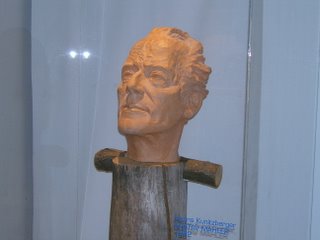
I was just about to take this picture when a young attendant walked up and saw my camera, "Excuse me, sir, you can't take pictures in the museum." I looked at her with woeful eyes and said, "Just one - I promise." She winked, "As long as I don't see it," as she passed into another room.
Without camera, I proceeded through the museum, which tells the story of the Vienna Philharmonic, its commitment to relatively democratic ideals in performance, and to the incredible list of conductors of the orchestra for the last two hundred years. I enjoyed the exhibit about the orchestra but was very anxious to get through this section, through the section on how sound is created and forms music, and various experimental and contemporary forms of music. I was ready for the 4th floor - the section on great composers. I patiently plodded through the composers most people worship, waiting at each turn to find Mahler. When I got there it was like entering a sanctuary. There was another person in the room who was equally taken but the pictures, artifacts, and the beautiful music playing in the background - some of Mahler's most profoundly beautiful pieces, including the adagietto from Symphony No. 5, his love prayer to his wife, Alma.
Mahler was born in 1860 of a Jewish peasant family. His parents were difficult and had health problems. He was not a good student, struggling with traditional studies. Nevertheless, he taught himself what he needed to know and found early on that he had a great gift for music. His father was urged to take Gustav to Vienna, which he did. From that time on, Mahler's life of composing and conducting unfolded in both meteoric and tempestual ways. His creative genius was such that he had difficulty in relationships, struggling to find the love of his life until he found Alma. He rose to be the conductor of the Vienna Opera House orchestra when he directed the Beethoven No. 9 by memory, effectively putting his predecessor out on the street in one night. Periods of isolation and brooding, coupled with the loss of his eldest daughter and eventual unfaithfulness of Alma, pushed him deeper into depression and finally therapy with none other than the man himself, Sigmund Freud. Ultimately, Mahler left Vienna, posting his resignation on the Opera House door and walking out. His last performance in Vienna was his Symphony No. 2, "The Resurrection." He served as the director of the New York Philharmonic, only to return to Vienna within a short time. He died in 1911 of heart complications. The details of Mahler's life reinforced some of what I had known, but telling more about the very difficult life story of an artistic genius who never really found a home.
As I was about to end my time at the Haus der Musik, I saw the same attendant who winked at my picture taking earlier in the evening. I asked her why there was so little about Mahler around the city, other than what I found in this museum. She said that the truth is that Vienna is very ambivalent about Mahler. She said that for most of the 20th century Mahler was not played at all in the city. Several years ago, "The Resurrection" was performed again. My fantasy is that it might have been a sort of "welcome home, Gustav" concert. I had known that Mahler was buried in Vienna and I asked the attendant where. She described a small cemetery quite a ways out of the city. I got the directions, tried to figure out if I could negotiate the transportation and if I had the time to go visit the burial site of my favorite of composers. As fate would have it, I didn't go. In retrospect, I think it's best. I don't know if I could have stood there in the darkness with him alone.
I will come back...
I had noticed throughout my journey around the city that there are monuments to Mozart, Strauss, and Beethoven all over the place. But, not one sign of Gustav Mahler, my personal and enthusiastic favorite. I figured that the Haus der Musik had to include him. To my great satisfaction, I purchased my ticket, almost ran up the flight of stairs only to find the bust of Mahler as the first thing to greet me.

I was just about to take this picture when a young attendant walked up and saw my camera, "Excuse me, sir, you can't take pictures in the museum." I looked at her with woeful eyes and said, "Just one - I promise." She winked, "As long as I don't see it," as she passed into another room.
Without camera, I proceeded through the museum, which tells the story of the Vienna Philharmonic, its commitment to relatively democratic ideals in performance, and to the incredible list of conductors of the orchestra for the last two hundred years. I enjoyed the exhibit about the orchestra but was very anxious to get through this section, through the section on how sound is created and forms music, and various experimental and contemporary forms of music. I was ready for the 4th floor - the section on great composers. I patiently plodded through the composers most people worship, waiting at each turn to find Mahler. When I got there it was like entering a sanctuary. There was another person in the room who was equally taken but the pictures, artifacts, and the beautiful music playing in the background - some of Mahler's most profoundly beautiful pieces, including the adagietto from Symphony No. 5, his love prayer to his wife, Alma.
Mahler was born in 1860 of a Jewish peasant family. His parents were difficult and had health problems. He was not a good student, struggling with traditional studies. Nevertheless, he taught himself what he needed to know and found early on that he had a great gift for music. His father was urged to take Gustav to Vienna, which he did. From that time on, Mahler's life of composing and conducting unfolded in both meteoric and tempestual ways. His creative genius was such that he had difficulty in relationships, struggling to find the love of his life until he found Alma. He rose to be the conductor of the Vienna Opera House orchestra when he directed the Beethoven No. 9 by memory, effectively putting his predecessor out on the street in one night. Periods of isolation and brooding, coupled with the loss of his eldest daughter and eventual unfaithfulness of Alma, pushed him deeper into depression and finally therapy with none other than the man himself, Sigmund Freud. Ultimately, Mahler left Vienna, posting his resignation on the Opera House door and walking out. His last performance in Vienna was his Symphony No. 2, "The Resurrection." He served as the director of the New York Philharmonic, only to return to Vienna within a short time. He died in 1911 of heart complications. The details of Mahler's life reinforced some of what I had known, but telling more about the very difficult life story of an artistic genius who never really found a home.
As I was about to end my time at the Haus der Musik, I saw the same attendant who winked at my picture taking earlier in the evening. I asked her why there was so little about Mahler around the city, other than what I found in this museum. She said that the truth is that Vienna is very ambivalent about Mahler. She said that for most of the 20th century Mahler was not played at all in the city. Several years ago, "The Resurrection" was performed again. My fantasy is that it might have been a sort of "welcome home, Gustav" concert. I had known that Mahler was buried in Vienna and I asked the attendant where. She described a small cemetery quite a ways out of the city. I got the directions, tried to figure out if I could negotiate the transportation and if I had the time to go visit the burial site of my favorite of composers. As fate would have it, I didn't go. In retrospect, I think it's best. I don't know if I could have stood there in the darkness with him alone.
I will come back...
The Habsburgs and the Hofburg
Much of the reason that Vienna is such a music, art, and architecture center is the result of the Habsburg family who ruled Austria and varying portions of the rest of Europe from 1273 to 1918. For part of this period, the Habsburgs rule the Holy Roman Empire and were devoted Catholics. They married across countries for political and military power and they amassed wealth that is simply stunning. I visited only two of their palaces in Vienna - the Schonbrunn (the summer home in the Vienna Woods with a modest 1,400 rooms) and the Hofburg (the winter home in the heart of Vienna with 2,400 rooms). The first picture is the exterior of the Hofburg.
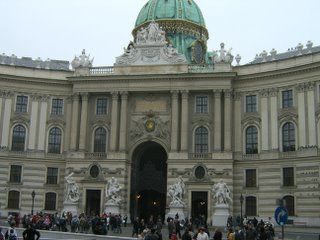
The next to last Emperor, Francis Joseph, and his wife, the Empress Elisabeth of Bavaria (nicknamed Sissi) ruled from 1848-1916 at which point Francis Joseph died, yielding the thrown to Charles who only held it two years before relinquishing it in pesant uprising. WWI and WWII both had heavy influence on changing the culture away from monarchy to new democratic governments. Elisabeth (Sissi) was known the world over for her beauty, for the opulence of her lifestyle, and eventually from distancing herself from Francis Joseph due to disagreements about the monarchy and affairs of state. She was stabbed and died, giving rise to many "Sissi" myths that spawned books, movies, etc. during the beginning of the 20th century.
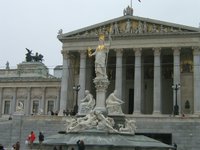
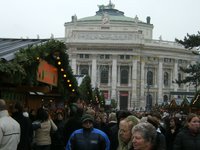
After viewing the royal apartments in the Hofburg, I enjoyed roaming throughout the area, first stopping by the Parliament (picture above), then attending a beautiful Christmas market placed between the Rathaus and the Burgtheater (to the right).
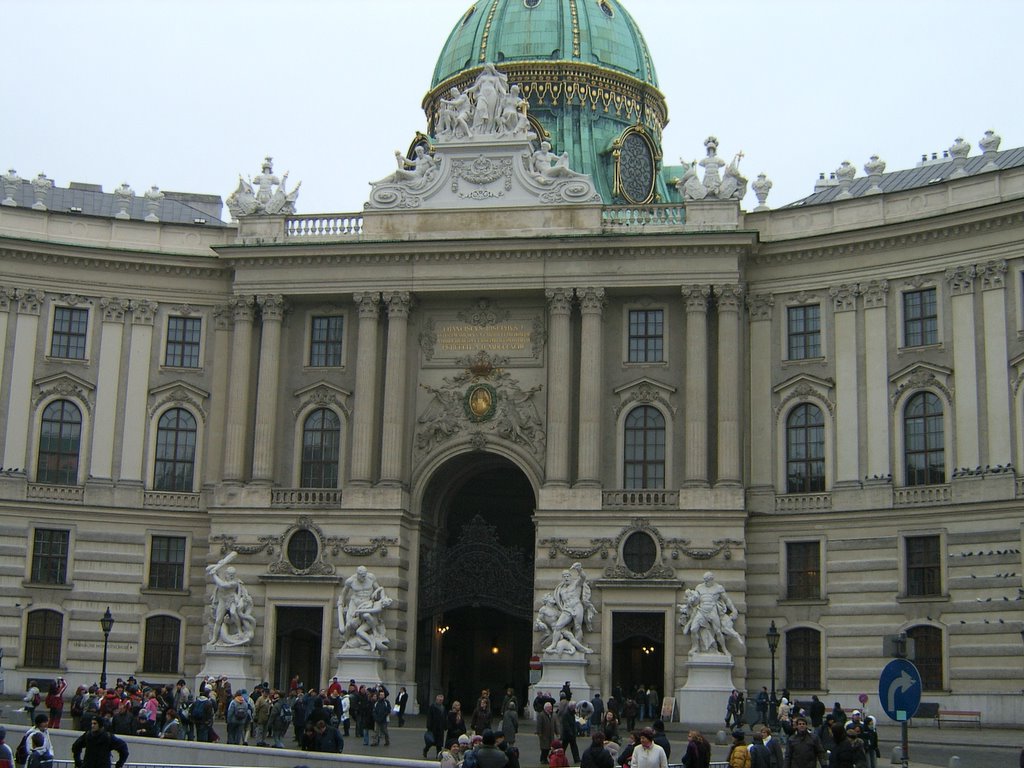
The next to last Emperor, Francis Joseph, and his wife, the Empress Elisabeth of Bavaria (nicknamed Sissi) ruled from 1848-1916 at which point Francis Joseph died, yielding the thrown to Charles who only held it two years before relinquishing it in pesant uprising. WWI and WWII both had heavy influence on changing the culture away from monarchy to new democratic governments. Elisabeth (Sissi) was known the world over for her beauty, for the opulence of her lifestyle, and eventually from distancing herself from Francis Joseph due to disagreements about the monarchy and affairs of state. She was stabbed and died, giving rise to many "Sissi" myths that spawned books, movies, etc. during the beginning of the 20th century.
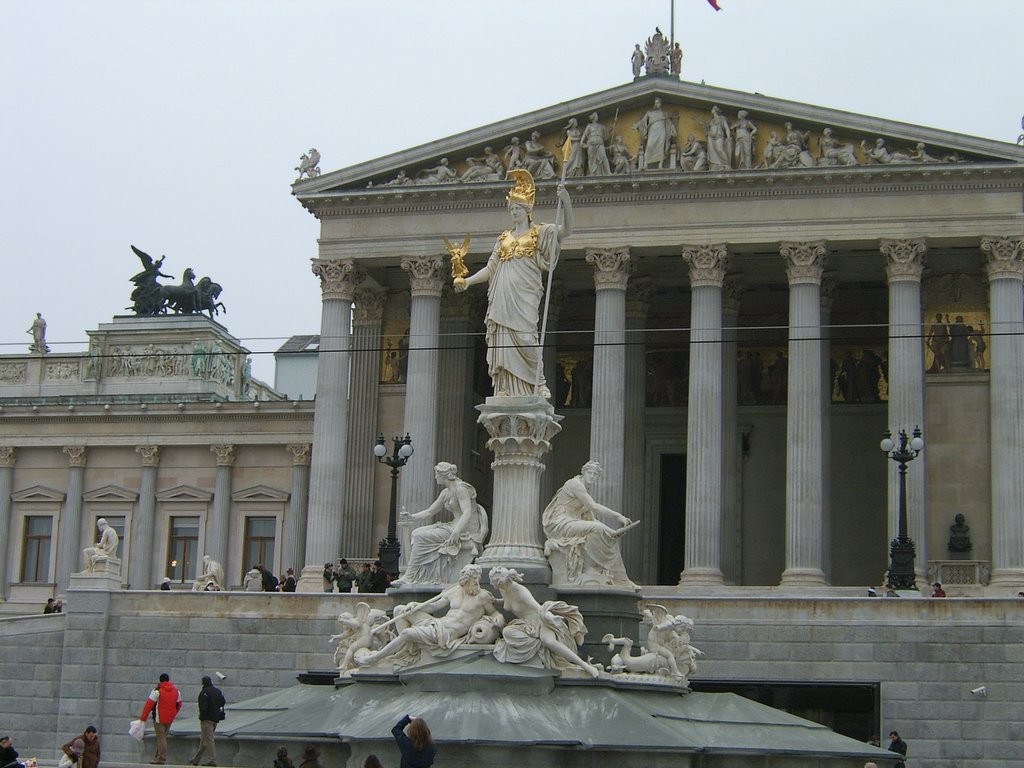
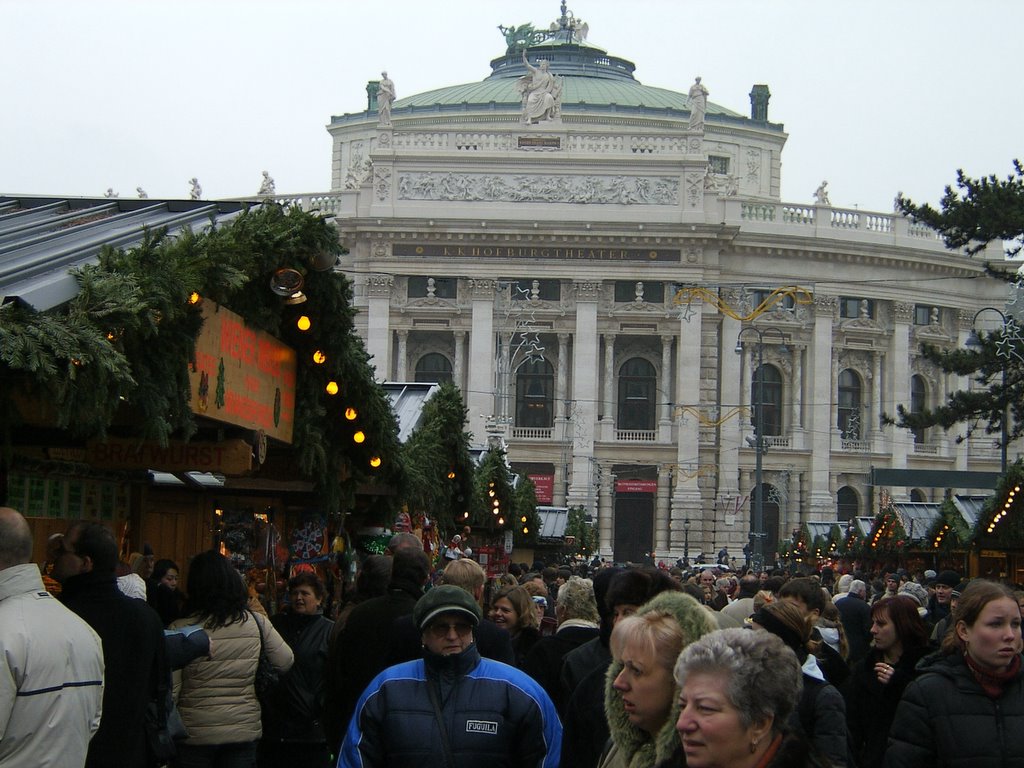
After viewing the royal apartments in the Hofburg, I enjoyed roaming throughout the area, first stopping by the Parliament (picture above), then attending a beautiful Christmas market placed between the Rathaus and the Burgtheater (to the right).
Finding the music
I think the title of this post is probably a metaphor for my life. It was certainly the inspiration for this weekend. As I said in the previous post, there was more music than I could absorb so Friday night I started out with one concert that had no competition - it was an Advent Meditation organ concert at St. Augustinkirche. The music was Bach played on one organ and Messian played on a French Baroque organ - both were magnificent.
My options after the organ meditation were to go to St. Stephen's for an advent concert at 8:30 p.m. However, I knew from my afternoon walk that the Vienna Opera House was playing Verdi's "La Traviata." I asked several people about how to get tickets and was told in no uncertain terms that my question was ridiculous. One person gave me a glimmer of hope saying that sometimes you could go shortly before the performance and there might be a seat open. I ran from St. Augustinkirche to the Vienna Opera House to get there 10 minutes before the opening, only to find that there's a side entrance for standing room only seats - I jumped to the end of the line and took my chances. My European luck panned out again - I snagged "La Traviata" at one of the world-reknowned Opera Houses for $2 Euro; if you're not familiar with opera, the tickets usually start at $75-$100 and go up to hundreds per seat. I hardly noticed the stand as my entire being was taken to another dimension watching this incredible performance.
The picture above is of the interior of the theatre during intermission. The only other picture (although dark) is of the grand staircase leading to the theatre. (If you click on the picture, it gets bigger and a littler easier to see.)
I cannot tell you how special this evening was. The only thing missing was Diane, my Violetta (she's the heroine), except that Diane brings considerably less drama into my world, which is a good thing (you'll only get this if you know the story).
My options after the organ meditation were to go to St. Stephen's for an advent concert at 8:30 p.m. However, I knew from my afternoon walk that the Vienna Opera House was playing Verdi's "La Traviata." I asked several people about how to get tickets and was told in no uncertain terms that my question was ridiculous. One person gave me a glimmer of hope saying that sometimes you could go shortly before the performance and there might be a seat open. I ran from St. Augustinkirche to the Vienna Opera House to get there 10 minutes before the opening, only to find that there's a side entrance for standing room only seats - I jumped to the end of the line and took my chances. My European luck panned out again - I snagged "La Traviata" at one of the world-reknowned Opera Houses for $2 Euro; if you're not familiar with opera, the tickets usually start at $75-$100 and go up to hundreds per seat. I hardly noticed the stand as my entire being was taken to another dimension watching this incredible performance.
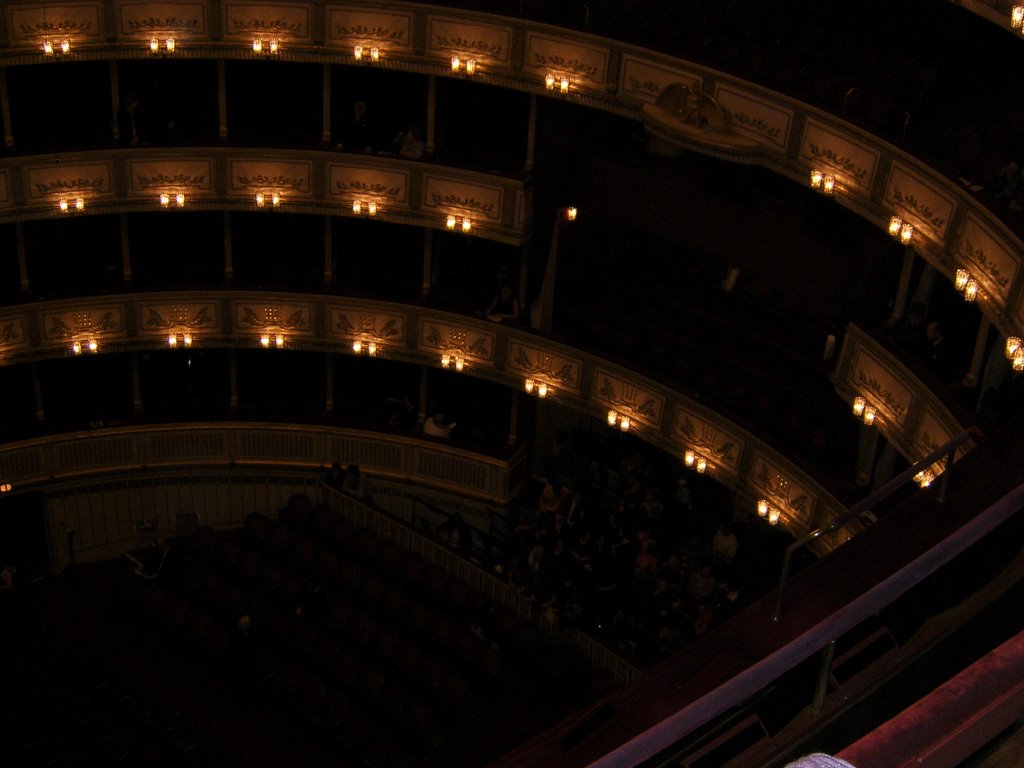
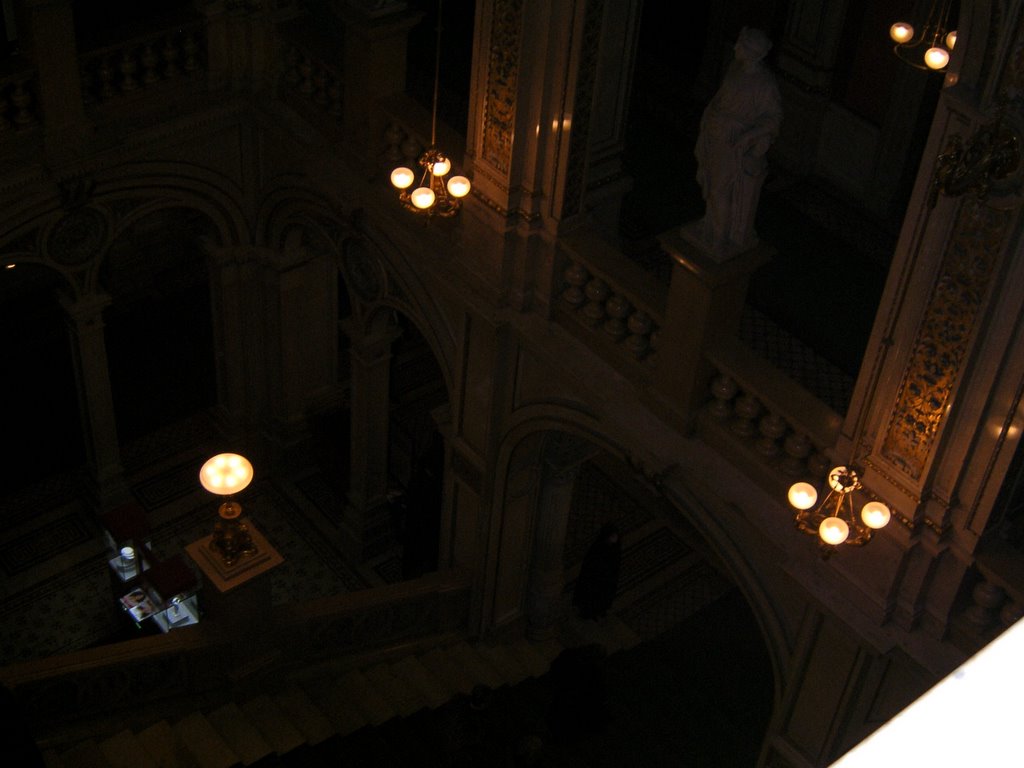
The picture above is of the interior of the theatre during intermission. The only other picture (although dark) is of the grand staircase leading to the theatre. (If you click on the picture, it gets bigger and a littler easier to see.)
I cannot tell you how special this evening was. The only thing missing was Diane, my Violetta (she's the heroine), except that Diane brings considerably less drama into my world, which is a good thing (you'll only get this if you know the story).
Vienna (Weiner) - center of the musical world
For my final solo travel I decided to take the long trek to Vienna (Weiner in Austrian) for the weekend. I took a night train on Thursday night, allowing me Friday and Saturday for touring, and then returning over night on Saturday night/Sunday. My major motivation to go to Vienna was because of my life-long dedication to music. Vienna was clearly the center of classic music for the 18th, 19th, and the beginning of the 20th century. Such composers as Mozart, Haydn, Beethoven, Schubert, Strauss, Brahms, Bruckner, Mahler, Berg, and Schoenberg all lived, composed, and/or directed in Vienna. My fantasies about the experience did not disappoint me!
Of course, my first challenge was finding a place to stay. I went to the Information center and was told that the entire city was booked up - yeah, sure. I think it was a ploy to get me to bump up what I was willing to pay for a room. Well, it worked. I paid $90 Euro which is almost double what I've been paying. However, it was a great hotel and in the middle of everything. The first picture is of the outside of the hotel on Neur Markt, right around the corner from shopping, St. Stephen's Cathedral, St. Peter's Catherdral, the Hofburg, and lots more.
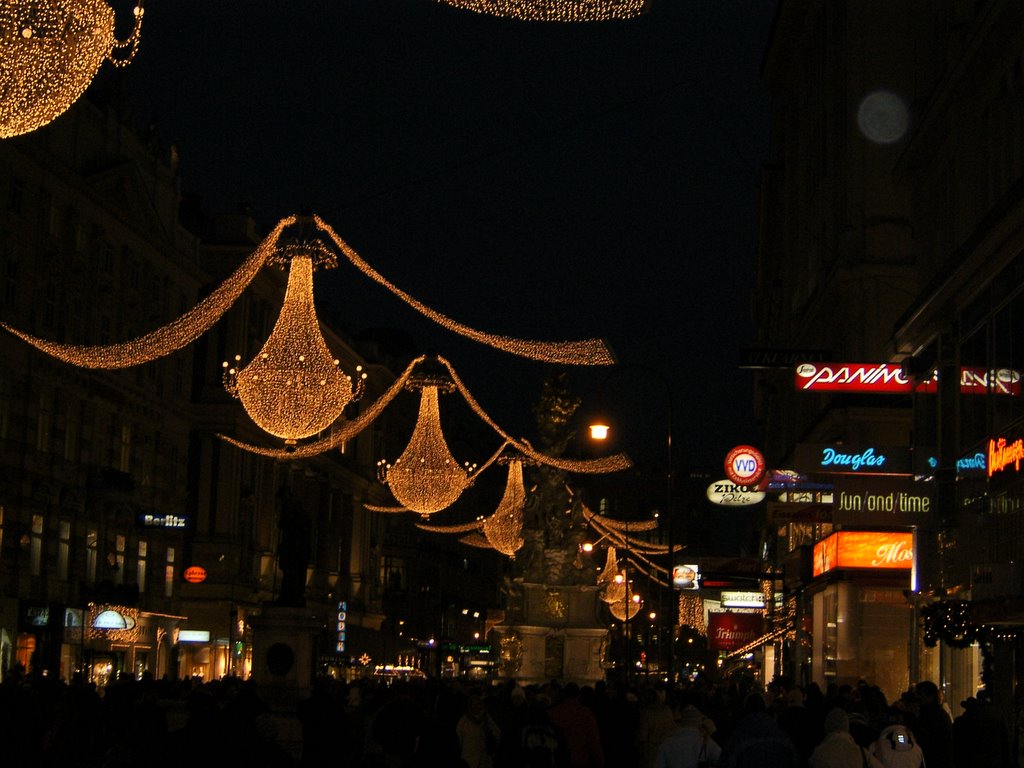
Because I hadn't cleaned up, I exercised with a quick walk, came back to shower, and dressed up to hit the streets. I didn't know for sure what I was going to do for the evening/night but I had already scoped out all the music - there were so many options I had to narrow it down (more on that later). I strolled through the streets where there were thousands of shoppers out for the holidays. Many of the city streets are pedestrian walk-ways and beautifully lighted (second picture). There was soft snow floating through the air and people enjoying the festive holiday spirit. Seeing people was really wonderful but I do have a slight "heads-up" for those who want to travel this wonderful city... Many of the people are very abrupt, impatient, and unfreindly - a marked contrast to the people of Luzern or to those in Paris for that matter. I don't know if it was the shopping atmosphere or what but some of the pedestrians were as agressive as Amsterdam cyclists - pretty freightening.
Of course, my first challenge was finding a place to stay. I went to the Information center and was told that the entire city was booked up - yeah, sure. I think it was a ploy to get me to bump up what I was willing to pay for a room. Well, it worked. I paid $90 Euro which is almost double what I've been paying. However, it was a great hotel and in the middle of everything. The first picture is of the outside of the hotel on Neur Markt, right around the corner from shopping, St. Stephen's Cathedral, St. Peter's Catherdral, the Hofburg, and lots more.

Because I hadn't cleaned up, I exercised with a quick walk, came back to shower, and dressed up to hit the streets. I didn't know for sure what I was going to do for the evening/night but I had already scoped out all the music - there were so many options I had to narrow it down (more on that later). I strolled through the streets where there were thousands of shoppers out for the holidays. Many of the city streets are pedestrian walk-ways and beautifully lighted (second picture). There was soft snow floating through the air and people enjoying the festive holiday spirit. Seeing people was really wonderful but I do have a slight "heads-up" for those who want to travel this wonderful city... Many of the people are very abrupt, impatient, and unfreindly - a marked contrast to the people of Luzern or to those in Paris for that matter. I don't know if it was the shopping atmosphere or what but some of the pedestrians were as agressive as Amsterdam cyclists - pretty freightening.
Tuesday, November 29, 2005
Maybe different languages aren't always a barrier...
I had a very fun experience on Monday that gave me a new appreciation for the importance of language. I've been meeting with the Agence du Benevolat of Differdange and Luxembourg City to see about the possibility of including service learning in MUDEC students' options. The conversations have been wonderful, welcoming, and full of possibility. The only problem is that I'm the only person out of seven who attended last Monday's meeting who is solely or even primarily English-speaking (how bad is that?). Anyway, the group is very gracious in keeping me in the loop and I speak to people directly or through Dr. Stiller when interpretation is necessary. Well, I had a moment of awakening when the group became so energized about the ideas that they completely forgot to translate for me. I mean everybody was popping all over the place until someone finally realized I wasn't catching anything. Actually, I didn't mind at all. I sat there completely content because I realized at the moment that the conversation broke loose that they had shifted to owning the question - they were so invested that I was no longer necessary!
Sometimes when we deal with people who share our language we're deceived. They say all the right words but they don't really share the commitment we think they do. The wonderful thing about language difference is that constant translation keeps everyone in the conversation but, when the question is owned, there's no need to translate. Everyone knows what's happened and it's totally OK. What a lesson to learn from different languages.
Sometimes when we deal with people who share our language we're deceived. They say all the right words but they don't really share the commitment we think they do. The wonderful thing about language difference is that constant translation keeps everyone in the conversation but, when the question is owned, there's no need to translate. Everyone knows what's happened and it's totally OK. What a lesson to learn from different languages.
Sunday, November 27, 2005
Sharon Parks Daloz - Influences in our lives
The other thing I did this weekend was finish Big Questions - Worthy Dreams by Sharon Parks Daloz. It was quite a fitting end to the weekend as I road through the countryside east of Paris. The timing of my reading this is a little more than uncanny. I'm working diligently on Deeper Learning in Leadership and have now completed four chapters. I have one more chapter that I intend to complete while here which will make me more than half done toward the goal of delivering the manuscript on May 1, 2006. I may even beat the deadline.
The book is focused on how to address questions of the purpose and organization of higher education related to developing deeper leadership potential in our graduates. Sharon's book has stimulated lots of new thoughts about the book, both in terms of style and substance. As a result, I've modified the thrust of the chapter I begin this week, which is focused on examples of leadership programs that drive understanding deeper.
One of the interesting examples that Sharon proposes as a helpful catalyst for young adults' inner journey is travel abroad. When I decided to come to MUDEC I didn't know entirely what I needed to learn but Sharon put her finger on at least one of the great lessons of this experience. She said that "international travel can evoke deepened recognition and connection and interdependence" by "awakening curiosity, evoking awe, deepening compassion, informing the mind, and opening possibilities." Wow! I couldn't even begin to describe my experience better than this. Even when you do your study abroad as a mature professional, there's so much to learn and it does take you to a different place.
Another part of my presence in Europe relates to a point Sharon made about nature being a stimulus for insight as well. She says about outdoor activities like hiking, camping, climbing, etc., "Also in relation to people, it teaches you how important it is to care about others. If you get into trouble, you need people or you will probably die - what to do if nobody cares enough to help." I've had this experience repeatedly in my travels - what to do if nobody cares... At first, I was afraid to ask due to language barriers or simply that tough, "I can do this on my own" thing. The result - anxiety, fear, loneliness. Traveling on weekends has taught me to reach out to others. I now even have people asking me for help and I try as I can. The chance encounters and brief interactions with truly wonderful people everywhere is infectious. Note to self - Letting go and realizing I will receive care is one of the most freeing experiences of my life.
The book is focused on how to address questions of the purpose and organization of higher education related to developing deeper leadership potential in our graduates. Sharon's book has stimulated lots of new thoughts about the book, both in terms of style and substance. As a result, I've modified the thrust of the chapter I begin this week, which is focused on examples of leadership programs that drive understanding deeper.
One of the interesting examples that Sharon proposes as a helpful catalyst for young adults' inner journey is travel abroad. When I decided to come to MUDEC I didn't know entirely what I needed to learn but Sharon put her finger on at least one of the great lessons of this experience. She said that "international travel can evoke deepened recognition and connection and interdependence" by "awakening curiosity, evoking awe, deepening compassion, informing the mind, and opening possibilities." Wow! I couldn't even begin to describe my experience better than this. Even when you do your study abroad as a mature professional, there's so much to learn and it does take you to a different place.
Another part of my presence in Europe relates to a point Sharon made about nature being a stimulus for insight as well. She says about outdoor activities like hiking, camping, climbing, etc., "Also in relation to people, it teaches you how important it is to care about others. If you get into trouble, you need people or you will probably die - what to do if nobody cares enough to help." I've had this experience repeatedly in my travels - what to do if nobody cares... At first, I was afraid to ask due to language barriers or simply that tough, "I can do this on my own" thing. The result - anxiety, fear, loneliness. Traveling on weekends has taught me to reach out to others. I now even have people asking me for help and I try as I can. The chance encounters and brief interactions with truly wonderful people everywhere is infectious. Note to self - Letting go and realizing I will receive care is one of the most freeing experiences of my life.
Teaser for "return to Paris"
On Sunday I went for a search of the best placed and most reasonable hotel room in Paris. I went back down to the central museum area and discovered that somehow I'd missed the Louvre the day before. I started by taking pictures from what I thought was the main entrance only to find out that the real thing was 20 times that size. I was absolutely stunned at the proportion of the collection and can't wait to go back with Diane and Darbi.

I searched and searched for hotels, checking rates as I went and have two nominees - one a block from the Louvre (my personal favorite) and the other a block from Sacre'-Coure pictured below. So, the choice will be up to Diane and Darbi whether they want to be in the downtown museum and attractions area or out in Montmartre. Either way, I'll be thrilled just to be back. Paris is a very special place.

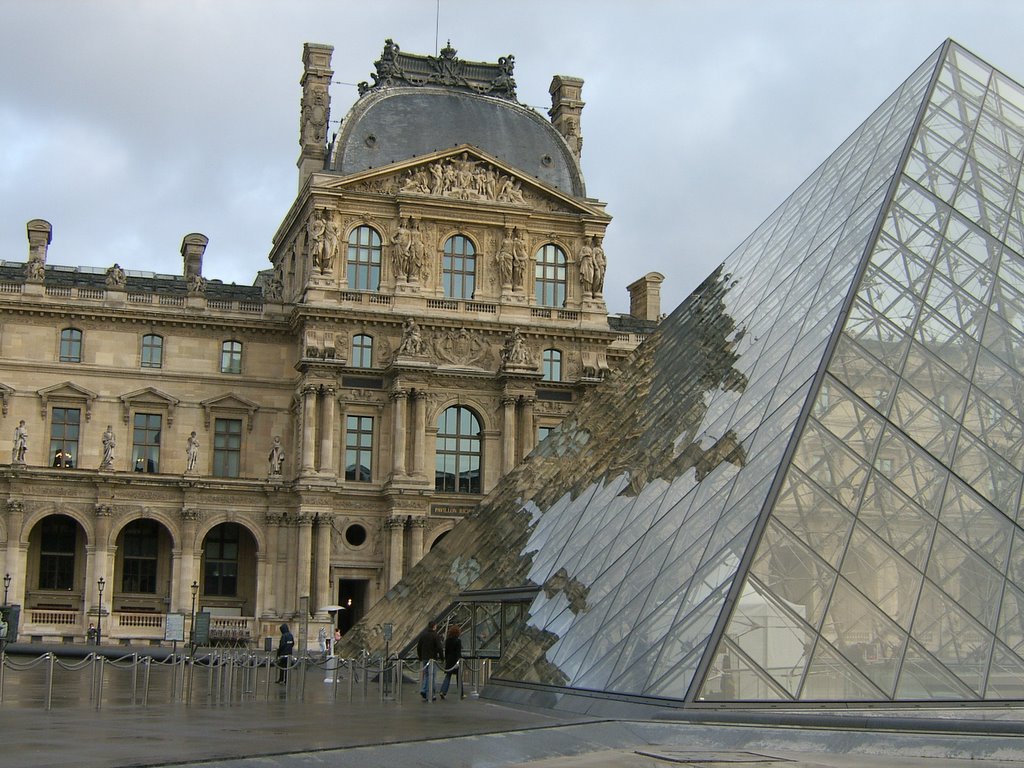
I searched and searched for hotels, checking rates as I went and have two nominees - one a block from the Louvre (my personal favorite) and the other a block from Sacre'-Coure pictured below. So, the choice will be up to Diane and Darbi whether they want to be in the downtown museum and attractions area or out in Montmartre. Either way, I'll be thrilled just to be back. Paris is a very special place.
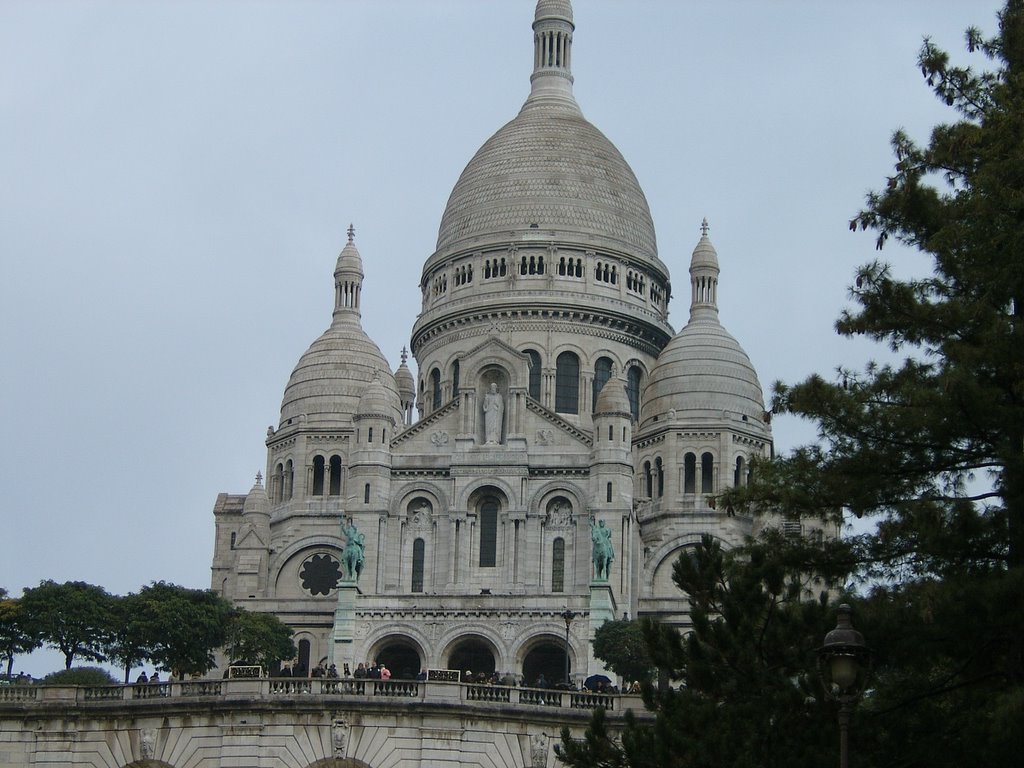
Subscribe to:
Posts (Atom)